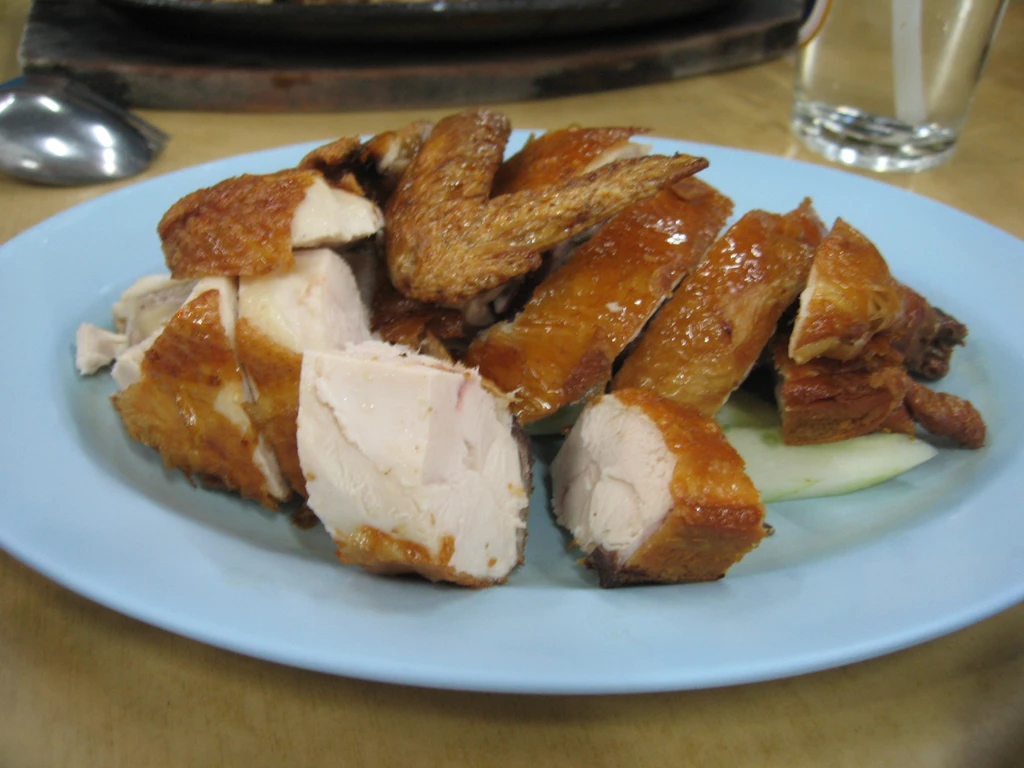
Skeletal Architecture: White Pectorals vs. Dark Locomotor Limbs
A standard broiler-fryer chicken (Gallus gallus domesticus) represents the complete whole bird containing two distinct muscular and metabolic profiles. The breast and wing primals consist of Type IIb fast-twitch muscle fibers, optimized for short anaerobic bursts, yielding ultra-lean protein with minimal intramuscular fat and high niacin (vitamin B3). In contrast, the locomotor pelvic limbs (thighs and drumsticks) feature Type I slow-twitch oxidative fibers packed with iron-rich myoglobin, gelatinizable collagen networks, and higher zinc (FDC #172388 / #172376).
Whole Chicken Serving & Carcass Yield Calculator
Official USDA Nutrition Facts Label (Per 100g Cooked)
Nutrition Facts
Whole Bird Micronutrient Synergy & Bioavailability
Consuming the whole chicken offers a naturally balanced nutritional profile that isolated cuts cannot replicate. The white pectoral meat contributes high concentrations of vitamin B3 (niacin) and phosphorus for ATP cellular energy, while the dark leg cuts furnish zinc, bioavailable heme iron, and gelatinized connective collagen.
Essential coenzyme in over 400 biochemical reactions including carbohydrate and fat catabolism.
Critical cofactor for transamination and amino acid metabolism, optimizing protein assimilation.
Dark meat portions of the whole bird supply 2.5× more zinc and higher myoglobin than white breast alone.
Dual-Zone Cooking Temperature Matrix: 165°F Breast vs. 175°F–185°F Thighs
The whole chicken presents a classic thermodynamic paradox: the lean white pectoral breast dries out and contracts rapidly once internal heat surpasses 165°F (74°C), whereas the dark locomotor leg joints (thighs and drumsticks) are packed with dense collagen that remains tough until heated to 175°F–185°F (79°C–85°C). Understanding this dual-zone thermal gradient is the secret to succulent meat throughout the entire carcass.
Below FSIS Minimum
Undercooked CenterUSDA FSIS mandates 165°F (74°C) as the food safety floor for whole poultry. Thigh joints remain bloody and tough.
FSIS Floor: Below USDA FSIS poultry minimum — verify with a digital probe before serving
Collagen: Collagen triple-helices remain rigid; joints rubbery
Texture: Spongy breast and rubbery pink thigh meat adhering to bone
Breast Sweet Spot / FSIS Safe Minimum
White Meat PerfectionThe exact endpoint for chicken breast. Pectoral muscle reaches pathogen safety while holding maximum cellular moisture without fiber drying.
FSIS Floor: Meets USDA FSIS minimum internal temperature; optimal for breast
Collagen: Breast tender; thigh and drumstick collagen starting denaturation
Texture: Ultra-juicy breast meat; dark leg joints safe but slightly firm
Leg & Thigh Gelatinization Window
Dual-Zone HarmonyDark meat collagen hydrolyzes into succulent gelatin. When spatchcocking, breast stays at ~165°F while thighs reach 175°F for simultaneous perfection.
FSIS Floor: Collagen liquefying rapidly into succulent natural juices
Collagen: Femoral and shank collagen unwinding into soluble gelatin
Texture: Tender dark meat peeling cleanly off the femur and tibia bones
Chef's Dark Meat Peak
Fall-Off-The-Bone LegsThe gold standard for rotisserie and roasted dark quarters. Tendons dissolve into silky gelatin while crispy skin seals in interior juices.
FSIS Floor: Peak culinary texture for whole-bird dark cuts
Collagen: Over 85% of leg connective tissue converted to rich gelatin
Texture: Fall-off-the-bone thigh meat with buttery, silky mouthfeel
Slow-Cooker & Braised Shredded State
Soup Bird / Pulled ChickenIdeal for slow-simmered chicken soup and pot pies. Carcass releases gelatin into stock while all meat shreds cleanly with forks.
FSIS Floor: Moist braising endpoint — bones slide right out
Collagen: Total connective tissue extraction into cooking liquid
Texture: Meltingly tender shreds; bones pull out with zero resistance
Because of whole carcass thermal mass, pull the bird from the oven when the thickest part of the breast reaches 160°F–162°F. During a 10-to-15-minute rest on a carving board, residual kinetic energy raises the core internal temperature by 4°F–6°F, achieving the mandatory 165°F FSIS food-safety standard without boiling away intracellular juices. Resting also allows muscle proteins to reabsorb rendered moisture, preventing liquid from pooling onto the cutting board.
Butchery Science: The 38% Carcass Tare & 8-Piece Breakdown
The 4-Pound Broiler Yield Equation
Understanding the non-edible skeletal tare is critical for accurate macro tracking. A standard 4.0-lb (1,814g) whole chicken divides cleanly into edible cuts and structural bone:
Zero-Waste Collagen Bone Broth Extraction
The greatest financial and nutritional dividend of whole bird cookery is the remaining skeleton. Simmering the stripped carcass extracts gelatin, chondroitin, and glycine:
The Simmer Chemistry:
Simmering the roasted spine and leg bones at 195°F–205°F for 3 to 6 hours cleaves tough collagen triple-helices into water-soluble gelatin. When refrigerated, the stock sets into a firm, spoonable jelly that coats soups and pan sauces without added starch.
Whole Bird Face-Offs: vs. Boneless Breast, Store Rotisserie & Whole Turkey
Whole Chicken vs. Boneless Skinless Breast
Culinary Range & Economy Showdown (100g Cooked)
Boneless breast is the gold standard for pure high-protein leanness. However, whole chicken costs 50–60% less per pound, provides diverse white and dark meat, crispy skin, and a free carcass that yields 2 quarts of mineral-dense collagen bone broth.
Home-Roasted Whole Bird vs. Supermarket Rotisserie
Sodium, Injections & Ingredient Transparency
Store rotisserie chickens are injected with up to 15–20% saline solution, sodium phosphates, and flavorings to maintain moistness under heat lamps, resulting in 6× to 8× higher sodium per 100g compared to fresh home-roasted poultry (FDC #171477).
Whole Chicken vs. Whole Turkey
Holiday Bird vs. Everyday Roaster
Whole turkeys suffer from severe thermal gradient lag: because the breast is massive, outer layers overcook while the inner cavity struggles to reach 165°F. Whole broilers roast in under an hour, especially when spatchcocked, achieving even doneness effortlessly.
Professional Techniques: Spatchcocking, Dry-Brining & Carving
The Spatchcock (Butterfly) Technique
Use heavy-duty poultry shears to snip along both sides of the backbone, removing it completely. Flip bird breast-side up, place both palms on the center of the sternum, and press down firmly until the keel bone cracks flat.
Overnight Dry-Brine & Skin Dehydration
Season the entire bird with 1 tsp diamond kosher salt per pound. Place on a wire rack set in a rimmed baking sheet and refrigerate uncovered for 12 to 24 hours prior to roasting at 425°F (220°C).
Anatomical Carving & Broth Extraction
After a 15-minute rest, slice through hip joints to separate leg quarters, then bisect thighs and drumsticks. Slice down the sternum keel to remove each breast lobe whole, slicing crosswise across the grain.
Meal Prep Batch Logistics, Safe Storage & Anti-WOF Reheating
The 4-Day Meal Division Blueprint
One 4-lb whole broiler provides ~750g cooked edible meat plus 2 quarts of stock, yielding 4 distinct, fatigue-free meals:
Safe Storage Timelines
- Raw Whole Bird: Store in coldest part of fridge at 34°F–38°F (1°C–3°C) for up to 1 to 2 days maximum.
- Cooked Carved Meat: Airtight glass meal containers at or below 40°F (4°C) for 3 to 4 days.
- Simmered Stock: Refrigerate up to 5 days, or freeze in silicone cube trays for up to 6 months.
- Frozen Carved Meat: Vacuum-sealed bags preserve peak flavor for 6 to 9 months at 0°F (-18°C).
Anti-WOF Reheating Science
Reheating cooked chicken frequently triggers "Warmed-Over Flavor" (WOF) caused by the rapid oxidation of polyunsaturated fatty acids in cell membranes, catalyzed by free iron during high-heat microwaving.
Reheat carved breast or leg meat in a skillet with 2 to 3 tablespoons of homemade chicken stock on medium-low heat with a lid. The warm broth creates a steam barrier that blocks oxygen, preventing lipid oxidation while rehydrating lean muscle fibers.
Frequently Asked Questions: Whole Chicken Nutrition & Roasting
Academic Citations & USDA FoodData Central References
U.S. Department of Agriculture, Agricultural Research Service. (2019). Chicken, broilers or fryers, meat and skin, cooked, roasted. FoodData Central (FDC ID: 171477).
View SourcePrimary cooked skin-on whole bird reference: ~215 kcal, 24.6g protein, 12.3g fat, 1.8mg iron, 1.9mg zinc per 100g.
U.S. Department of Agriculture, Agricultural Research Service. (2019). Chicken, broilers or fryers, meat only, cooked, roasted. FoodData Central (FDC ID: 171478).
View SourcePrimary cooked skinless whole bird reference: ~190 kcal, 27.3g protein, 8.1g fat, 1.3mg iron, 1.7mg zinc per 100g.
U.S. Department of Agriculture, Agricultural Research Service. (2019). Chicken, broilers or fryers, meat and skin, raw. FoodData Central (FDC ID: 171056).
View SourceRaw whole bird baseline: ~190 kcal, 25.9g protein, 8.8g fat per 100g raw edible portion.
USDA Food Safety and Inspection Service. (2024). Safe Minimum Internal Temperature Chart.
View SourceMandates 165°F (73.9°C) minimum internal temperature for all poultry parts, measured with a calibrated food thermometer.
Mendes, A. A., & Komiyama, C. M. (2011). Carcass and meat yield of broiler chickens: Influences of genetics, nutrition, and processing. Brazilian Journal of Poultry Science, 13(3), 163–172.
View SourceComprehensive carcass study establishing bone tare percentages (35–40%) and commercial cut distribution (breast 30%, thighs 20%, drumsticks 15%, wings 10%, back 25%).
Purslow, P. P. (2018). Intramuscular connective tissue and its role in meat texture: Collagen denaturation kinetics in avian dark muscle. Meat Science, 144, 133–142.
View SourceThermal kinetics proving dark leg/thigh collagen requires sustained heat above 175°F (79°C) to convert to gelatin.
Informational & journaling tool only
This page is a nutrition reference and personal awareness utility — not medical, dietary, or professional advice. Macro values come from USDA FoodData Central (FDC #171477, #171478, #171056, #171057, and related entries). Actual values vary by broiler breed, trimming, skeletal bone mass, skin consumption, and cooking method. Always verify a minimum internal temperature of 165°F (74°C) with a calibrated digital food thermometer. I am not a doctor.