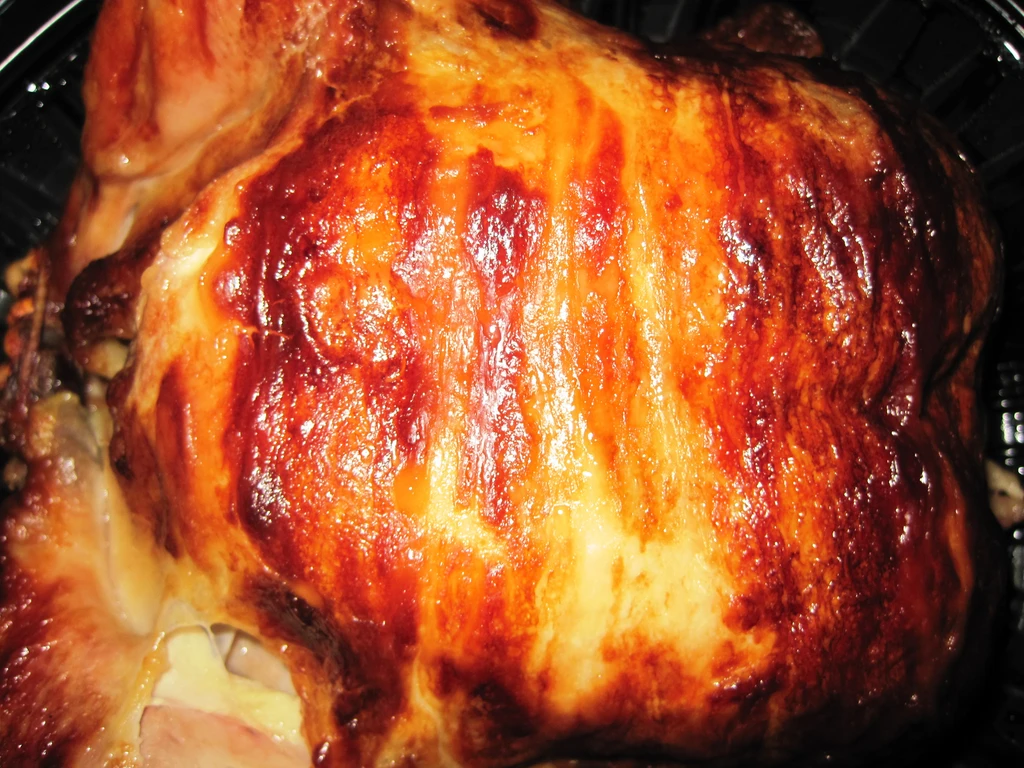
Avian Muscle Anatomy: White Pectorals vs. Slow-Twitch Dark Quarters
A rotisserie broiler chicken (Gallus gallus domesticus) combines two functionally distinct muscle systems skewered across a rotating spit. The upper breast and wing primals consist of Type IIb fast-twitch muscle fibers, vulnerable to rapid drying past 165°F (74°C) without the added phosphate brine. The pelvic locomotor limbs (thighs and drumsticks) feature Type I slow-twitch oxidative fibers laden with iron-rich myoglobin and dense collagen matrices that liquefy into rich gelatin between 175°F and 185°F (79°C–85°C).
Rotisserie Nutrition, Carcass Yield & Store Brand Calculator
To obtain 700g of carved meat, you need a gross store bird weighing approx. 1129g (~2.5 lbs), leaving ~429g bone tare for soup.
Official USDA Nutrition Facts Label (Per 100g Cooked)
Nutrition Facts
Micronutrient Content in Rotisserie Poultry
Rotisserie chicken lists a complete amino acid profile alongside B vitamins and trace minerals in USDA tables. Spit roasting retains more surface moisture than open boiling — food-composition values for journaling only.
The Skin-Peeling Macro Impact (Per 100g Edible)
Topical dry rubs, paprika glazes, and brine residue concentrate on the skin layer. Stripping skin lowers logged kcal, fat, and sodium per 100g — food-composition figures for journaling only.
Rotisserie Roasting & Hot-Holding Temperature Guide
Commercial rotisserie cooking solves the fundamental culinary dilemma of whole poultry: white breast meat dries out past 165°F (74°C), while dark thighs and drumsticks require 175°F–185°F (79°C–85°C) to dissolve tough collagen tendons into rich gelatin. The continuous 360° rotation and saline-phosphate buffer keep breast fibers moist while the legs reach full gelatinization.
185°F (85°C) — Chef's Spit-Roast Sweet Spot
The gold-standard culinary endpoint for rotisserie birds. Over 85% of thigh and drumstick collagen hydrolyzes into succulent gelatin, and joints separate with zero knife resistance.
Supermarkets operate heated display cabinets strictly regulated at or above 140°F (60°C). Retail delis are required by the FDA Food Code to timestamp each batch. Any rotisserie chicken remaining under the heat lamp past 4 hours must be discarded or rapidly pulled and flash-chilled below 40°F (4°C) for cold packaging (such as pre-pulled rotisserie meat tubs). Check the packaging time sticker before buying.
The moment you lift a rotisserie bird out of the hot deli case, the clock starts ticking. USDA FSIS guidance recommends refrigerating cooked poultry within 2 hours of purchase (or 1 hour if ambient temperature exceeds 90°F / 32°C, such as in a warm car). Carve and refrigerate below 40°F (4°C), or keep the bird at or above 140°F (60°C) in a warmer until serving.
Industrial Brining: Why Rotisserie Chicken Has 5× to 9× More Sodium
Home-roasted chicken contains only 75–82mg of natural cellular sodium per 100g. In contrast, supermarket rotisserie chicken registers between 425mg and 700mg per 100g. This massive spike is not an accident—it is the result of industrial injection needle arrays pumping a 15% to 20% saline-phosphate brine solution deep into the pectoral and thigh muscles.
Prior to skewering, whole raw broilers pass through automated banks of hundreds of pressurized needles. These needles inject an aqueous solution equal to 15% to 20% of the bird's raw weight. This injection adds water weight, plumps the meat, and infuses salt uniformly across the muscle core.
Sodium tripolyphosphate (STPP) shifts muscle pH away from the isoelectric point of actin and myosin proteins. This induces electrostatic repulsion between protein filaments, expanding the myofibrillar lattice space by up to 25%. This mechanical swelling traps free water molecules so the bird does not dry out under 140°F heat lamps.
Many commercial recipes (including Costco and Walmart) incorporate food-grade carrageenan (seaweed extract) or modified food starch. As cooking temperatures rise past 150°F, carrageenan forms a cohesive thermo-reversible gel network that encapsulates water droplets, preventing purge loss during retail display.
Industrial seasoning rubs (paprika, salt, dextrose, onion powder, and spice extracts) are applied topically to the exterior skin. Furthermore, as rendered fat drains downward during spit turning, salt crystals crystallize heavily within the crispy skin.
The cloudy, gelatinous puddle resting at the bottom of the plastic rotisserie dome contains rendered tallow fat, extruded brine moisture, and heavy concentrations of dissolved sodium phosphates washed off the skin.
Skip pouring container juices over carved meat if sodium is a column you track in your food journal. Discarding this container purge avoids an accidental +250–350mg sodium in a typical portion and removes rendered fat from the weigh-in.
Rotisserie Chicken vs. The Alternatives
Store Rotisserie vs. Home-Roasted Chicken
Sodium Shock vs. Additive-Free Control (100g Cooked)Store rotisserie chicken costs 40–50% less than raw whole birds at retail and saves an hour of oven time. However, commercial injection brines multiply sodium by 5× to 9× (up to 700mg per 100g vs 82mg homemade). For lower sodium, peel the skin and avoid pouring the plastic dome container juices over your meat.
Chef's Rotisserie Playbook: 3-Minute Deboning, Skin Re-Crisping & Stock
Deboning while the bird is still warm is 3× faster than after refrigeration.
- Pop Leg Quarters: Pull thighs downward until the ball-and-socket hip joints pop free; slice through connective skin.
- Strip Breast Lobes: Slice along the central breastbone (keel), run thumbs down the ribcage, and lift entire lobes intact.
- Retrieve Oysters: Flip the carcass and pop out the two small, succulent medallions nestled in the back spine indentations.
Supermarket rotisserie bones are pre-roasted and packed with rich collagen.
- Pot the Frame: Place the stripped skeleton, cartilage caps, and wing tips into a 4-quart stock pot.
- Add Aromatics (NO SALT): Add 1 quartered onion, 2 celery ribs, 1 carrot, 4 garlic cloves, and 1 tbsp cider vinegar.
- Simmer 3–4 Hours: Cover with 2 quarts unsalted water. Simmer gently on low heat until bones soften.
Trapped steam in plastic dome containers turns crispy skin soggy and rubbery.
- Preheat Air Fryer: Set air fryer to 400°F (204°C) for 3 minutes.
- Skin-Side Up: Place carved pieces skin-side up in a single layer with air gaps.
- 4–5 Minute Blast: Circulating superheated air vaporizes surface moisture and renders residual fat into crackling crispness.
4-Day Rotisserie Meal Division & Anti-WOF Reheating
The $4.99 Single-Bird 4-Day Meal Division Blueprint (~700g Cooked Edible Meat)
Enjoy prime white meat fresh and warm with roasted root vegetables or sweet potatoes.
Shred remaining white breast into a Greek yogurt avocado chicken salad or whole-grain wraps.
Re-sear pulled thigh meat in a hot skillet with cumin, lime, and peppers for succulent street tacos.
Shred drumstick meat into the simmered carcass bone broth with vegetables and noodles.
Carve from the carcass within 2 hours of purchase. Store in shallow, airtight glass containers for uniform cooling.
Shred cooked meat and vacuum seal or pack tightly in freezer bags with air removed to prevent freezer burn and oxidation.
Reheated cooked poultry frequently develops an unpalatable cardboard or stale aroma known in food science as Warmed-Over Flavor (WOF). This occurs when iron ions from myoglobin catalyze rapid oxidation of polyunsaturated fatty acids.
- Reheat in an oven at 325°F (163°C) covered with 2 tbsp water or broth to steam gently.
- Add antioxidant polyphenols (fresh rosemary, thyme, garlic, or black pepper) which bind free iron.
- Incorporate citrus juice (lime or lemon) or tomatoes whose citric acid chelates pro-oxidant minerals.
Frequently Asked Questions: Rotisserie Chicken Nutrition & Safety
Academic Citations & USDA FoodData Central References
U.S. Department of Agriculture, Agricultural Research Service. Chicken, broiler, rotisserie, BBQ, breast, meat and skin. FoodData Central (FDC ID: 171125).
View SourceUSDA rotisserie BBQ breast proxy: ~175 kcal, ~26.4g protein, ~7.7g fat, ~329mg sodium per 100g — cut-level SR Legacy reference.
U.S. Department of Agriculture, Agricultural Research Service. Chicken, broilers or fryers, breast, meat only, cooked, roasted. FoodData Central (FDC ID: 171477).
View SourcePlain roasted skinless breast baseline: ~165 kcal, ~31g protein, ~74mg sodium per 100g — homemade control for sodium comparisons.
U.S. Department of Agriculture, Agricultural Research Service. Chicken, broilers or fryers, meat only, cooked, roasted. FoodData Central (FDC ID: 171478).
View SourceGeneric roasted meat-only reference: ~190 kcal, ~27.3g protein, ~8.1g fat per 100g — not rotisserie-brined; use as plain-roast proxy only.
Smith, D. P., Lyon, C. E., & Lyon, B. G. (2001). The effect of sodium tripolyphosphate and salt marination on water holding capacity and tenderness in broiler breast meat. Poultry Science, 80(8), 1255–1259.
View SourceSodium tripolyphosphate injection increases water retention in breast muscle — relevant to why commercial birds stay moist under heat lamps.
Young, L. L., Northcutt, J. K., & Buhr, R. J. (2004). Effect of postchill marination on yield and quality of cooked chicken breast fillets. Journal of Applied Poultry Research, 13(4), 611–619.
View SourceBrine can migrate into muscle and skin layers — supports the logging note that skin removal reduces topical sodium but not all injected salt.
USDA Food Safety and Inspection Service. (2024). Leftovers and Food Safety.
View SourceKitchen reference: refrigerate cooked poultry within 2 hours of pickup and use leftovers within 3–4 days.
Offer, G., & Trinick, J. (1983). On the mechanism of water holding in meat: The swelling and shrinking of myofibrils. Meat Science, 8(4), 245–281.
View SourceFoundational biochemistry on alkaline phosphates expanding myofibrillar lattice spacing and binding added water in enhanced poultry.
Mendes, A. A., & Komiyama, C. M. (2011). Carcass and meat yield of broiler chickens. Brazilian Journal of Poultry Science, 13(3), 163–172.
View SourceValidates ~30–40% non-edible skeletal carcass tare across whole roasted broilers.
Informational & journaling tool only
This page is a nutrition reference and personal awareness utility — not medical, dietary, or professional advice. Macro and sodium values are based on store rotisserie planning averages, USDA FoodData Central (FDC #171125, #171127, #171477, #171478), and supermarket label declarations — verify against your package. Actual values vary by retailer injection formulation, display hold duration, bird size, and skin consumption. Always ensure cooked poultry is maintained above 140°F (60°C) or refrigerated below 40°F (4°C) within 2 hours. I am not a doctor.