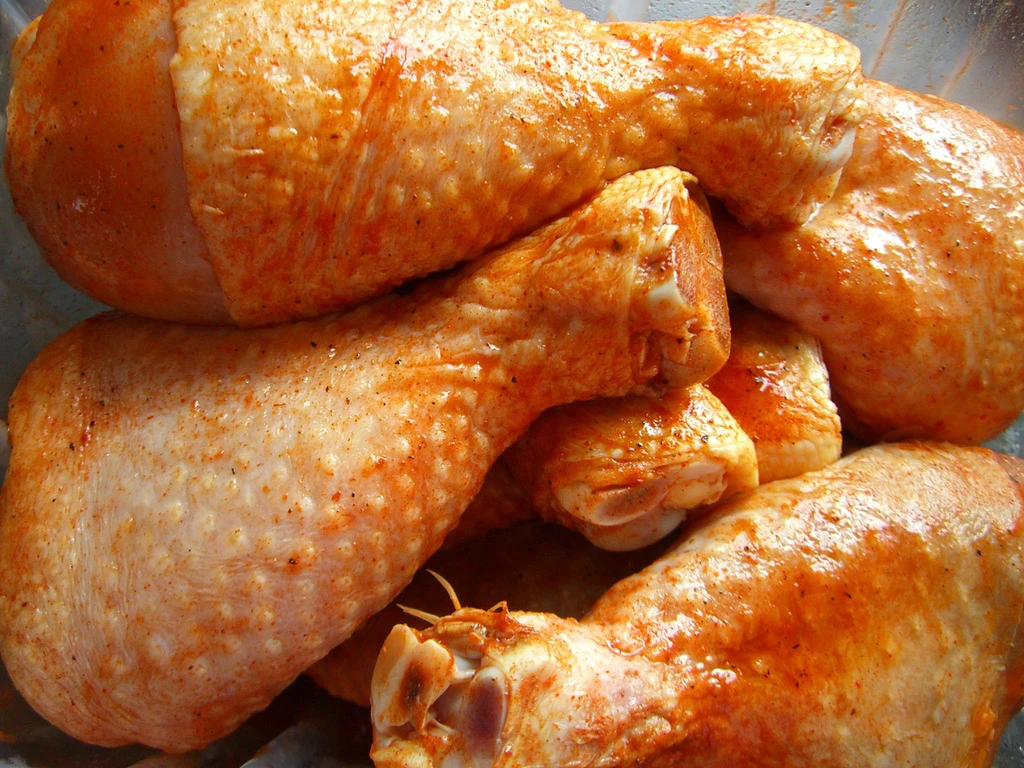
Avian Lower Leg Shank: Tibia Bone & Connective Collagen
The chicken drumstick comprises the lower anatomical segment of the pelvic limb (shank), separated from the thigh at the knee joint (stifle) through the femorotibial articulation, and severed from the foot at the hock joint. It is built around a central, dense Tibia bone and a slender lateral Fibula pin bone. Because domestic chickens walk continuously, drumstick musculature is dominated by endurance-adapted Type I slow-twitch oxidative muscle fibers. These fibers carry more myoglobin than breast, producing the characteristic dark coloration, robust savory flavor, and higher zinc values in USDA tables (FDC #172376 / #173612).
Chicken Drumstick Nutrition & Serving Calculator
Official USDA Nutrition Facts Label (Per 100g Cooked)
Nutrition Facts
Zinc, Iron & Taurine in Dark Leg Muscle
Drumsticks are slow-twitch leg muscles with higher myoglobin than breast. USDA tables list more zinc and slightly more total iron per 100g than skinless breast (FDC #171477). Taurine (~175 mg) is a literature estimate for dark poultry — not a standard FDC column. Food-composition values for journaling only.
Mineral column in FDC #172376 / #173612 — roughly triple the zinc per 100g versus roasted skinless breast (~0.9 mg in FDC #171477).
USDA tables report total iron — not a separate heme-iron column. Slightly higher than breast (~1.0 mg in FDC #171477) in SR Legacy rows.
Optional literature estimate for dark poultry muscle — shown for food-composition awareness only, not a standard USDA macro field.
Cooking Temperature Matrix: 165°F FSIS Minimum vs. 175°F–185°F Gelatin Peak
USDA FSIS lists 165°F (74°C) as the minimum internal temperature for all poultry. Pulling a drumstick at exactly 165°F is food-safe, but shank pin tendons often remain chewy. Many cooks prefer 175°F to 185°F (79°C–85°C) so dense leg collagen converts to gelatin — a culinary texture choice, not a substitute for the FSIS minimum.
Below FSIS Minimum
Undercooked CenterUSDA FSIS lists 165°F (74°C) as the minimum internal temperature for all poultry. Shank pin tendons and collagen have not softened at this endpoint.
FSIS / Core: Below USDA FSIS poultry minimum — verify with a food thermometer before serving
Collagen: Collagen triple-helices remain intact; pin tendons stiff
Texture: Rubbery meat fibers firmly adhering to the tibia bone
USDA FSIS Safe Minimum
Required Food-Safety FloorThe FSIS safe minimum for all poultry. Food-safe at this endpoint, but dark-leg pin tendons often remain chewy because collagen has not fully converted to gelatin.
FSIS / Core: Meets USDA FSIS minimum internal temperature for poultry
Collagen: Early collagen denaturation; pin tendons still noticeable
Texture: Safe to eat, but tendons may feel stringy or tough
Collagen Softening Begins
Culinary Pull ZoneMany cooks prefer 175°F–185°F for drumsticks because femoral and shank collagen begins solubilizing into gelatin, producing juicier dark meat. This is a texture preference — not a substitute for the 165°F FSIS minimum on undercooked poultry.
FSIS / Core: Well above FSIS minimum — connective tissue converting to gelatin
Collagen: Type I/III collagen unwinding into soluble gelatin
Texture: Juicy meat releasing more easily from the central bone shank
Chef's Peak Sweet Spot
Fall-Off-The-Bone TendernessPeak sensory endpoint in many poultry cooking guides. Pin tendons soften substantially and myofibrils stay moist when surrounded by rendered gelatin.
FSIS / Core: Culinary texture target — well above FSIS minimum
Collagen: Majority of shank collagen solubilized (>80%)
Texture: Fall-off-the-bone tenderness; pin tendons largely softened
Pulled / Braise Doneness
Shredded Meat StateIdeal for slow cookers, stews, and soups where meat shreds effortlessly. Extended moist heat completes collagen breakdown; dry roasting beyond this may drive off free moisture.
FSIS / Core: Braise/slow-cook endpoint — fully set and shreddable
Collagen: Complete collagen gelatinization in moist heat
Texture: Extremely tender shreds; bones slide out cleanly
Home cooks often mistake dark red or purplish meat clinging to the drumstick tibia for undercooked poultry. In young broilers, bones remain porous. During high-heat roasting, marrow pigments can migrate through the bone cortex into adjacent meat fibers, fixing as a deep burgundy color. Surface color is not a reliable doneness indicator — use a calibrated food thermometer at the thickest part (165°F / 74°C FSIS minimum).
The 33% Bone Tare Rule & Skin Delta Science
The 33% Bone Tare Conversion Formula
One of the most frequent macro logging mistakes is recording the gross weight of whole bone-in drumsticks directly from the grocery packaging. On average across commercial broilers:
Skin-On vs. Skinless Nutritional Delta
Removing the skin from a cooked chicken drumstick slashes the total fat content by nearly half, while leaving the high-leucine protein intact:
The Skin Advantage: While the skin adds +36 kcal and +4.5g fat per 100g, over 70% of those fatty acids are oleic (monounsaturated) and linoleic (polyunsaturated) acids. Leaving skin on during roasting also shields the meat from evaporative drying.
Nutritional Battles: Drumstick vs. Thigh, Wings & Breast
Drumstick vs. Thigh
Dark Meat Showdown: 100g Cooked Skinless
Skinless drumstick lists ~13% fewer calories and ~2.5g less fat than skinless thigh with similar protein (~24g per 100g). Thighs offer higher edible meat yield per bone-in piece (~76% vs ~58% after bone tare) with fewer pin tendons.
Drumstick vs. Chicken Wings
Bone-In Skin-On Comparison: 100g Cooked
Roasted skin-on drumstick (FDC #173612) lists ~63 fewer calories and ~6.7g less fat per 100g than roasted wings with skin (FDC #173630), with similar protein grams. Drumsticks also yield more edible meat per piece after bone tare.
Drumstick vs. Chicken Breast
Juiciness & Minerals vs. Pure Leanness
Roasted skinless breast (FDC #171477) delivers ~6g more protein per 100g with lower fat — higher protein-per-calorie density. Skinless drumstick (FDC #172376) lists roughly triple the zinc (~2.56 mg vs ~0.9 mg) and slightly more total iron (~1.14 mg vs ~1.0 mg) in USDA tables — food-composition figures for journaling only.
Professional Techniques: Lollipops, Convection Crisp & Braising
The Butcher "Lollipop" Frenching
Slice circumferentially around the narrow ankle joint through all 7 flexor tendons. Push the meat upward toward the fleshy knee joint into a compact meat sphere. Scrape the bottom bone clean with the back of your knife.
Baking Powder Micro-Blistering
Toss dried raw drumsticks with 1 tsp aluminum-free baking powder and kosher salt per pound. Roast on a wire rack at 425°F (220°C) or air-fry at 390°F for 25–30 minutes.
Collagen Broth Braising
Brown drumsticks in a Dutch oven, then submerge halfway in broth, aromatics, and wine. Cover and braise at 325°F (165°C) for 60–75 minutes until internal temp crosses 185°F.
Meal Prep Batch Math, Safe Storage & Anti-WOF Reheating
Batch Procurement Math
Because drumsticks lose ~33% to non-edible bone and ~28% to evaporative roasting water, use this simple ratio to hit your weekly target protein:
Safe Storage Timelines
- Raw Drumsticks: Store at 34°F–38°F (1°C–3°C) for 1 to 2 days maximum before cooking or freezing.
- Cooked Drumsticks: Airtight container at or below 40°F (4°C) for 3 to 4 days.
- Frozen: Vacuum-sealed drumsticks maintain peak quality for up to 9 months at 0°F (-18°C).
Anti-WOF Reheating
Chicken breast often develops "Warmed-Over Flavor" (WOF) upon reheating due to polyunsaturated lipid oxidation. Dark meat drumsticks, with higher monounsaturated fat, naturally resist WOF.
Frequently Asked Questions: Drumstick Nutrition & Cooking
Academic Citations & USDA FoodData Central References
U.S. Department of Agriculture, Agricultural Research Service. (2019). Chicken, broilers or fryers, dark meat, drumstick, meat only, cooked, roasted. FoodData Central (FDC ID: 172376).
View SourcePrimary cooked skinless anchor: ~155 kcal, 24.2g protein, 5.7g fat, 1.14mg iron, 2.56mg zinc per 100g.
U.S. Department of Agriculture, Agricultural Research Service. (2019). Chicken, broilers or fryers, drumstick, meat and skin, cooked, roasted. FoodData Central (FDC ID: 173612).
View SourceCooked skin-on reference: ~191 kcal, 23.4g protein, 10.2g fat per 100g edible meat.
U.S. Department of Agriculture, Agricultural Research Service. (2019). Chicken, broilers or fryers, dark meat, drumstick, meat only, raw. FoodData Central (FDC ID: 173614).
View SourceRaw skinless anchor: ~116 kcal, 19.4g protein, 3.7g fat per 100g before cooking moisture loss.
U.S. Department of Agriculture, Agricultural Research Service. (2019). Chicken, broilers or fryers, drumstick, meat and skin, raw. FoodData Central (FDC ID: 172373).
View SourceRaw bone-in skin-on anchor: ~161 kcal, 18.1g protein, 9.2g fat per 100g gross weight.
USDA Food Safety and Inspection Service. (2024). Safe Minimum Internal Temperature Chart.
View SourceLists 165°F (73.9°C) as the minimum internal temperature for all poultry. Higher pull temps (175°F–185°F) are a culinary texture choice for dark-meat collagen softening.
Purslow, P. P., & Voutila, L. (2018). Intramuscular connective tissue and its role in meat texture: Collagen denaturation kinetics in avian dark muscle. Meat Science, 144, 133–142.
View SourceDocuments that poultry shank collagen requires sustained internal temperatures above 175°F (79°C) to solubilize connective tissue into gelatin for tender texture.
Wu, G. (2020). Important roles of dietary taurine, creatine, carnosine, anserine and 4-hydroxyproline in human nutrition and health. Amino Acids, 52, 329–360.
View SourceReviews taurine levels across meat types — contextual background for why dark poultry muscle is often cited as higher in taurine in composition literature (~175 mg literature estimate; not a standard FDC column).
Informational & journaling tool only
This page is a nutrition reference and personal awareness utility — not medical, dietary, or professional advice. Macro values come from USDA FoodData Central (FDC #172376, #173612, #173614, #172373, and related entries). Actual values vary by broiler breed, trimming, bone mass, skin consumption, and cooking method. Always verify a minimum internal temperature of 165°F (74°C) with a calibrated digital food thermometer. I am not a doctor.