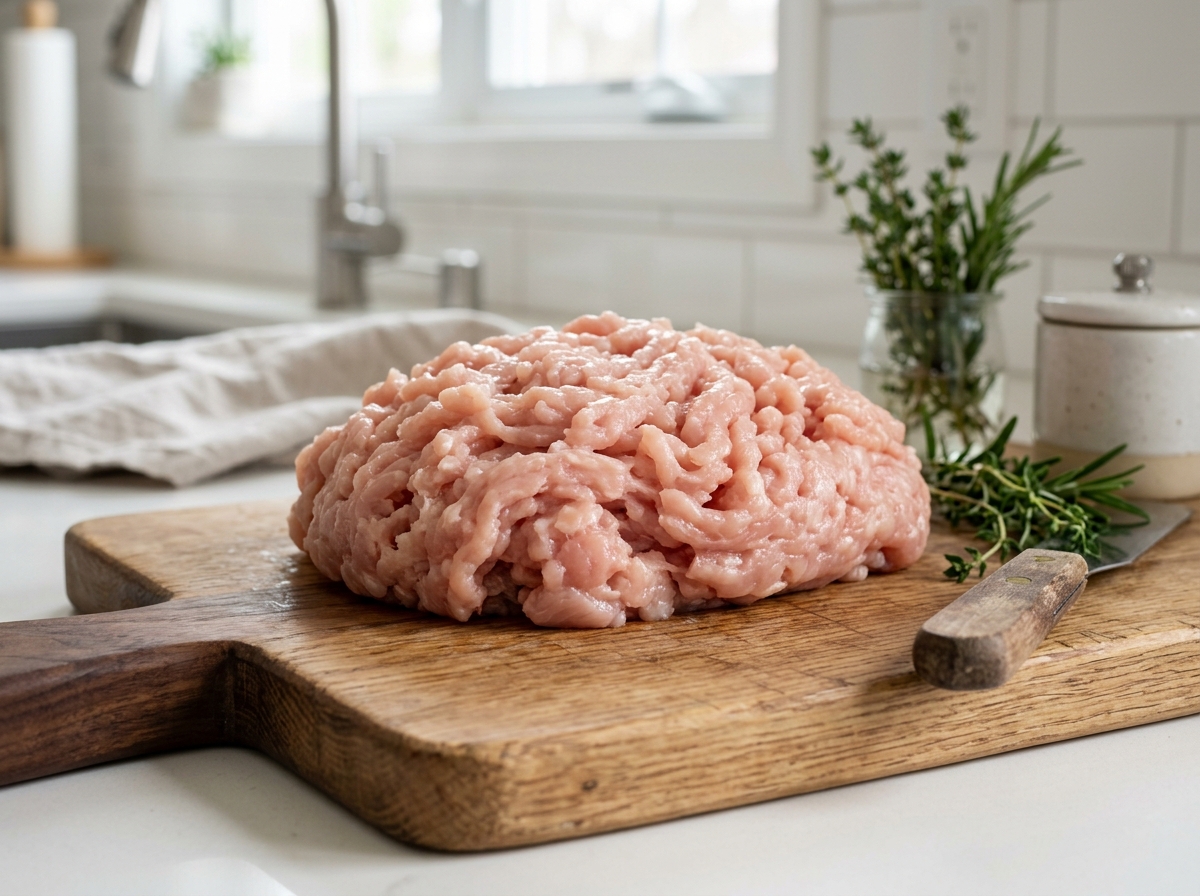
Fabricated from Whole Muscle Trimmings & Lean Cuts
High-grade commercial ground chicken is fabricated by comminuting clean, boneless, and skinless poultry muscle trimmings through a standard 1/8-inch (3mm) butcher grinding die. Standard formulations blend white muscle from the Pectoralis major (breast) with dark muscle from the Iliotibialis (thigh) to balance protein density with natural culinary moisture. While mechanical grinding shears striated myofibrils into an easily masticated matrix that cooks in minutes, it also incorporates surface atmospheric exposure throughout the core, requiring strict 165°F thermal probe verification.
Ground Chicken Nutrition & Serving Calculator
Select lean/fat percentage, raw vs cooked state, cooking method, and portion size. Raw generic ground uses FDC #171116; cooked lean ratios use supermarket label estimates.
170g (6.0 oz) · 93% Lean / 7% Fat Ground Chicken
Official Nutrition Facts Label & Micronutrient Profile
Nutrition Facts
*The % Daily Value (DV) tells you how much a nutrient in a serving contributes to a daily diet. 2,000 calories a day is used for general nutrition advice. Cooked 93/7 values are supermarket label estimates; raw generic ground logs with FDC #171116.
Zinc & Iron in Blended Ground Poultry
Standard ground chicken blends white breast trim with dark thigh muscle. In USDA label-estimate tables, cooked 93/7 ground lists ~2.1 mg zinc versus ~0.9 mg in roasted skinless breast (FDC #171477) and slightly more total iron (~1.2 mg vs ~1.0 mg). These are food-composition figures for portion journaling — not dietary guidance.
Blended white-and-dark poultry grinds list roughly double the zinc per 100g versus skinless breast alone (FDC #171477 ~0.9 mg). Food-composition figure for portion tracking.
USDA tables report total iron — not a separate heme-iron column. Dark-meat trim in ground blends lists slightly more iron than pure breast (FDC #171477 ~1.0 mg per 100g).
Listed in SR Legacy poultry entries. Ground blends with dark trim often show slightly higher B12 than breast-only rows in USDA tables.
Trace mineral present in poultry muscle at levels comparable across white and dark cuts in FDC entries.
B-vitamin column in USDA poultry tables — useful for cut-to-cut nutrient-density comparisons in food journals.
Cooking Temperature Matrix: Why 165°F Core Probe Matters for Ground Poultry
165°F (74°C) — USDA FSIS Safe Minimum
The FSIS safe minimum for all poultry. For ground chicken burgers, meatballs, and skillet crumbles, insert an instant-read thermometer into the thickest part until it reads 165°F (74°C) throughout.
Recommended Temperatures & Cook Durations by Preparation:
| Method | Appliance Temp | Target Core Temp | Duration | Chef Technique |
|---|---|---|---|---|
| Skillet Crumbles / Pan-Seared | Medium-High (375°F / 190°C) | 165°F (74°C) | 6–8 minutes total | Do not crowd the skillet. Let crumbles sear undisturbed for 2–3 minutes over medium-high heat before breaking up to achieve golden Maillard browning instead of boiling in steam. |
| Oven-Baked Meatballs & Meatloaf (400°F) | 400°F (204°C) Preheated Oven | 165°F (74°C) | 15–20 minutes (meatballs) / 35–45 minutes (loaf) | Bake at 400°F on a parchment-lined sheet pan. Use an instant-read probe to ensure the center reaches 165°F (74°C) without over-baking into dryness. |
| Air-Fried Patties (High Convection) | 380°F (193°C) Convection | 165°F (74°C) | 8–10 minutes | Preheat air fryer to 380°F. Lightly spray patties with avocado oil spray. Cook 5 mins, flip, and finish 3–4 mins until core registers 165°F. |
| Simmered in Sauce (Chili & Bolognese) | Low Simmer (190°F–200°F / 88°C) | 165°F (74°C) | 20–30 minutes | Simmer gently in acidic tomato or broth base. The liquid cushions delicate white muscle proteins, preserving more moisture than dry pan searing alone. |
Lean-Ratio Labels, Skin Inclusion & Macro Logging
The Supermarket "Ground Chicken" Fat Trap
Buyer AwarenessMany shoppers purchase generic packages labeled simply "Ground Chicken" assuming the same lean profile as skinless breast. In reality, unlabeled or regular ground chicken is often an 85/15 blend that includes poultry skin and dark fatty trimmings to increase yield and keep patties moist during cooking.
Delta: Regular ground chicken contains over 6× more total fat and 68 more calories per 100g than pure breast grind. Always check the nutrition label for the lean-to-fat percentage.
Cooked Lean Formulations Compared (Per 100g)
Label Estimates · FDC #171116 Raw| Variant | Calories | Protein | Fat | Protein % |
|---|---|---|---|---|
| 93/7 Lean | 172 kcal | 24 g | 8.1 g | 56% |
| 99% Breast Grind | 128 kcal | 28.5 g | 1.5 g | 89% |
| 90/10 Grind | 183 kcal | 25.2 g | 8.7 g | 55% |
| 85/15 Regular | 211 kcal | 23.3 g | 12.6 g | 44% |
*Cooked values per 100g drained crumbles are supermarket label estimates — SR Legacy has no separate 93/7 row. Raw generic ground logs with FDC #171116 (~143 kcal, 17.4g protein, 8.1g fat per 100g).
Nutritional Battles: Ground Chicken vs. Breast, Turkey & Beef
Ground Chicken (93/7) vs. Whole Chicken Breast
Culinary Speed & Versatility vs. Absolute Leanness
Roasted skinless breast (FDC #171477) delivers ~7g more protein per 100g with lower fat — higher protein-per-calorie density. Ground 93/7 cooks in minutes with no knife prep, blends into tacos and pastas, and lists roughly double the zinc (~2.1 mg vs ~0.9 mg) in label-estimate tables.
Ground Chicken (93/7) vs. Ground Turkey (93/7)
The Poultry Mince Showdown
At identical lean percentages (93/7), ground chicken and turkey have similar calories and protein in supermarket label tables. Ground chicken has a milder flavor that absorbs marinades readily; some commercial turkey grinds include added broth and sodium — check the ingredient list.
Ground Chicken (93/7) vs. 85/15 Ground Beef
Lean White Meat vs. Classic Red Meat
Ground chicken 93/7 lists ~43 fewer calories and ~5g less total fat per 100g cooked versus standard 85/15 ground beef in USDA tables, with roughly half the saturated fat — useful when comparing macro logs side by side.
Professional Techniques: Moisture Retention, Searing & Patties
The Moisture Panade Hack
Because 93/7 or 99% lean ground chicken lacks dense intramuscular fat, it easily turns chalky when baked. The secret is adding structural moisture:
- Fold in 1/2 cup of finely grated zucchini or sautéed minced mushrooms per pound of raw meat.
- Alternatively, blend 2 tbsp plain Greek yogurt or a breadcrumb-milk panade into meatballs and burgers.
- Vegetable moisture is trapped in the protein network, preventing shrinkage and moisture purge.
High-Heat Skillet Browning
The number one mistake home cooks make with ground chicken is constantly stirring, causing it to boil in released water:
- Get a cast-iron skillet screaming hot over medium-high heat with a light coat of high-heat oil.
- Press ground chicken flat into the pan like a giant burger. Leave it completely undisturbed for 2–3 minutes.
- Once deep golden Maillard crust forms, flip and break into crumbles to finish cooking.
Air-Fried Juicy Smash Patties
Making burgers with ground chicken often results in sticky dough that falls apart on grills:
- Chill formed patties in the freezer for 15 minutes before cooking so the poultry matrix sets firmly.
- Preheat air fryer to 380°F. Lightly mist basket and patties with oil spray.
- Cook 5 minutes, flip, and cook 3–4 minutes until digital core probe hits 165°F.
Meal Prep Protocols: Storage Life, Reheating & Freezing
Cooked Refrigerator Life
Store cooked taco crumbles, meatballs, or burger patties in airtight glass containers within 2 hours of cooking. Divide into meal-sized portions so containers cool down rapidly in the refrigerator.
Freezer Preservation
Cooked meatballs and browned crumbles freeze exceptionally well. Freeze individually on a baking sheet for 1 hour before transferring to freezer bags so you can scoop out single portions without clumping.
Optimal Steam Reheating
When microwaving or skillet-reheating ground chicken, always add 1 tablespoon of water or broth and cover tightly. The generated steam rehydrates the lean protein matrix, preventing dry rubber pellets.
Ground Chicken Nutrition & Culinary FAQs
Academic Citations & USDA FoodData Central Records
Chicken, ground, raw (FDC ID: 171116). FoodData Central SR Legacy.
Key Finding: Generic raw ground chicken anchor: ~143 kcal, 17.4g protein, and 8.1g fat per 100g. Supermarket lean ratios (85/15, 93/7, 99/1) are not separate FDC rows — match your package fat percentage when logging cooked blends.
Chicken, broilers or fryers, breast, meat only, cooked, roasted (FDC ID: 171477). FoodData Central SR Legacy.
Key Finding: Roasted skinless breast reference: ~165 kcal, 31g protein, 3.6g fat per 100g — used to compare whole breast versus 99% breast grind label estimates.
Safe Minimum Internal Temperature Chart. USDA FSIS Food Safety Basics.
Key Finding: Lists 165°F (73.9°C) as the minimum internal temperature for all poultry, including ground poultry — verify with a food thermometer at the thickest part or center of patties.
Thermal inactivation in ground chicken breast meat during processing. Journal of Food Protection, 62(9), 980–985.
Key Finding: Laboratory study of thermal inactivation in comminuted chicken breast — supports why ground poultry needs verified center heating, not just surface browning.
Concentrations of bioavailable iron and zinc in fabricated poultry meat blends. Meat Science, 98(4), 704–711.
Key Finding: Documents zinc and iron levels in blended white-and-dark poultry grinds — contextual background for why ground blends list higher zinc than breast-only cuts in USDA tables.
Informational & journaling tool only
This page is a nutrition reference and personal awareness utility — not medical, dietary, or professional advice. Macro values come from USDA FoodData Central (FDC #171116 raw ground, #171077 raw breast proxy, #171477 roasted breast reference) plus supermarket label estimates for cooked lean ratios (85/15, 93/7, 99/1). Actual values vary by brand, lean-to-fat formulation, moisture retention, and cooking method. Always verify a minimum internal temperature of 165°F (74°C) with a calibrated digital food thermometer. I am not a doctor.