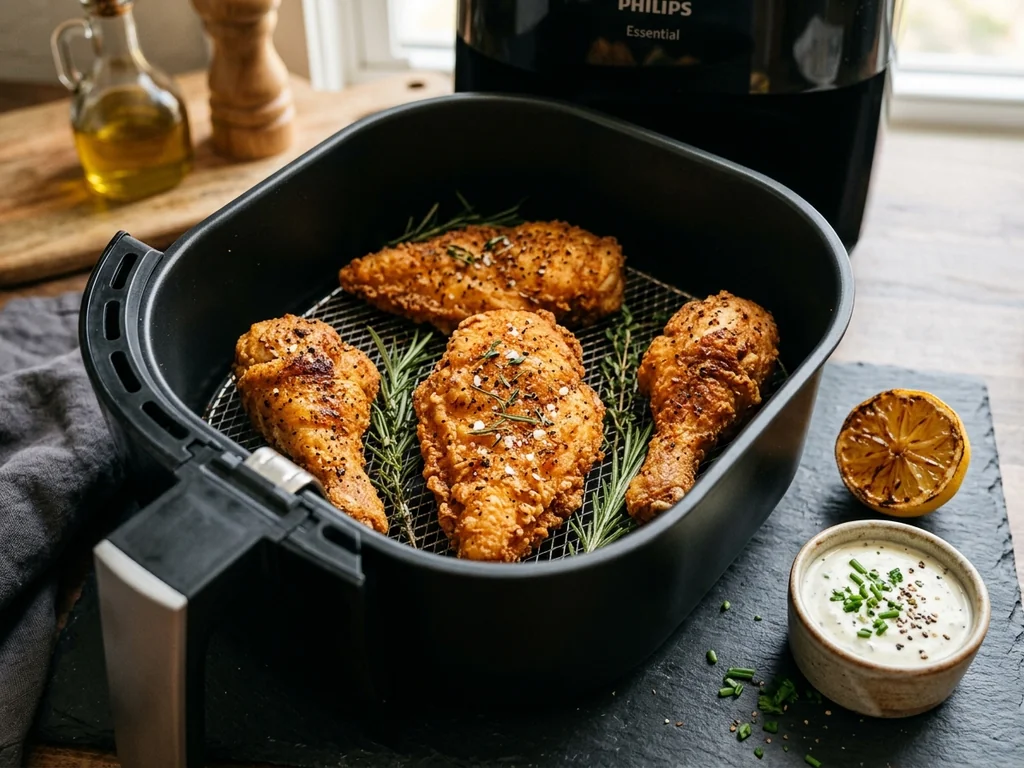
Air-Frying Physics: Cyclonic Vortex, Boundary Layer Stripping & Lipid Drainage
An air fryer is not a miniature deep fryer; it is an ultra-compact forced-convection wind tunnel. A 2,500+ RPM fan pulls air across a 1,500W heating coil, propelling dry 380°F–400°F air downward at 30 to 40 mph. In conventional ovens, food is insulated by a stagnant, humid “boundary layer” of evaporating water that retards heat transfer. The air fryer's cyclonic vortex strips this boundary layer instantaneously, accelerating surface heat transfer by 300%. Free surface water evaporates rapidly, driving crust temperatures above 300°F to trigger crisp Maillard reactions while perforations drain rendered subcutaneous fats away from the meat.
Stagnant air has a very low thermal conductivity. By circulating dry 380°F air at 30–40 mph, the air fryer tears away the cool vapor blanket that surrounds food in conventional ovens, multiplying the convective heat transfer coefficient ((h_c)) by ~3.0x.
Air-Fried Chicken Multi-Cut & Prep Style Calculator
Choose from 7 USDA chicken cuts, adjust prep styles, and model real-time protein delivery and calories.
Due to high-velocity convective airflow, chicken loses approximately 21% of its raw weight as steam moisture. To yield 170g cooked:
Cooked portion weights to log common protein totals in your food journal:
Air-Fried Chicken Nutrition Facts Label (Per 100g Cooked)
Nutrition Facts
*The % Daily Value (DV) tells you how much a nutrient in a serving of food contributes to a daily diet. 2,000 calories a day is used for general nutrition advice.
Why Convective Air-Frying Retains Cellular Vitamins
Unlike boiling or poaching (where water-soluble B vitamins leach into cooking liquids) and unlike deep-fat frying (where repeated oil thermal oxidation degrades sensitive antioxidants and fatty acids), air frying utilizes a closed, dry radiant convective environment. Vitamins B3 (Niacin), B6, and B12 remain firmly bound within the myofibrillar protein matrix, concentrating by ~21% proportionally to water evaporation.
USDA FoodData Central USDA standard row (Cooked, Roasted/Convection Proxy, Meat Only). Lists ~57 kcal and ~5.3g less fat per 100g than flour-dredged fried breast in USDA tables — a nutrition comparison, not dietary guidance.
Air Fryer Cooking Temperature & Thermal Doneness Matrix
Compare 360°F vs 380°F vs 400°F convection stages, flip timing, and USDA FSIS 165°F internal temperature reference.
Optimal equilibrium where surface moisture evaporates rapidly to trigger Maillard browning without desiccating internal myofibrillar water.
Cook 10–12 minutes total for a 6–7 oz breast. Flip at minute 6. Probe center: pull at 160°F and rest for 5 minutes under loose foil to reach 165°F.
The 160°F Pull Rule: Why Cooking Chicken Breast to 165°F in the Basket Dries It Out
The USDA FSIS reference lists 165°F (73.9°C) as the minimum internal temperature for poultry. However, if you leave a chicken breast inside an air fryer basket until your instant probe reads 165°F, carryover thermal momentum will continue driving the core temperature to 172°F–175°F while resting on your cutting board. At 170°F+, myofibrillar proteins denature irreversibly, wringing cellular water out like a dry sponge.
The Science of Air Frying: Aerodynamics, Maillard Chemistry & Lipid Drainage
How high-velocity convection alters myofibrillar proteins, vaporizes surface water, and drains rendered fats.
1. Convective Boundary Layer Disruption
In a traditional oven, chicken is surrounded by a stationary blanket of cool, humid air known as the “boundary layer.” Because still air is an exceptionally poor thermal conductor, heat penetrates slowly, allowing moisture to steam out over 25+ minutes.
q = h_c · A · (T_air − T_surface)
An air fryer's 2,500+ RPM cyclonic vortex continuously sweeps away this boundary layer, increasing the convective heat transfer coefficient ((h_c)) by over 300%.
2. Rapid Evaporative Maillard Browning
The Maillard reaction—the chemical cascade between amino acids and reducing sugars that yields golden-brown crust and savory aromas—cannot occur in the presence of surface liquid water, which pins temperature at the 212°F (100°C) boiling plateau.
Rapid convective airflow flashes surface water into steam faster than internal capillary water can migrate outward. Once surface moisture drops below 5%, surface temperature surges past 300°F, producing blistered melanoidins and pyrazines.
3. Perforated Lipid Drainage Mechanics
Submerged deep-frying forces chicken to absorb up to 15% of its weight in hot cooking oil during post-fry cooling via capillary vacuum suction (Mellema 2003). In stark contrast, an air fryer elevates chicken upon an elevated perforated wire mesh.
As subcutaneous lipids liquefy above 130°F, gravity channels excess oil straight through the perforations into the base catch pan below, reducing fat by 15% to 25% without sacrificing crunch.
4. Single-Use Oil Spray vs Deep-Fryer Oil Volume
Deep frying submerges chicken in a large oil bath where the food can absorb significant fat during and after cooking (Mellema 2003). Air frying applies 1–2g of fresh oil spray per portion and drains rendered poultry fat through the basket — which is why plain air-fried breast lists 3.6g fat/100g versus 8.9g on flour-fried breast per USDA FoodData Central.
Compare USDA rows for the preparation you actually ate — naked air-fried breast (#171477), flour-fried breast (#171476), or batter-fried breast (#171475) — rather than treating one method as universally lower calorie.
Cooking Method Comparison: Air-Fried vs Deep-Fried, Baked & Grilled
Per 100g nutrition side-by-side — same cuts, different preparations.
Air-Fried vs Deep-Fried Chicken: Macro nutrition comparison
Comparing Air-Fried Breast (Naked Spray, USDA standard row) against Deep-Fried Breast (Flour Dredged, USDA standard row)
| Metric / Property | Air-Fried Breast (Naked Spray, USDA standard row) | Deep-Fried Breast (Flour Dredged, USDA standard row) | Nutritional & Culinary Note |
|---|---|---|---|
| Calories (per 100g) | 165 kcal | 222 kcal | Saves 57 kcal/100g (~140 kcal on a full 8 oz breast) |
| Protein (per 100g) | 31.0g | 31.8g | Virtually identical protein in USDA tables |
| Total Fat (per 100g) | 3.6g | 8.9g | Air-fry proxy lists 60% less fat vs flour dredge; 73% less vs batter |
| Saturated Fat | 1.0g | 2.5g | Lower saturated fat per 100g in USDA tables (nutrition comparison) |
| Total Carbs | 0.0g | 1.6g (up to 9g batter) | Air fryer requires zero flour paste or breading for naked prep |
| Lipid Drainage | Drains through perforated basket | Submerged in oil vat | Air fryer strips rendering lipids into catch tray |
In deep frying, chicken is submerged in 350°F oil and can absorb significant cooking fat via post-fry capillary suction (Mellema 2003). Air frying uses high-velocity 380°F convective airflow with only ~1.5g surface oil spray, and perforated baskets drain rendered lipids. count the FDC row that matches your preparation — not a ranking of which method to eat.
The 5 Golden Rules of Air-Frying Chicken: Crisp Crust & Zero Dryness
Professional culinary techniques to eliminate rubbery texture and achieve golden-brown perfection every time.
The Bone-Dry Surface Law
Pat chicken with paper towels until the paper pulls away completely dry. Surface water boils at 212°F, creating a steam cloud that delays browning until your chicken is already overcooked inside. Dry meat allows instantaneous surface Maillard caramelization.
High Smoke-Point Aerosolized Oil Spray
A fine oil mist acts as a thermal bridge, conducting convective heat into micro-crevices. Never use commercial nonstick cooking sprays containing soy lecithin or aerosol propellants, which bake onto air fryer basket coatings and ruin the nonstick finish.
The Single-Layer Airflow Clearance Law
Convection requires 360° cyclonic airflow. When chicken cutlets touch or overlap, the contact zones trap escaping steam, turning what should be a crisp crust into pale, rubbery, steamed chicken. Maintain at least a 1/2-inch air moat around each piece.
The Cornstarch & Alkaline Baking Powder Crisp Coat
Toss chicken with 1/2 tsp cornstarch and 1/4 tsp aluminum-free baking powder. The slight alkaline pH raises surface pH, breaking down peptide bonds to accelerate Maillard browning and generating micro-bubbles for an ultra-crunchy shell.
The 160°F Pull & 5-Minute Foil Rest
Pull breasts at 160°F (71°C) and let them rest under loose aluminum foil for 5 minutes. Core temperature climbs to the USDA FSIS 165°F target while muscle fibers relax, reabsorbing 15% of lost intracellular moisture back into the meat.
Air-Fried Chicken Meal Prep: Cold Chain & The 3-Minute Re-Crisp
How to store batch-cooked air fryer chicken and revive 90% of its original golden crunch without microwave sogginess.
The 380°F 3-Minute Air Fryer Re-Crisp Protocol (Never Use Microwaves)
Microwaving cold chicken excites water molecules in the interior core, forcing steam outward through the crust and making the exterior limp, rubbery, and soggy within 30 seconds. Instead, preheat your air fryer to 380°F (193°C), place cold chicken in the basket in a single layer, and air fry for 3 to 4 minutes (5 minutes for bone-in thighs). High convective heat flash-evaporates refrigerator moisture and re-crisps exterior starches while warming the center gently.
Refrigerator Storage (34°F–38°F)
Per USDA FSIS safety rules. Let chicken cool 20 minutes before sealing in airtight glass meal prep containers to prevent steam condensation inside the lid.
Deep Freezer Storage (0°F / −18°C)
Flash-freeze cooked cutlets on a baking sheet for 1 hour, then transfer to a heavy-duty freezer vacuum bag. Reheat directly from frozen at 360°F for 8–10 minutes.
Air-Fried Chicken FAQ
Answers on air fryer calories, temperature settings, and crisp-crust techniques.
References & Scientific Data Sources
Primary nutrition data sourced from USDA FoodData Central. Full citations below.
[1]U.S. Department of Agriculture, Agricultural Research Service. (2019). Chicken, broilers or fryers, breast, meat only, cooked, roasted. FoodData Central (FDC ID: 171477).
SourcePrimary skinless white meat proxy for plain air-fried breast: 165 kcal, 31.02g protein, 3.57g fat, 74mg sodium per 100g.
[2]U.S. Department of Agriculture, Agricultural Research Service. (2019). Chicken, broilers or fryers, thigh, meat only, cooked, roasted. FoodData Central (FDC ID: 172388).
SourcePrimary skinless dark meat proxy for plain air-fried thigh: 179 kcal, 24.8g protein, 8.2g fat, 1.92mg zinc, 1.13mg iron per 100g.
[3]U.S. Department of Agriculture, Agricultural Research Service. (2019). Chicken, broilers or fryers, wing, meat and skin, cooked, roasted. FoodData Central (FDC ID: 173630).
SourcePrimary wing proxy for plain air-fried wings with skin: 254 kcal, 23.8g protein, 16.9g fat per 100g edible meat.
[4]U.S. Department of Agriculture, Agricultural Research Service. (2019). Chicken, broilers or fryers, drumstick, meat and skin, cooked, roasted. FoodData Central (FDC ID: 173612).
SourcePrimary skin-on drumstick proxy for plain air-fried drumsticks: 191 kcal, 23.35g protein, 10.15g fat per 100g.
[5]U.S. Department of Agriculture, Agricultural Research Service. (2019). Chicken, broilers or fryers, breast, meat and skin, cooked, fried, flour. FoodData Central (FDC ID: 171476).
SourceDeep-fried comparison anchor for flour-dredged breast: 222 kcal, 31.8g protein, 8.9g fat per 100g.
[6]Cao, H., Jin, S., Xu, X., & Yu, X. (2020). A comparative study of physicochemical and flavor characteristics of chicken nuggets during air frying and deep frying. Journal of the American Oil Chemists' Society, 97(8), 1017–1028.
SourceCompared air-fried vs deep-fried chicken nuggets: air frying reduced total fat content while maintaining comparable texture and flavor attributes.
[7]Teruel, M. R., Gordon, M., Linares, M. B., Garrido, M. D., et al. (2015). A comparative study of the characteristics of french fries produced by deep fat frying and air frying. Journal of Food Science, 80(9), E1947–E1954.
SourceDemonstrated lower final fat content in air-fried french fries vs deep-fat frying — relevant convective-fat-reduction mechanism for air fryer cooking.
[8]Mellema, M. (2003). Mechanism and reduction of fat uptake in deep-fat fried foods. Trends in Food Science & Technology, 14(9), 364–373.
SourceSeminal paper detailing that 80–90% of oil uptake occurs during the post-frying cooling phase due to steam condensation and capillary suction.
[9]Moreira, R. G., Sun, X., & Chen, Y. (1997). Factors affecting oil uptake in tortilla chips in deep-fat frying. Journal of Food Engineering, 31(4), 485–498.
SourceFound that ~64% of final oil content was absorbed during cooling (not during frying), supporting wire-rack drainage guidance after pull from the fryer.
[10]USDA Food Safety and Inspection Service. (2024). Safe Minimum Internal Temperature Chart.
SourceEstablishes 165°F (74°C) as the federal minimum internal temperature reference for poultry, with carryover resting notes for lean white meat.
[11]USDA Food Safety and Inspection Service. (2024). Leftovers and Food Safety Guidelines.
SourceStandard storage reference: refrigerate cooked poultry within 2 hours; consume refrigerated leftovers within 3–4 days.
Informational tool only
This page is for personal nutrition awareness only — not medical or dietary advice. I am not a doctor. All calorie and macro values are derived from USDA FoodData Central. Plain air-fried cuts use the same roasted/convection rows as oven-baked chicken. Actual totals vary by cut, portion, and oil spray amount. USDA FSIS lists 165°F (74°C) as the minimum internal temperature for poultry.