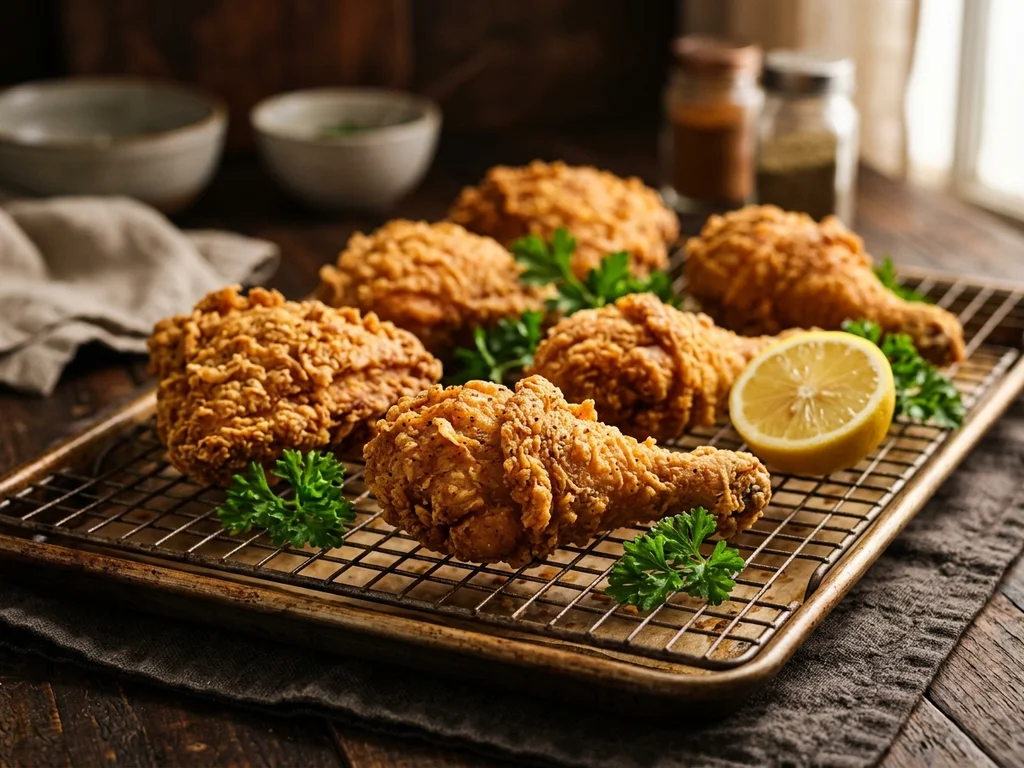
Deep-Frying Physics: The Steam Barrier vs. The Cooling Vacuum
Contrary to popular belief, chicken does not absorb significant cooking oil while submerged in properly heated 365°F (185°C) oil. Deep frying is a simultaneous heat and mass transfer process: as internal moisture boils above 212°F, vigorous escaping steam creates an outward positive vapor pressure barrier that physically blocks oil from entering. Peer-reviewed research (Mellema 2003) proves that 80% to 90% of oil uptake occurs after removal from the fryer, when internal steam cools and condenses, creating a vacuum that suctions surface oil into the crust pores.
365°F (185°C) Steam Barrier: When raw chicken enters hot oil, moisture instantaneously vaporizes into steam at 212°F (100°C). The forceful outward rush of steam creates a continuous positive pressure gradient that physically prevents surrounding oil from invading the interior meat.
Fried Chicken Calories, Macros & Oil Absorption Calculator
Fried Chicken Nutrition Facts Label (Per 100g Cooked)
Nutrition Facts
* The % Daily Value (DV) tells you how much a nutrient in a serving of food contributes to a daily diet. 2,000 calories a day is used for general nutrition advice. Source: USDA FoodData Central.
Key Vitamins & Minerals in Southern Flour-Dredged Fried Chicken Breast
USDA FoodData Central official mineral and B-vitamin values for fried poultry. Frying retains mineral density (zinc, iron, phosphorus) while breading adds trace carbohydrate calories.
While flame grilling allows fat to drip away, deep-fat frying adds 8g to 14g of cooking oil per 100g. This lipid uptake increases caloric density by ~58% compared to grilled breast. However, because the crust acts as a pressure shield, the interior meat stays tender, juicy, and packed with 29.2g complete protein per 100g.
Oil Temperature Matrix: 325°F Sponge vs. 365°F Sweet Spot
In deep-fat frying, oil temperature determines whether your chicken becomes a shatteringly crisp masterpiece or an oil-logged sponge. Maintaining the oil at 350°F to 365°F (177°C to 185°C) generates the critical outward steam pressure needed to block excess fat ingress. For doneness, pull lean breast meat at 160°F (71°C) internal probe for carryover rest to the USDA FSIS 165°F minimum; dark thighs require 175°F–180°F.
The sweet spot validated by food rheologists (Mellema 2003). Outward water vaporization creates an intense positive steam barrier that physically blocks oil penetration during frying while creating an ultra-crisp craggy crust.
Shatteringly crisp, light craggy flakes, zero greasy mouthfeel.
Heat refined peanut oil or high-oleic oil to 375°F (190°C) to anticipate the 15°F drop when cold chicken is added. Rest dredged chicken 15 minutes before dropping to hydrate the flour gluten.
Gently lower chicken pieces away from your body. Do not overcrowd the pot. The oil stabilizes at 350°F–365°F. Intense bubbling signals outward steam pressure blocking oil ingress.
Fry breasts for 12–14 minutes, thighs for 14–16 minutes. Insert probe into thickest center: pull white meat at 160°F (71°C) and dark thighs at 175°F–180°F (80°C) for tender collagen melt.
Transfer pieces immediately onto an elevated wire cooling rack (NEVER paper towels). Rest for 5 minutes. Surface oil drips away while carryover heat safely elevates the core to 165°F.
The Science of Frying: Chicken
What happens biochemically when dredged poultry enters a 365°F oil bath? Below is a food-rheology breakdown of simultaneous heat and mass transfer, the post-fry capillary vacuum discovered by Mellema (2003), and the glass-like starch crust that locks in chicken juices.
1. The Outward Vapor Pressure Steam Barrier
When raw chicken meets 365°F (185°C) oil, boundary moisture violently flashes into steam at 212°F (100°C). The rapid expansion forces continuous steam bubbles outward, creating a positive vapor pressure gradient that physically blocks frying oil from entering the interior meat.
As long as oil stays above 350°F, steam bubbling continues and core meat remains 100% free of absorbed oil.
2. Capillary Suction During Cooling (Mellema Law)
The landmark study by Mellema (2003) discovered that 80% to 90% of total oil uptake occurs AFTER frying. When lifted from oil, the internal steam cools and rapidly condenses, creating an internal vacuum that sucks surface oil into the open crust pores.
Elevated wire rack draining lets surface oil roll off before the cooling vacuum draws it into the crust pores.
3. Starch Gelatinization & Glass-Like Crisp
Flour and cornstarch dredges contain amylose and amylopectin granules. At 140°F–160°F in hot oil, these starches gelatinize into an elastic film. As surface water vaporizes, the starch dehydrates into a rigid, crispy glass-like polymer shell.
This rigid shell traps natural chicken moisture inside the meat, creating the signature contrast of crunchy exterior and succulent, juicy interior.
Deep-Fried vs. Air-Fried, Fried vs. Grilled & Flour vs. Batter
Nutritional and culinary showdowns: deep-fried vs air-fried chicken breast, fried vs grilled macro density, and Southern flour dusting vs heavy wet batter coating.
Deep-Fried Chicken Breast vs. Air-Fried Chicken Breast
Oil Submersion vs. High-Velocity Hot Air (100g Cooked)
Deep frying submerges poultry in hot oil, which can absorb into crust pores during and after cooking (Mellema 2003). Air frying circulates high-velocity convection air around lightly sprayed cutlets — a different preparation with fewer absorbed lipids in planning estimates. count the row that matches how the chicken was actually cooked.
The 3 Golden Rules: Shaggy Double Dredge, 365°F Recovery & Wire Rack Law
Master the professional culinary secrets used by top Southern fry masters to produce shatteringly crisp, craggy crusts that never slough off, turn greasy, or get soggy on the plate.
The Shaggy Double-Dredge & 15-Min Hydration
Crust falling off chicken is caused by dry flour meeting hot oil without proper hydration.
- Mix 80% unbleached flour with 20% cornstarch, 1 tsp baking powder, and heavy spices.
- Drizzle 2 tablespoons of buttermilk into the dry flour and rub with fingers to form small "shaggy flakes".
- Dip chicken into buttermilk wash, pack firmly into the shaggy flour dredge, and transfer to a wire rack.
- Mandatory: Let dredged chicken rest for 15 minutes before frying. The flour hydrates into a sticky gluten bond that locks onto the chicken.
Oil Temperature Recovery (375°F Pre-Drop)
Dropping cold poultry causes oil temperature to plummet by 20°F–30°F, creating a greasy oil sponge.
- Preheat refined peanut oil or high-smoke-point oil to 375°F (190°C), not 350°F.
- Add chicken in small batches (no more than 2–3 large pieces at once to avoid thermal shock).
- The cold meat brings the oil precisely down to the 350°F–360°F golden frying zone.
- Adjust stove burner to keep the oil steady at 350°F throughout the entire cooking process.
The Wire Cooling Rack Law (Never Paper Towels)
Draining freshly fried chicken on paper towels is the #1 mistake in home kitchens.
- Lift fried pieces with metal tongs and hold above the oil bath for 5 seconds to drain gross oil.
- Place directly onto an elevated wire cooling rack set inside a rimmed baking sheet.
- Paper towels trap escaping underside steam, creating a soggy condensation sauna that ruins crust.
- An elevated wire rack allows air to circulate 360 degrees around the crust while surface oil rolls off.
Fried Chicken Storage, Shelf Life & Air Fryer Re-Crisping Guide
USDA FSIS storage guidelines for fried poultry, batch-prep logistics, and the 385°F air fryer re-crisping method that restores 95% of freshly fried crunch without microwave sogginess.
Microwaves excite water molecules into steam that instantly turns crispy breading into rubbery mush. Instead, place cold fried chicken into an air fryer preheated to 385°F (196°C). Heat for 4 to 6 minutes. High-velocity dry convection air renders residual oil and evaporates trapped moisture, restoring 95% of original restaurant crunch!
Cooking for a crowd? Fry chicken in batches for just 4–5 minutes until the exterior crust sets into a pale golden shell. Transfer to a wire rack set in a sheet pan in a 350°F (177°C) oven for 15–18 minutes. The oven finishes cooking the interior to 165°F while you fry the next batch with zero stress.
Dredge raw tenders or cutlets in seasoned flour, freeze on a parchment-lined baking sheet for 2 hours until rock-hard, then transfer to a freezer bag. Cook directly from frozen in a 390°F air fryer for 10–12 minutes with a light oil spray for homemade fast-food tenders anytime.
If you peel off the crispy skin and breading before eating, use the meat-only fried row: 187 kcal, 33.4g protein, and 4.7g fat per 100g. Compared to batter-dipped breast, that removes roughly 73 kcal and 8.5g fat per 100g from your portion estimate.
Fried Chicken Nutrition, Food Tracking & Frying FAQs
Common culinary and nutritional questions: calories by cut, peeling skin off calories saved, optimal oil frying temperatures, capillary oil uptake, safe internal temperatures, and air fryer re-crisping methods.
References & Scientific Data Sources
Primary nutrition data sourced from USDA FoodData Central. Full citations below.
[1]U.S. Department of Agriculture, Agricultural Research Service. (2019). Chicken, broilers or fryers, breast, meat and skin, cooked, fried, flour. FoodData Central (FDC ID: 171476).
SourcePrimary standard for Southern flour-dredged fried breast: 222 kcal, 31.8g protein, 8.9g fat, 1.6g carbs per 100g.
[2]U.S. Department of Agriculture, Agricultural Research Service. (2019). Chicken, broilers or fryers, breast, meat and skin, cooked, fried, batter. FoodData Central (FDC ID: 171475).
SourceStandard for extra-crispy batter-dipped fried breast: 260 kcal, 24.8g protein, 13.2g fat, 9.0g carbs per 100g.
[3]U.S. Department of Agriculture, Agricultural Research Service. (2019). Chicken, broilers or fryers, breast, meat only, cooked, fried. FoodData Central (FDC ID: 171078).
SourceMeat-only fried breast proxy for crust-peeled journaling: 187 kcal, 33.4g protein, 4.7g fat, 0.5g carbs per 100g.
[4]U.S. Department of Agriculture, Agricultural Research Service. (2019). Chicken, broilers or fryers, thigh, meat and skin, cooked, fried, flour. FoodData Central (FDC ID: 173624).
SourcePrimary standard for flour-dredged fried thigh: 262 kcal, 26.8g protein, 15.0g fat, 3.2g carbs per 100g.
[5]U.S. Department of Agriculture, Agricultural Research Service. (2019). Chicken, broilers or fryers, thigh, meat and skin, cooked, fried, batter. FoodData Central (FDC ID: 172386).
SourceStandard for batter-dipped fried thigh: 277 kcal, 21.6g protein, 16.5g fat, 9.1g carbs per 100g.
[6]U.S. Department of Agriculture, Agricultural Research Service. (2019). Chicken, broilers or fryers, drumstick, meat and skin, cooked, fried, flour. FoodData Central (FDC ID: 173611).
SourcePrimary standard for flour-dredged fried drumstick: 245 kcal, 27.0g protein, 13.7g fat, 1.6g carbs per 100g.
[7]U.S. Department of Agriculture, Agricultural Research Service. (2019). Chicken, broilers or fryers, wing, meat and skin, cooked, fried, flour. FoodData Central (FDC ID: 173629).
SourcePrimary standard for flour-fried whole wings: 321 kcal, 26.1g protein, 22.2g fat, 2.4g carbs per 100g.
[8]Mellema, M. (2003). Mechanism and reduction of fat uptake in deep-fat fried foods. Trends in Food Science & Technology, 14(9), 364–373.
SourceSeminal paper detailing that 80–90% of oil uptake occurs during the post-frying cooling phase due to steam condensation and capillary suction.
[9]Moreira, R. G., Sun, X., & Chen, Y. (1997). Factors affecting oil uptake in tortilla chips in deep-fat frying. Journal of Food Engineering, 31(4), 485–498.
SourceFound that ~64% of final oil content was absorbed during cooling (not during frying), supporting wire-rack drainage guidance after pull from the fryer.
[10]USDA Food Safety and Inspection Service. (2024). Safe Minimum Internal Temperature Chart for Poultry & Carryover Cooking Guidelines.
SourceEstablishes 165°F (74°C) as the federal minimum internal safety floor for poultry, with carryover recommendations for lean white meat.
[11]USDA Food Safety and Inspection Service. (2024). Leftovers and Food Safety Guidelines.
SourceStandard storage reference: refrigerate cooked poultry within 2 hours; consume refrigerated leftovers within 3–4 days.
[12]Dobarganes, C., & Márquez-Ruiz, G. (2015). Formation and analysis of oxidized fatty acids in frying fats and oils. Current Opinion in Food Science, 4, 110–117.
SourceAnalyzes thermal lipid degradation and emphasizes temperature maintenance to prevent excessive fatty acid oxidation in fryer oils.
Informational tool only
This page is for personal nutrition awareness only — not medical or dietary advice. I am not a doctor. All calorie and macro values are derived from USDA FoodData Central. Deep-fried entries include absorbed cooking oil and breading beyond plain grilled or baked chicken — match your coating style in the calculator. USDA FSIS minimum internal temperature for all poultry is 165°F (74°C). Actual totals vary by cut, portion, and preparation.