Oven Baking Thermodynamics: Why 400°F Outperforms 350°F
The traditional rule of baking boneless chicken breast at 350°F for 35–45 minutes is the leading cause of dry, stringy poultry. In an oven, dry convective air heats the exterior while driving evaporative cooling. At 350°F, prolonged heat slowly contracts actin and myosin proteins over 40 minutes, squeezing intracellular moisture out into the pan where the meat essentially boils in its own liquid. Baking at 400°F (204°C) hot and fast rapidly denatures surface proteins into a protective barrier, finishing in just 18–22 minutes while locking in savory cell juices.
400°F (204°C) Convection Airflow: High ambient heat circulates 360 degrees around the cutlet. Within the first 7 minutes, surface actin denatures to form a sealed barrier that minimizes moisture weepage into the baking dish. Total bake time is trimmed to 18–22 minutes.
Baked Chicken Nutrition Calculator
Baked Chicken Nutrition Facts Label (Per 100g Cooked)
Nutrition Facts
* The % Daily Value (DV) tells you how much a nutrient in a serving of food contributes to a daily diet. 2,000 calories a day is used for general nutrition advice. Source: USDA FoodData Central.
Key Vitamins & Minerals in Baked Skinless Chicken Breast (Lean Cutlet)
USDA FoodData Central lists B-vitamins and minerals for oven-baked poultry below. Values are for food-composition reference and personal nutrition journaling only.
Raw chicken breast is approximately 74% water and 22.5% protein by weight. During oven roasting, roughly 20% to 24% of that intracellular moisture evaporates into steam. This water reduction concentrates the solid protein fibers, raising the protein density from 22.5g per 100g raw to an impressive 31.02g per 100g cooked on your plate!
Oven Temperature Matrix: 350°F vs 400°F & The 160°F Carryover Law
USDA FSIS mandates that all poultry reach a safe internal minimum of 165°F (74°C). For tender, juicy baked chicken breast, professional culinary chefs pull cutlets at 160°F (71°C) and rest them tented under foil for 5 minutes, allowing carryover conduction to safely reach 165°F without squeezing out intracellular cell juices. Dark meat cuts (thighs and drumsticks) require 175°F–185°F to fully hydrolyze connective collagen.
The sweet spot endorsed by professional culinary chefs. The high ambient heat rapidly coagulates surface proteins into a sealed barrier within the first 7 minutes, preserving juices while finishing in just 18–22 minutes.
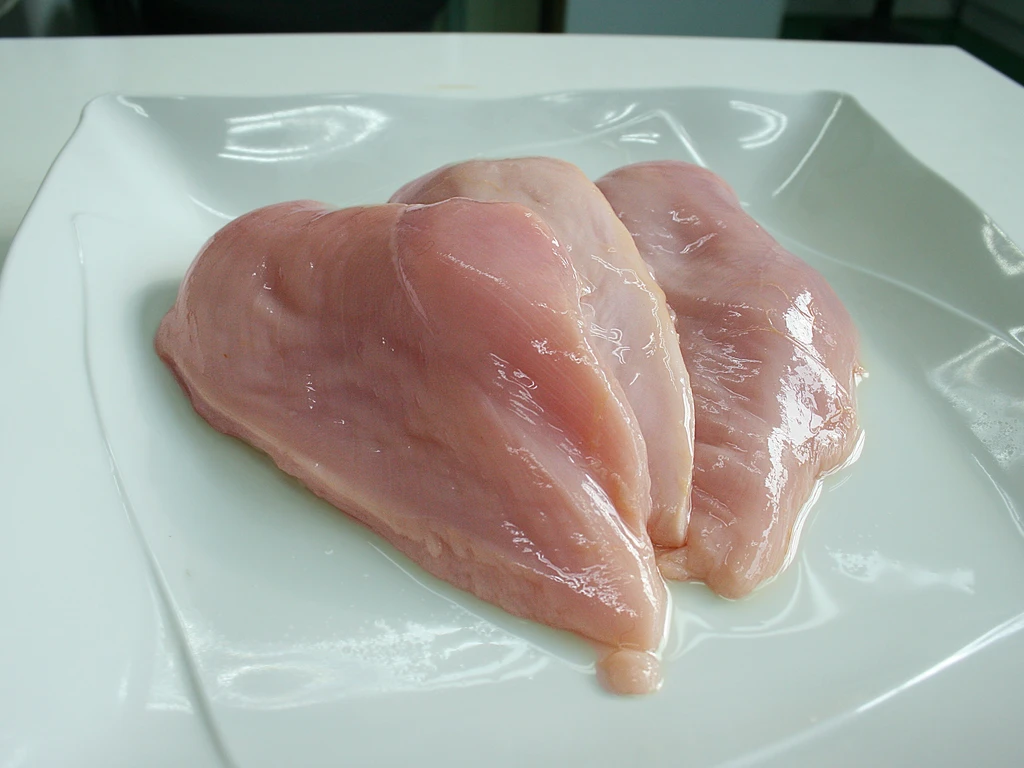
Glistening, plump, extraordinarily tender with intact cell juices.
Preheat oven to 400°F (204°C). Pound chicken breast cutlets to a uniform 3/4-inch thickness between parchment sheets so cooking rates are equal across the entire lobe.
Place cutlets on the sheet pan and drape a piece of parchment paper loosely over the top. This creates an en papillote microclimate, preventing surface drying while baking.
Discard the parchment tent for the final 5 minutes so convective heat lightly browns the top. Insert an instant-read probe into the thickest center; pull when it hits 160°F (71°C).
Transfer to a cutting board and tent loosely with foil for 5 minutes. Residual heat pushes internal temp to 165°F (74°C) while cell juices redistribute throughout the cutlet.
The Science of Baking: Chicken
What happens biochemically when poultry enters a 400°F oven? Below is a food-science breakdown of convective heat transfer, temperature-dependent myofibrillar contraction kinetics, and why dark meat collagen requires 175°F+ to transform into succulent gelatin.
1. Convection & Surface Coagulation Kinetics
In an oven, heat transfers via radiant energy from elements and convective circulating air. At 400°F (204°C), exterior sarcoplasmic proteins denature within the first 6–8 minutes, creating a coagulated surface barrier that restricts evaporative fluid loss.
At 350°F, slow heating delays surface coagulation, allowing intracellular juices to seep continuously into the baking dish for over 40 minutes.
2. Actin-Myosin Shrinkage & Moisture Loss
Poultry muscle is ~75% water trapped between protein filaments. Around 140°F (60°C), myosin denatures and contracts. Above 155°F, actin contracts transversely, forcefully expelling cell moisture. Pulling at 160°F prevents excessive shrinkage.
Resting under foil for 5 minutes allows pressurized internal juices to be reabsorbed into relaxed myofibrillar lattices.
3. Dark Meat Collagen Hydrolysis to Gelatin
Chicken leg muscles contain higher intramuscular collagen than breast (Voutila et al. 2009). While poultry reaches the FSIS 165°F minimum earlier, many cooks bake dark meat to 175°F–185°F (80°C–85°C) so connective collagen softens into gelatin for tender texture.
This explains why baked thighs can bake for 35+ minutes without turning dry, while lean breast becomes chalky if overcooked.
Baked vs. Fried, Breast vs. Thigh & 400°F vs. 350°F Compared
Per 100g nutrition side-by-side — same cuts, different preparations: baked skinless breast vs deep-fried battered breast, white breast vs dark thigh macro metrics, and why 400°F hot baking beats 350°F slow drying.
Baked Chicken Breast vs. Deep-Fried Chicken Breast
Dry Convective Heat vs. Submerged Boiling Lipid Immersion (100g Cooked)
Plain oven-baked breast cooks in its own moisture without batter or absorbed fryer oil. Fried battered breast lists ~260 kcal and ~13.2g fat per 100g — count the row that matches your preparation, not a ranking of which to eat.
The 3 Golden Rules: Parchment Steam Tent, Pounding & 160°F Rest
Master the professional culinary techniques used in restaurant kitchens to eliminate dry, rubbery baked chicken forever. Learn the parchment steam tent secret, thickness equalization, and why cutting into hot chicken immediately bleeds out 30% of its moisture.
The Parchment Steam Tent ("En Papillote")
Baking lean cutlets uncovered desiccates surface muscle bundles, while crimped aluminum foil traps heavy moisture that boils the meat.
- Lightly brush cutlets with olive oil or seasoned broth and arrange on a rimmed sheet pan.
- Cut a sheet of parchment paper slightly larger than your pan and butter or oil one side.
- Drape the parchment paper loosely over the chicken (buttered-side down) like a relaxed tent.
- Bake at 400°F for 15 minutes, then discard parchment for the final 5 minutes to lightly brown.
Pounding to Uniform 3/4-Inch Thickness
Chicken breasts naturally taper from 1.5 inches at the thick cranial lobe to 0.25 inches at the tapered tail.
- Place raw breasts between two sheets of parchment paper or plastic wrap on a sturdy board.
- Using the flat side of a meat mallet or a heavy rolling pin, gently pound only the thickest cranial end.
- Stop when the entire cutlet measures an even 3/4-inch across its full length.
- The entire fillet now finishes in exactly 18–20 minutes with zero dry, chalky edges!
The 160°F Pull & 5-Minute Foil Rest
Cutting into baked chicken straight from the oven forces up to 30% of its juices to pool onto your cutting board.
- Insert a digital thermometer probe into the thickest center; pull the chicken out at 160°F (71°C).
- Transfer cutlets to a warm wooden cutting board or platter.
- Tent loosely with a sheet of aluminum foil (do not wrap airtight to avoid steam condensation).
- Rest for 5 full minutes. Carryover heat pushes the core to 165°F while muscle fibers relax.
Baked Chicken Meal Prep: Cold-Chain Storage & Reheating Guide
USDA FSIS storage timelines for oven-baked poultry, sheet-pan batch meal prep strategies, and a skillet broth-steam reheating method that prevents rubbery texture.
Bake 6–8 seasoned cutlets on two large rimmed baking sheets at 400°F (204°C) for 20 minutes. Let rest 10 minutes before slicing into strips. Portion 150g cooked servings (~248 kcal, ~46.5g protein per USDA skinless breast row) into airtight glass containers. Safe in the fridge for 3 to 4 days.
Bake chicken breasts in a deep baking dish with 1/2 cup of chicken broth, garlic cloves, and a squeeze of lime juice covered with foil. Once cooked to 165°F, shred hot with two forks directly in the pan liquid. The meat re-absorbs the flavorful broth, staying moist for days.
Place raw pounded chicken breasts with herbs, garlic powder, and 1 tsp olive oil into zip-top freezer bags and press flat. Freeze up to 4 months. Thaw overnight in the refrigerator and slide straight onto a hot sheet pan for a 20-minute weeknight meal.
Never microwave cold baked chicken on high power—it vaporizes moisture and turns cutlets rubbery. Instead, place cold sliced chicken into a skillet with 2–3 tablespoons of chicken bone broth or water, cover tightly with a lid, and steam gently over medium-low heat for 3 minutes to restore fresh-out-of-the-oven juiciness.
Baked Chicken Nutrition, Food Tracking & Cooking FAQs
Common culinary and nutritional questions: calories by cut, 350°F vs 400°F baking temps, raw vs cooked weight logging, foil vs parchment paper, and juiciness restoration techniques.
References & Scientific Data Sources
Primary nutrition data sourced from USDA FoodData Central. Full citations below.
[1]U.S. Department of Agriculture, Agricultural Research Service. (2019). Chicken, broilers or fryers, breast, meat only, cooked, roasted. FoodData Central (FDC ID: 171477).
SourcePrimary skinless white meat benchmark for plain baked breast: 165 kcal, 31.02g protein, 3.57g fat, 74mg sodium per 100g.
[2]U.S. Department of Agriculture, Agricultural Research Service. (2019). Chicken, broilers or fryers, thigh, meat only, cooked, roasted. FoodData Central (FDC ID: 172388).
SourcePrimary skinless dark meat benchmark for plain baked thigh: 179 kcal, 24.8g protein, 8.2g fat, 1.92mg zinc, 1.13mg iron per 100g.
[3]U.S. Department of Agriculture, Agricultural Research Service. (2019). Chicken, broilers or fryers, wing, meat and skin, cooked, roasted. FoodData Central (FDC ID: 173630).
SourcePrimary wing proxy for plain oven-baked wings with skin: 254 kcal, 23.8g protein, 16.9g fat per 100g edible meat.
[4]U.S. Department of Agriculture, Agricultural Research Service. (2019). Chicken, broilers or fryers, drumstick, meat only, cooked, roasted. FoodData Central (FDC ID: 172376).
SourcePrimary skinless drumstick proxy: 155 kcal, 24.2g protein, 5.7g fat, 2.56mg zinc per 100g.
[5]USDA Food Safety and Inspection Service. (2024). Safe Minimum Internal Temperature Chart for Poultry & Carryover Cooking Guidelines.
SourceEstablishes 165°F (74°C) as the federal minimum internal safety floor for poultry, with culinary resting recommendations for 160°F carryover in lean breast meat.
[6]Murphy, R. Y., & Marks, B. P. (2000). Effect of meat temperature on proteins, texture, and cook loss for ground chicken breast patties. Poultry Science, 79(1), 99–104.
SourceDocuments ~10.3% cook loss as breast meat temperature rose from 23°C to 80°C, with myofibrillar protein denaturation and texture changes — supporting shorter high-heat bakes for moisture retention.
[7]Voutila, L., et al. (2009). Thermal properties of connective tissue in breast and leg muscles of chickens and turkeys. Journal of the Science of Food and Agriculture, 89(4), 727–732.
SourceLeg muscles contain higher intramuscular collagen than breast in chickens (~4.0 vs ~2.4 mg/g dry basis) and show distinct thermal-shrinkage profiles — context for longer bakes and 175°F–185°F culinary pull targets on dark meat.
[8]USDA Food Safety and Inspection Service. (2024). Leftovers and Food Safety Guidelines.
SourceStandard storage reference: refrigerate cooked poultry within 2 hours; consume refrigerated leftovers within 3–4 days.
Informational tool only
This page is for personal nutrition awareness only — not medical or dietary advice. I am not a doctor. All calorie and macro values are derived from USDA FoodData Central. Plain baked and roasted poultry share the same cooked dry-heat proxy rows. Chicken loses approximately 20% to 24% of its weight in water during baking — use cooked weights when estimating portions. USDA FSIS minimum internal temperature for poultry is 165°F (74°C). Actual totals vary by cut, portion, and added oils or seasonings.