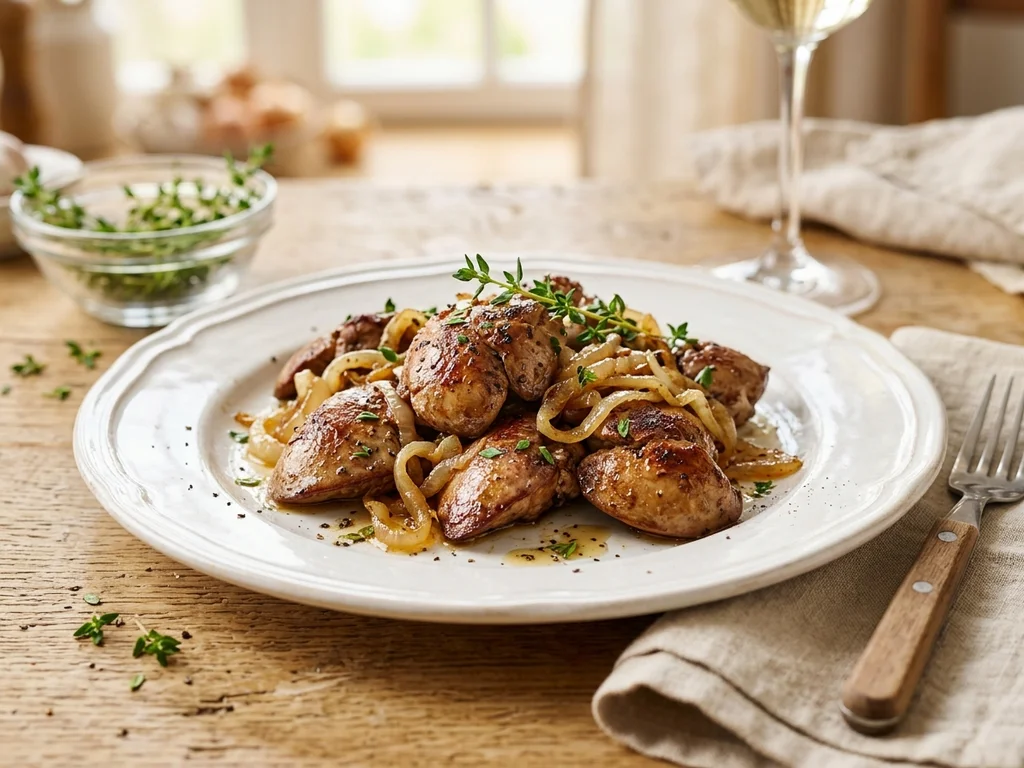
Avian Visceral Architecture: Bilobed Hepatic Lobes & Bile Trimming
In the domestic broiler chicken (Gallus gallus domesticus), the liver is a large, deep reddish-brown organ situated ventral to the proventriculus and spleen. Unlike skeletal locomotor cuts (such as drumsticks and wings) which are structured with striated muscle fascicles and connective collagen sheaths, chicken liver is composed of dense hepatic parenchyma. This cellular architecture gives cooked liver its exceptionally tender, buttery mouthfeel.
Chicken Liver Nutrition, Vitamin A & Iron Calculator
Your selected 100g portion logs 4200 mcg RAE of preformed vitamin A (467% DV). Logging chicken liver 1 to 2 times weekly in 75–100g portions is a common pattern when tracking organ meat alongside the IOM 3,000 mcg RAE/day upper-limit reference.
Official USDA Nutrition Facts Label (Per 100g)
Nutrition Facts
Micronutrient Content in Hepatic Tissue (Per 100g)
Chicken liver concentrates fat-soluble retinol, B-complex vitamins, iron, and choline in USDA tables — values far higher per 100g than skinless breast (FDC #171477). Food-composition figures for journaling only.
Iron & B-Vitamin Density (Food-Composition Note)
Cooked chicken liver lists 11.6–12.9mg iron, 16.8–21.1mcg B12, and 560–720mcg folate per 100g in USDA tables (FDC #171061–#174491). Literature sources note higher typical absorption for animal iron versus plant non-heme iron — food-composition values for journaling only.
Chicken Liver Cooking Temperature & Doneness Guide
Chicken liver cooks quickly. Undercooking leaves a cold core below the USDA FSIS poultry minimum, while overcooking past 175°F (79°C) can dry and toughen the texture. The common 160°F pull with a 3-minute carryover rest targets a 165°F core with a tender, blush-pink center.
160°F (71°C) — Chef's Pull Point (Blush Pink)
Common culinary pull point. Removing livers from the skillet at 160°F allows carryover heat during a 3-minute tented rest to reach the USDA FSIS 165°F (74°C) core target without toughening delicate proteins.
A CDC/MMWR investigation of chicken liver pâté outbreaks (Ohio and Oregon, 2012) linked cases to products where the interior core did not reach 165°F (74°C). Because organ tissue is not surface-only like a thin cutlet, verify core temperature with a thermometer — color alone is unreliable.
Exterior searing turns deep mahogany within 90 seconds while the interior may remain cold. Insert a fast-response instant-read thermometer horizontally into the thickest center of the largest lobe. Pull from the pan at 160°F (71°C), cover with foil, and rest 3 minutes before serving or logging your portion weight.
Vitamin A Retinol, Iron & Weekly Portion Planning
Chicken liver lists high concentrations of preformed vitamin A (retinol) and iron in USDA FoodData Central. Plant foods like carrots supply beta-carotene that must be converted to retinol; liver provides retinol directly. These are food-composition figures for journaling — not dietary guidance.
Plants provide provitamin A carotenoids (beta-carotene) converted by the BCMO1 enzyme — conversion efficiency varies. Chicken liver lists preformed retinyl esters (FDC #171061: ~3,981 mcg RAE/100g simmered; FDC #174491: ~4,296 mcg RAE/100g pan-fried).
The Institute of Medicine sets a tolerable upper intake level of 3,000 mcg RAE (10,000 IU) per day for preformed retinol — used on many Nutrition Facts labels. A 100g cooked portion can exceed that reference on paper, so spacing portions across the week simplifies daily journal totals.
Cooked chicken liver lists 11.6–12.9mg iron per 100g (FDC #171061–#174491). USDA tables report total iron — not a separate heme-iron column. Literature sources cite higher typical absorption for animal heme iron versus plant non-heme iron (Hurrell & Egli, 2010).
A 100g cooked portion can log 442–477% of the 900 mcg RAE vitamin A Daily Value and may exceed the 3,000 mcg RAE IOM upper-limit reference in a single entry. If vitamin A is a column you track, use smaller portions (50–75g) or spread organ-meat entries across multiple days in your app.
Common meal-prep logging patterns for organ meat:
- Frequency: 1 meal (75g–100g) once or twice per week in many journals.
- Portion: 3 cooked lobes (~90g) log ~16–19 mcg B12 and ~10–12mg iron on USDA simmered/pan-fried scales.
- Pairing: Serve with vitamin C sources (lemon, peppers) if you also log plant iron in the same meal.
Chicken Liver vs. Beef Liver, Breast & Eggs
Chicken Liver vs. Beef Liver
Culinary Palatability vs. Extreme Copper Density (100g Cooked)Chicken liver is milder and softer in texture than beef liver — useful for pâtés and first-time organ-meat logging. USDA tables list nearly double the iron per 100g cooked (11.6mg vs ~6.5mg) with far less copper (~0.45mg vs ~14.6mg). Food-composition figures for journaling only.
Chef's Playbook: Milk Soaking, Flash Sauté & French Pâté
Eliminates metallic bitterness and leaves livers sweet and mild.
- Trim & Inspect: Remove connective sinew and inspect for green bile stains (slice away if present).
- Submerge in Cold Milk: Cover completely in whole milk or buttermilk in the refrigerator for 30 to 60 minutes.
- Discard & Dry: Discard the milk (do NOT cook with it). Pat livers thoroughly dry with paper towels to ensure a crisp sear.
High heat searing creates a golden crust while keeping the interior velvety.
- Smoking Hot Pan: Heat 1 tbsp butter and 1 tsp olive oil in cast iron over medium-high until shimmering.
- Single Layer Sear: Add livers without crowding. Sear undisturbed for 90–120 seconds per side with shallots and thyme.
- 160°F Pull & Rest: Pull at 160°F internal; tent with foil for 3 minutes for carryover heat to hit 165°F blush-pink perfection.
Transform nutrient-dense livers into an elegant, silk-smooth spread.
- Cognac Flambé: Deglaze the sauté skillet with 2 tbsp cognac or brandy and reduce until syrupy.
- High-Speed Emulsion: Blend warm livers, pan juices, shallots, and cubed softened butter in a food processor until glossy.
- Clarified Butter Seal: Pour into ramekins and top with a thin layer of melted clarified butter; chill 4+ hours.
Weekly Integration Blueprint & Freezer Preservation
Weekly Organ-Meat Logging: Three Meal-Prep Strategies
Dedicate one weeknight dinner to 100g of pan-seared chicken livers with caramelized onions and roasted vegetables — logs ~11–13mg iron on USDA simmered/pan-fried scales.
Prepare a small crock of smooth herb pâté on Sunday. Spread 1–2 tablespoons (~25g) on artisanal sourdough or seed crackers across the week.
Freeze cooked puréed liver in 30g silicone ice cube molds. Pop 1 cube into ground beef chili, tacos, or bolognese. 100% undetectable to children!
Because organ tissue has high moisture and enzymatic activity, fresh livers degrade faster than muscle cuts. Cook or freeze immediately.
Store in airtight glass containers. Reheat gently in a warm skillet with a splash of broth rather than microwaving.
A hardened layer of melted clarified butter poured over chilled pâté forms an airtight lipid seal that prevents oxidation and spoilage.
Divide bulk tubs into 100g single-meal portions. Flash freeze on parchment before vacuum-sealing to prevent freezer burn.
Always thaw frozen livers overnight in the refrigerator. Never thaw in warm water or microwave, which starts cooking delicate surface albumins prematurely.
Finished chicken liver mousse freezes remarkably well. Wrap ramekins tightly in plastic wrap and heavy foil; thaw in the fridge 24 hours before serving.
Frequently Asked Questions: Chicken Liver Nutrition & Safety
Academic Citations & USDA FoodData Central References
U.S. Department of Agriculture, Agricultural Research Service. Chicken, liver, all classes, raw. FoodData Central (FDC ID: 171060).
View SourceRaw liver anchor: 119 kcal, 16.9g protein, 4.8g fat, 8.99mg iron, 3,296 mcg RAE vitamin A per 100g.
U.S. Department of Agriculture, Agricultural Research Service. Chicken, liver, all classes, cooked, simmered. FoodData Central (FDC ID: 171061).
View SourceSimmered cooked anchor: 167 kcal, 24.5g protein, 6.5g fat, 11.6mg iron, 3,981 mcg RAE vitamin A, 16.85 mcg B12 per 100g.
U.S. Department of Agriculture, Agricultural Research Service. Chicken, liver, all classes, cooked, pan-fried. FoodData Central (FDC ID: 174491).
View SourcePan-fried cooked anchor: 172 kcal, 25.8g protein, 6.4g fat, 12.9mg iron, 4,296 mcg RAE vitamin A, 21.1 mcg B12 per 100g.
Institute of Medicine (US) Panel on Micronutrients. (2001). Dietary Reference Intakes for Vitamin A, Vitamin K, Arsenic, Boron, Chromium, Copper, Iodine, Iron, Manganese, Molybdenum, Nickel, Silicon, Vanadium, and Zinc. National Academies Press (US).
View SourceLabel reference: tolerable upper intake level of 3,000 mcg RAE (10,000 IU) per day for preformed retinol.
USDA Food Safety and Inspection Service. (2024). Leftovers and Food Safety.
View SourceKitchen reference: refrigerate cooked poultry within 2 hours and use leftovers within 3–4 days.
Lanier, W. A., Hall, J. M., Herlihy, R. K., et al. (2014). Outbreak of Campylobacter jejuni infections associated with chicken liver pâté — Ohio and Oregon, 2012. Morbidity and Mortality Weekly Report (MMWR), 63(34), 741–745.
View SourceOutbreak investigation underscoring that undercooked chicken liver pâté did not reach 165°F (74°C) core temperature in linked cases.
Hurrell, R., & Egli, I. (2010). Iron bioavailability and dietary reference values. The American Journal of Clinical Nutrition, 91(5), 1461S–1467S.
View SourceLiterature context on heme vs non-heme iron absorption rates — supplementary to USDA food-composition tables for journaling.
Informational & journaling tool only
This page is a nutrition reference and personal awareness utility — not medical or dietary advice. Macro and micronutrient values are derived from USDA FoodData Central (FDC #171060, #171061, #174491) and IOM DRI label references. Chicken liver lists high preformed vitamin A (retinol) per 100g — check portion sizes when logging in your food journal. Always ensure internal core temperature reaches 165°F (74°C) with a calibrated digital thermometer. I am not a doctor.