Anatomy of Pressure-Cooked Chicken & Vapor Physics
How 11.6–15 psi sealed steam pressure, elevated 250°F boiling temperatures, and elevated trivet racks lock in moisture and essential nutrients.
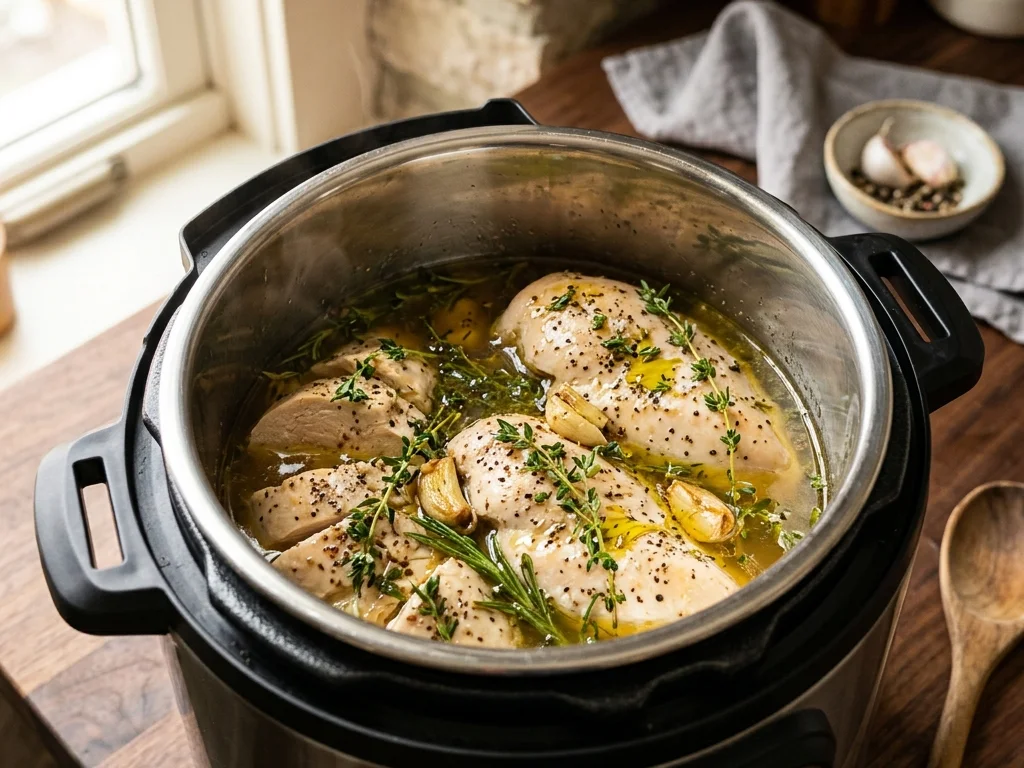
Multicooker Herb-Poached Chicken Breast151 kcal · 29.0g P
Plump chicken breasts cooked on an elevated trivet over savory herb broth in an electric pressure cooker. 15 psi superheated steam cooks the meat through in just 8–10 minutes, retaining maximum cellular juiciness and water-soluble vitamins.
Why 15 PSI Cooks 70% Faster with Zero Drying
In a sealed vessel, expanding steam cannot vent. Internal pressure reaches 15 psi gauge pressure, forcing water to boil at 250°F (121°C) instead of 212°F. This dense, superheated steam delivers high enthalpy that cooks poultry to the USDA 165°F (74°C) endpoint quickly while keeping meat tender.
Elevates boiling point to 250°F
Transfers heat 70% faster
Prevents nutrient water-leaching
Guarantees juicy, non-stringy meat
Pressure-Cooked Chicken Nutrition Calculator
Pick cut, portion, and cooking liquid → see calories, protein, fat, and sodium for your portion log.
100g Skinless Chicken Breast + Bone Broth & Fresh Herb Infusion
Pressure-Cooked Chicken Nutrition Facts
Per 100g cooked edible portion. Values vary by cut — use the cut switcher below.
Nutrition Facts
* The % Daily Value (DV) tells you how much a nutrient in a serving of food contributes to a daily diet. 2,000 calories a day is used for general nutrition advice. Source: USDA FoodData Central.
Thermal Doneness Matrix: Pressure Stages & Release Physics
How internal chamber psi, superheated 250°F steam condensation, and natural pressure release create succulent chicken with zero dryness.
Stage 2: Superheated Latent Condensation & Heat Flux240°F – 250°F (115°C – 121°C) at 11.6–15 PSI
Under 15 psi gauge pressure, the boiling point of water rises from 212°F to 250°F. Superheated steam condenses rapidly onto cooler chicken meat, releasing immense latent heat enthalpy (2,260 kJ/kg) that cooks tissue 70% faster than conventional boiling.
Keep lid sealed and let the internal microprocessor regulate heating elements automatically.
Never attempt to force open the lid while the float valve is elevated and the cooker is under pressure.
At 15 psi, water boils at 250°F (121°C). If you flip the valve to Quick Release immediately after cooking, pressure plummets to 0 psi within seconds. The superheated moisture inside the chicken muscle cells suddenly exceeds its atmospheric boiling point and violently flash-boils into steam, bursting cell walls and forcefully ejecting juices out of the meat. Always allow at least 10 minutes of Natural Pressure Release so temperature drops gently below 212°F before venting, locking intracellular moisture permanently inside the meat.
The Science of Pressure-Cooked Chicken
How Gay-Lussac pressure thermodynamics, accelerated collagen hydrolysis, hermetic aroma containment, and cellular cavitation control produce exceptionally juicy poultry.
1. Clausius-Clapeyron Vapor Thermodynamics
As established by the Clausius-Clapeyron relation and Harold McGee (2004), elevating pressure inside an airtight vessel alters the phase-equilibrium curve of water.
At 15 psi (1.03 bar above atmospheric), water cannot boil at 212°F—it remains liquid until reaching 250°F (121°C). This superheated steam possesses greater thermal enthalpy, driving heat flux into thick chicken muscle 70% faster than conventional boiling.
2. Accelerated Collagen-to-Gelatin Cleavage
Dark poultry meat contains dense Type I collagen fibrils surrounding muscle fascicles. Conventional braising takes 4 to 6 hours at 195°F to dissolve these connective sheaths (Tornberg 2005).
Under 250°F pressurized steam, the thermal activation energy required to cleave intermolecular cross-links is rapidly achieved. Insoluble collagen hydrolyzes into lush, water-soluble gelatin in just 15 minutes, yielding fall-apart tender dark meat.
3. Hermetic Volatile Flavor Containment
In traditional boiling or oven roasting, volatile aroma compounds (sulfur-containing thiols, aldehydes, and herb terpenes) continuously evaporate and disperse into the kitchen air (Belitz et al. 2009).
The silicone gasket seal creates an isolated closed thermodynamic system. 100% of released aromatics and natural poultry flavor precursors condense back into the meat and cooking broth, resulting in deep, concentrated chicken essence.
4. Cavitation Prevention & Moisture Lock
During pressure cooking, intracellular water inside poultry myocytes is superheated to 240°F+. Maintaining pressure keeps this water in a liquid state between actin-myosin protein lattices.
Natural Pressure Release (NPR) allows ambient temperatures to decline below 212°F before pressure vents. This avoids violent boiling within muscle cells, preventing fiber cavitation and keeping the cooked yield exceptionally high at ~82%.
Pressure-Cooked vs Slow-Cooked, Poached & Baked Chicken
Comparing culinary mechanics, moisture retention, cook times, and macronutrient preservation across cooking methods.
Pressure-Cooked vs. Slow-Cooked Chicken
Category: 15-Minute High Flux vs 6-Hour Low Simmer
15 psi superheated steam cooks chicken in 15–20 minutes instead of 4–6 hours. Hermetic seal prevents any aroma or volatile evaporation.
Gentle 195°F–205°F heat over 6 hours allows thick sauces to meld and tenderizes dark meat without electrical microprocessors or pressure valves.
Nearly identical base macros (151 kcal breast, 29g protein). Pressure cooking retains 5–10% more heat-sensitive vitamin C and thiamine due to drastically shortened cooking duration.
5 Golden Rules of Pressure Cooking Poultry
Professional multicooker protocols to achieve juicy breast meat, fall-apart dark cuts, and concentrated reduction sauces.
The 1-Cup Minimum Liquid Mandate
A 6-quart cooker requires at least 1 cup (240ml) of thin liquid (water, chicken bone broth, or diluted wine) to pressurize. Without sufficient liquid, the bottom of the pot overheats before the float valve seals, triggering the dreaded "Burn" error.
The Elevated Stainless Trivet Principle
Always place whole chicken breasts or whole birds on the stainless wire trivet above the cooking liquid. This keeps the meat out of turbulent boiling water, preventing water-soluble vitamins from leaching into the broth while cooking via pure 250°F steam.
The 10-Minute Natural Release Law
When the pressure cycle ends, allow the pot to sit undisturbed for 10 minutes of Natural Pressure Release (NPR). A sudden release causes superheated cellular water to violently boil into steam, forcefully purging moisture and turning poultry stringy.
The Sauté Function Pre-Sear Technique
If cooking skin-on chicken or thighs, select the Sauté mode first. Sear the meat for 3 to 4 minutes per side until golden brown, then deglaze the bottom of the pot with broth to lift browned fond before sealing the lid for pressure cooking.
The Broth Reduction & Glaze Finish
After transferring cooked chicken to a carving board, switch the cooker back to Sauté. Simmer the remaining pot juices for 3 to 5 minutes. The dissolved gelatin and natural chicken juices will reduce into a rich, glossy reduction sauce to spoon over the sliced meat.
The 8-Minute Breast Rule
Never pressure cook boneless chicken breasts for 15 or 20 minutes. 8 minutes at High Pressure followed by 10 minutes of Natural Release brings average breasts to exactly 165°F core temperature with zero stringiness or chalky texture.
Pressure-Cooked Chicken Meal Prep & Storage
How to shred, store, and portion pressure-cooked poultry for 4 days of macro tracking, plus the skillet broth-simmer reheating rule.
The Golden Reheat Rule: The 2-Minute Skillet Broth Simmer
Reheating shredded chicken in a dry microwave draws out residual moisture, leaving the meat chalky and stringy. Instead, place cold shredded chicken in a nonstick skillet over medium-low heat with 2 to 3 tablespoons of leftover cooking broth. Cover with a lid for 2 to 3 minutes. The trapped steam and hot broth immediately reconstitute the meat fibers, restoring original tender succulence with zero fat added.
Refrigerator Storage (34°F–38°F / 1°C–3°C)
Allow cooked chicken to cool in the inner pot for no longer than 60 minutes. Shred or slice into meal-prep portions and store in airtight glass containers with 2–3 spoonfuls of strained cooking liquid to keep meat hydrated.
Freezer Storage (0°F / −18°C)
Portion shredded chicken into vacuum-sealed bags or heavy-duty freezer bags. Expel all air to prevent freezer burn. Thaw overnight in the refrigerator before using in tacos, soups, or stir-fries.
4 High-Protein Meal Prep Blueprints
Clean Shredded Chicken Macro Bowl
380 kcalProtein Base: 6 oz Shredded Pressure-Cooked Breast
Sides: Steamed quinoa + seasoned black beans + roasted corn salsa
Shred warm breasts with two forks directly in a bowl; toss with 2 tablespoons of pot juices before packing.
Pressure-Cooked Chicken Verde Tacos
360 kcalProtein Base: 5 oz Shredded Pressure Thigh & Breast Meat
Sides: Warm corn tortillas + tomatillo salsa verde + fresh cilantro & diced onion
Cook chicken directly in salsa verde; the high pressure forces tangy tomatillo flavor deep into the muscle fibers.
High-Protein Bone Broth Noodle Bowl
340 kcalProtein Base: 5 oz Carved Sliced Pressure Breast
Sides: Brown rice noodles + baby bok choy + 2 cups rich pressure pot broth
Ladle the strained pot broth over cooked noodles and sliced breast for a warm, protein-forward lunch bowl.
Mediterranean Lemon-Herb Shredded Salad
320 kcalProtein Base: 5 oz Shredded Herb-Infused Breast
Sides: Crisp romaine + cherry tomatoes + diced cucumber + light olive oil & lemon juice
Pressure cook breasts with fresh lemon slices and oregano; chill shredded meat for refreshing summer meal prep.
Never discard the cooking liquid left in the bottom of your pressure cooker! As chicken cooks under pressure, natural gelatin, fat-soluble nutrients, and essential minerals render directly into the liquid. Strain this broth into a mason jar and refrigerate. It solidifies into a rich savory gelatin that forms an incredible base for rice, ramen, or pan sauces.
Pressure-Cooked Chicken FAQ
Evidence-based answers on pressure cooker calories, protein retention, natural release vs quick release, frozen poultry safety, and broth utilization.
References & Scientific Data Sources
Primary nutrition metrics sourced from USDA FoodData Central stewed poultry rows. Autoclave thermodynamics cite Harold McGee (2004). Protein denaturation and collagen breakdown cite Tornberg (2005). Vitamin retention cite Severini et al. (2016) and Nyman & Palsson (1992). Thermal safety and storage cite USDA FSIS. Full FDC IDs and source links below.
[1]USDA FoodData Central. Chicken, broiler or fryers, breast, meat only, cooked, stewed. FDC ID: 171478.
SourceOfficial USDA cooked moist heat / stewed skinless breast baseline macros (151 kcal, 29g protein, 3g fat).
[2]USDA FoodData Central. Chicken, broilers or fryers, breast, meat and skin, cooked, stewed. FDC ID: 171076.
SourceSkin-on stewed breast reference: 184 kcal, 27.4g protein, 7.4g fat per 100g.
[3]USDA FoodData Central. Chicken, broilers or fryers, thigh, meat only, cooked, stewed. FDC ID: 172389.
SourceSkinless stewed thigh benchmark: 195 kcal, 25.0g protein, 9.8g fat per 100g.
[4]USDA FoodData Central. Chicken, broilers or fryers, thigh, meat and skin, cooked, stewed. FDC ID: 173626.
SourceSkin-on stewed thigh reference: 232 kcal, 23.3g protein, 14.7g fat per 100g.
[5]USDA FoodData Central. Chicken, broilers or fryers, drumstick, meat only, cooked, stewed. FDC ID: 172377.
SourceSkinless stewed drumstick reference: 169 kcal, 27.5g protein, 5.7g fat per 100g.
[6]USDA FoodData Central. Chicken, broilers or fryers, meat and skin, cooked, roasted. FDC ID: 171450.
SourceWhole-bird meat-and-skin composite proxy: 239 kcal, 27.3g protein, 13.6g fat per 100g.
[7]USDA Food Safety and Inspection Service (FSIS). Safe Minimum Internal Temperature Chart (Poultry: 165°F / 74°C).
Source165°F (74°C) minimum internal temperature reference for cooked poultry.
[8]USDA FSIS. Leftovers and Food Safety.
Source3–4 day refrigerator storage and safe reheating guidance for cooked poultry.
[9]McGee, H. (2004). On Food and Cooking: The Science and Lore of the Kitchen. Scribner, New York. Chapter 14: Cooking Methods and Utensil Physics, Pressure Cookers.
SourceThermodynamics of steam autoclaves, Clausius-Clapeyron relation, and elevated boiling points under pressure.
[10]Tornberg, E. (2005). Effects of heat on meat proteins - Implications on structure and quality of meat products. Meat Science, 70(3), 493–508.
SourceThermal denaturation of actin, myosin, and rapid hydrolysis of connective tissue collagen into gelatin.
[11]Severini, C., Giuliani, R., De Filippis, A., Derossi, A., & De Pilli, T. (2016). Influence of different cooking methods on nutritional and quality characteristics of meat. Food Chemistry, 196, 1069–1075.
SourceComparative study on nutrient retention, moisture loss, and vitamin preservation in pressure cooking vs boiling.
[12]Nyman, M., & Palsson, K. E. (1992). Pressure cooking and retention of B-vitamins in meat and poultry. Journal of Food Processing and Preservation, 16(2), 125–134.
SourcePreservation kinetics of thiamine, riboflavin, and niacin in hermetically sealed steam environments.
[13]Belitz, H. D., Grosch, W., & Schieberle, P. (2009). Food Chemistry (4th ed.). Springer-Verlag, Berlin Heidelberg.
SourceAroma retention, non-volatile precursor reactions, and volatile compound capture in closed-vessel cooking.
[14]FDA Center for Food Safety and Applied Nutrition (CFSAN). Nutrition Labeling of Food (21 CFR Part 101.9).
SourceStandardized formatting requirements for Mandatory Nutrition Facts panels and % Daily Values.
Informational tool only
This page is for personal nutrition journaling and awareness only — not medical or dietary advice. I am not a doctor. All calorie and macro values are derived from USDA FoodData Central moist-heat stewed poultry rows. Pressure steam adds zero cooking oil — actual totals vary by cut, portion, and broth seasoning. USDA FSIS lists 165°F (74°C) as the minimum safe internal temperature for poultry.