Anatomy of Smoked Chicken & Convective Airflow
How indirect convective hardwood smoke, moisture-buffering water pans, and nitric oxide gas diffusion create tender meat with an iconic pink smoke ring.
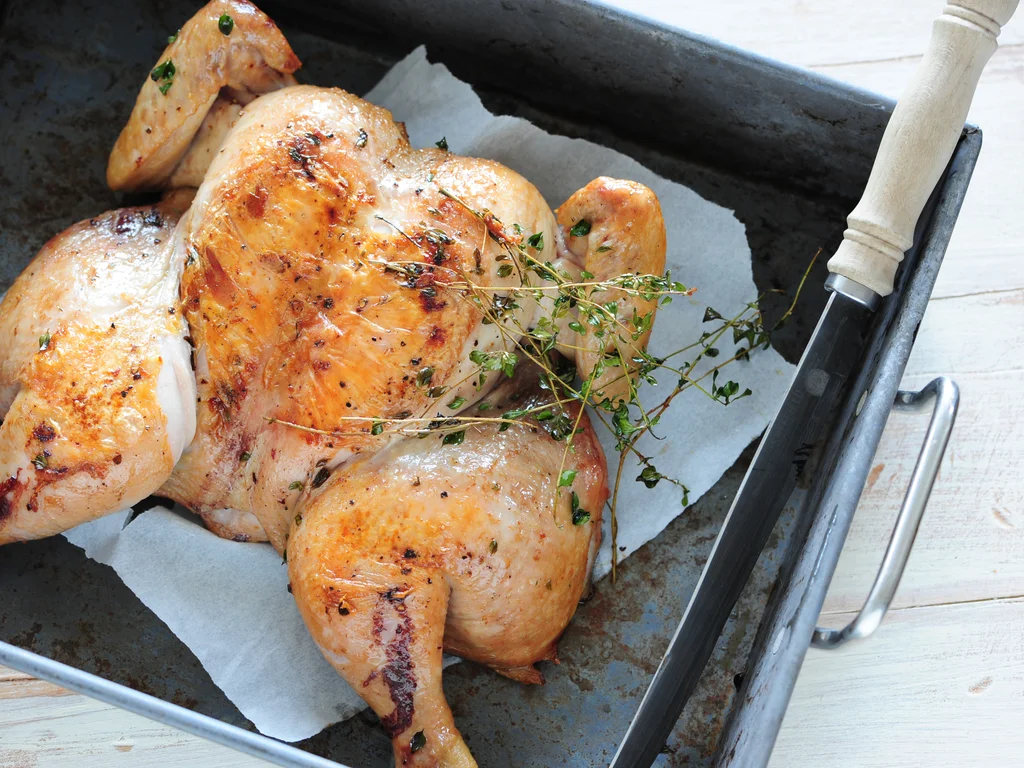
Whole Spatchcock Smoked Broiler239 kcal · 27.3g P
Butterflied whole chicken smoked over applewood and pecan logs. Spatchcocking flattens the carcass for uniform 360° convective heat exposure, allowing the breast core to coast to 165°F while dark thighs tenderize to 175°F+.
Why Low-and-Slow Convection Preserves Juiciness
Air enters the firebox intake, combusts hardwood coals into clean heat, and draws across the cook chamber. Nitrogen monoxide (NO) gas bonds with cold meat myoglobin before 140°F, fixing the permanent 2–8mm pink smoke ring.
225°F–250°F indirect heat
Maintains humidity & tenderness
Myoglobin bonding before 140°F
Sweet aromatics, zero bitter creosote
Smoked Chicken Nutrition Calculator
Pick cut, portion, and rub style → see calories, protein, fat, and sodium for your portion log.
100g Skinless Chicken Breast + Texas Dalmatian Rub
Smoked Chicken Nutrition Facts
Per 100 g cooked edible portion using roasted USDA proxy rows. Values vary by cut — use the switcher below.
Nutrition Facts
* The % Daily Value (DV) tells you how much a nutrient in a serving of food contributes to a daily diet. 2,000 calories a day is used for general nutrition advice. Data source: USDA FoodData Central roasted proxy (FDC #171477).
Thermal Doneness Matrix: Smoker Temperatures & Internal Stages
How convective hardwood smoke, myoglobin chemical binding, and internal core temperatures create succulent barbecue with a distinct pink smoke ring.
Stage 3: USDA Minimum Breast Pull Reference160°F – 165°F (71°C – 74°C) · Internal breast probe monitoring
Actin proteins coagulate and tighten. Pushing white breast meat well beyond 165°F expels bound intracellular water, leading to chalky texture.
Pull white breast meat at 160°F–162°F. Carryover heat during a 10-minute rest typically coasts the core to the USDA FSIS 165°F minimum.
Verify with an instant-read probe in the thickest part of the breast. Do not pull poultry below 160°F if you plan to rest and serve immediately.
Not all smoke is beneficial. When wood chunks burn with restricted oxygen, smoldering produces thick white smoke packed with heavy tars and unburned soot (creosote), giving chicken a bitter, numbing taste. To achieve sweet, aromatic pitmaster flavor, always provide ample intake airflow so combustion generates clean, translucent thin blue smoke rich in pleasant syringol and guaiacol volatile phenolics.
The Science of Smoked Chicken
How hardwood combustion gases, myoglobin binding kinetics, lignin pyrolysis, and collagen hydrolysis create tender meat with a signature pink smoke ring.
1. The Nitric Oxide Smoke Ring Reaction
As documented by food scientist Harold McGee (2004) and Dr. Greg Blonder (2012), the pink band under smoked chicken skin is not undercooked meat. It is a stable biochemical pigment formed by combustion gases.
Nitric oxide (NO) and carbon monoxide (CO) diffuse into the outer 2–8mm of cold poultry muscle. NO binds with raw deoxymyoglobin, fixing it into heat-stable nitrosylmyoglobin. When cooked past 140°F, this complex resists turning into brown metmyoglobin, locking in the vivid pink smoke ring.
2. Hardwood Pyrolysis & Lignin Aromatics
Hardwood logs comprise roughly 50% cellulose, 25% hemicellulose, and 25% lignin. Thermal decomposition of lignin at 225°F–250°F yields a complex bouquet of volatile phenolic compounds (Maga 1987).
Syringol provides the sweet, fragrant woodsy aroma of barbecue smoke, while Guaiacol contributes the spicy, pungent, campfire flavor. Proper firebox airflow ensures complete combustion, preventing bitter creosote formation.
3. Low-and-Slow Collagen Hydrolysis
Dark meat thighs and drumsticks are rich in dense Type I collagen fibrils surrounding muscle bundles and joint attachments. Fast searing can leave these connective tissues tough and chewy.
Extended exposure to 225°F–250°F gentle convective heat allows internal temperatures to reach 175°F–185°F, slowly hydrolyzing insoluble collagen into silky, moisture-retaining gelatin that bathes muscle fibers in succulent tenderness.
4. Pellicle Formation & Smoke Adhesion
Smoke is an aerosol of microscopic solid particles and liquid droplets suspended in hot gases. If chicken skin or flesh is dripping wet, smoke particles wash off or dissolve into pools of liquid, causing streaking.
Air-drying chicken uncovered in the refrigerator forms a tacky, semi-dry protein film known as the pellicle. This tacky matrix acts as microscopic Velcro, capturing smoke aerosols evenly to build an aromatic, mahogany-hued barbecue bark.
Smoked vs Grilled, Rotisserie & Baked Chicken
Comparing culinary mechanics, moisture retention, smoke compounds, and macro efficiency across cooking methods.
Smoked vs. Charcoal-Grilled Chicken
Category: Indirect Convection vs Direct High Sear
Gentle 225°F indirect convection slowly softens collagen in dark meat without scorching the exterior. Can produce a pink smoke ring from wood combustion gases.
High direct 450°F–500°F radiant heat triggers intense Maillard browning in 12–15 minutes, producing grill marks and crisp skin.
Nearly identical base macros for skinless breast (~165 kcal, ~31 g protein per 100 g cooked). Smoking often loses slightly more moisture (~33%) than grilling (~28%), concentrating protein per gram.
5 Golden Rules of Smoking Poultry
Professional smokehouse techniques to achieve mahogany bite-through skin, tender juicy meat, and a distinct pink smoke ring.
The Spatchcock Butterfly Technique
Use heavy poultry shears to cut out the backbone, then press firmly on the breastbone until it cracks flat. Spatchcocking ensures the flat carcass receives uniform convective airflow, cutting smoking time in half and cooking breasts and thighs at the same rate.
The Dry-Brine & Pellicle Formation Law
Season raw chicken generously with kosher salt and refrigerate uncovered on a wire rack for 8 to 24 hours. The salt dissolves into the muscle fibers, while circulating cold air desiccates surface proteins into a tacky pellicle lacquer that captures wood smoke aerosols.
The "Thin Blue Smoke" Standard
Always maintain clean, efficient hardwood combustion with wide-open exhaust dampers. You want faint, shimmering, translucent blue smoke containing sweet syringol and guaiacol phenolics—never thick white billowing smog that deposits bitter creosote.
Strategic Hardwood Species Pairing
Opt for mild fruitwoods like Applewood and Cherrywood, which impart sweet floral aromatics and a deep mahogany sheen. For classic Southern barbecue flavor, blend with Pecan or Hickory. Avoid heavy, resinous mesquite, which easily overpowers chicken.
Dual-Zone Orientation & Carryover Rest
In an offset or kettle smoker, orient the denser dark meat thighs toward the heat source so they push to 175°F–185°F to melt tough collagen. Pull breasts when internal core reaches 160°F–162°F; a 10-minute rest will coast them safely to 165°F without drying.
The 162°F Breast Pull Guarantee
Many cooks pull breasts at 160°F–162°F rather than waiting for 165°F in the smoker. Thermal inertia from 225°F convection often adds 3°F–5°F during a 10-minute foil tent rest, reaching the USDA FSIS 165°F reference while keeping white meat juicier.
Smoked Chicken Meal Prep & Storage
How to carve, store, and portion smoked poultry for 4 days of macro tracking, plus the gentle broth-tent reheating rule that prevents dry rubberiness.
The Golden Reheat Rule: The 325°F Gentle Broth-Tent Method
Microwaving cold smoked chicken violently boils internal moisture, turning tender protein strands into rubbery, chewy fibers. Instead, wrap sliced chicken loosely in an aluminum foil packet with 1 to 2 tablespoons of chicken broth or apple cider. Warm in an oven or air fryer at 325°F (163°C) for 10 to 12 minutes. The enclosed aromatic steam rehydrates the meat without washing off the pepper bark or drying out the core.
Refrigerator Storage (34°F–38°F / 1°C–3°C)
Allow smoked chicken to cool to room temperature (no longer than 90 minutes). Carve into meal-sized portions and store in airtight glass containers to preserve moisture and prevent refrigerator odor absorption.
Freezer Storage (0°F / −18°C)
Shred or slice cooked chicken and pack into vacuum-seal bags or freezer bags with air thoroughly expelled. Thaw overnight in the refrigerator before using in soups, chili, grain bowls, or tacos.
4 High-Performance Meal Prep Blueprints
Pitmaster High-Protein Macro Box
340 kcalProtein Base: 6 oz Sliced Smoked Skinless Breast
Sides: Roasted sweet potato cubes + grilled asparagus spears
Carve breast lobes across the grain once rested; pack tightly with roasted vegetables for clean portion tracking.
Pulled Smoked Dark Meat Tacos
390 kcalProtein Base: 5 oz Shredded Smoked Thigh & Drumstick Meat
Sides: Warm corn tortillas + fire-roasted salsa verde + lime & fresh cilantro
Shred dark meat while warm; natural gelatin in thigh shreds melts into tortillas upon gentle reheating.
Low-Carb Smoked BBQ Chopped Salad
360 kcalProtein Base: 5 oz Carved Mahogany Smoked Breast
Sides: Crisp romaine hearts + diced avocado + pickled red onions + light vinaigrette
Pack dressing separately; crisp greens and crunchy onions provide refreshing contrast to smoky barbecue chicken.
High-Protein Smoke & Grain Bowl
420 kcalProtein Base: 6 oz Smoked Skinless Breast Strips
Sides: Steamed quinoa + black beans + roasted bell peppers + salsa
Balanced macro bowl for portion logging — log chicken, grains, and beans separately for accurate totals.
Never throw away the bones and carcass from a whole smoked chicken! Simmer the smoked bones, cartilage, and wingtips with an onion, celery, and peppercorns for 3 to 4 hours. The hardwood smoke and dissolved collagen yield an extraordinary, amber-hued bone broth that adds rich barbecue depth to soups, stews, and grains.
Smoked Chicken FAQ
Answers on smoked chicken calories, the pink smoke ring, internal temperature references, wood species selection, storage timing, and reheating for meal-prep logging.
References & Scientific Data Sources
Nutrition data uses USDA roasted poultry proxy rows (FDC #171477, #172388, #171450) because SR Legacy has no separate cooked-smoked entries. Wood smoke chemistry cites Harold McGee (2004) and Greg Blonder (2012). Hardwood pyrolysis phenolics cite J. A. Maga (1987) and Guillén & Manzanos (2002). Internal temperature references cite USDA FSIS.
[1]U.S. Department of Agriculture, Agricultural Research Service. Chicken, broilers or fryers, breast, meat only, cooked, roasted. FDC ID: 171477.
SourceSkinless breast logging proxy for smoked poultry: 165 kcal, 31 g protein, 3.6 g fat per 100 g.
[2]U.S. Department of Agriculture, Agricultural Research Service. Chicken, broilers or fryers, thigh, meat only, cooked, roasted. FDC ID: 172388.
SourceSkinless thigh logging proxy: 179 kcal, 24.7 g protein, 8.2 g fat per 100 g.
[3]U.S. Department of Agriculture, Agricultural Research Service. Chicken, broilers or fryers, meat and skin, cooked, roasted. FDC ID: 171450.
SourceWhole bird blend logging proxy: 239 kcal, 27.3 g protein, 13.6 g fat per 100 g.
[4]USDA Food Safety and Inspection Service (FSIS). Safe Minimum Internal Temperature Chart (Poultry: 165°F / 74°C).
SourceUSDA minimum internal temperature reference for cooked poultry products.
[5]McGee, H. (2004). On Food and Cooking: The Science and Lore of the Kitchen. Scribner, New York.
SourceWood smoke chemistry, myoglobin color changes, and heat effects on poultry muscle.
[6]Maga, J. A. (1987). Smoke in Food Processing. CRC Press, Boca Raton, FL.
SourceVolatile aromatic phenol fractions (guaiacol, syringol) from hardwood pyrolysis.
[7]Blonder, G. (2012). The Science of the Smoke Ring. AmazingRibs.com.
SourceCombustion gases (NO, CO), surface moisture, and smoke ring formation on barbecued meats.
[8]Guillén, M. D., & Manzanos, M. J. (2002). Study of the volatile composition of an aqueous oak smoke preparation. Food Chemistry, 79(3), 283–292.
SourceChemical characterization of hardwood smoke condensates and phenolic compounds.
[9]FDA Center for Food Safety and Applied Nutrition. Nutrition Labeling of Food (21 CFR Part 101.9).
SourceDaily Reference Values (DRV) and Reference Daily Intakes (RDI) for nutrition label formatting.
Informational tool only
This page is for personal nutrition journaling and awareness only — not medical or dietary advice. I am not a doctor. All calorie and macro values use USDA FoodData Central roasted poultry proxy rows (FDC #171477, #172388, #171450) — SR Legacy has no separate cooked-smoked entries. Natural hardwood smoke adds zero calories or fat; totals vary by cut, portion, and rub sugar content. USDA FSIS lists 165°F (74°C) as the minimum internal temperature reference for poultry — for kitchen awareness only, not medical guidance.