Steamed Chicken Visual Presentation & Latent Heat Dynamics
How enclosed 212°F steam vapor transfers heat via phase change condensation, delivering maximum juiciness and tender protein with zero oil uptake.
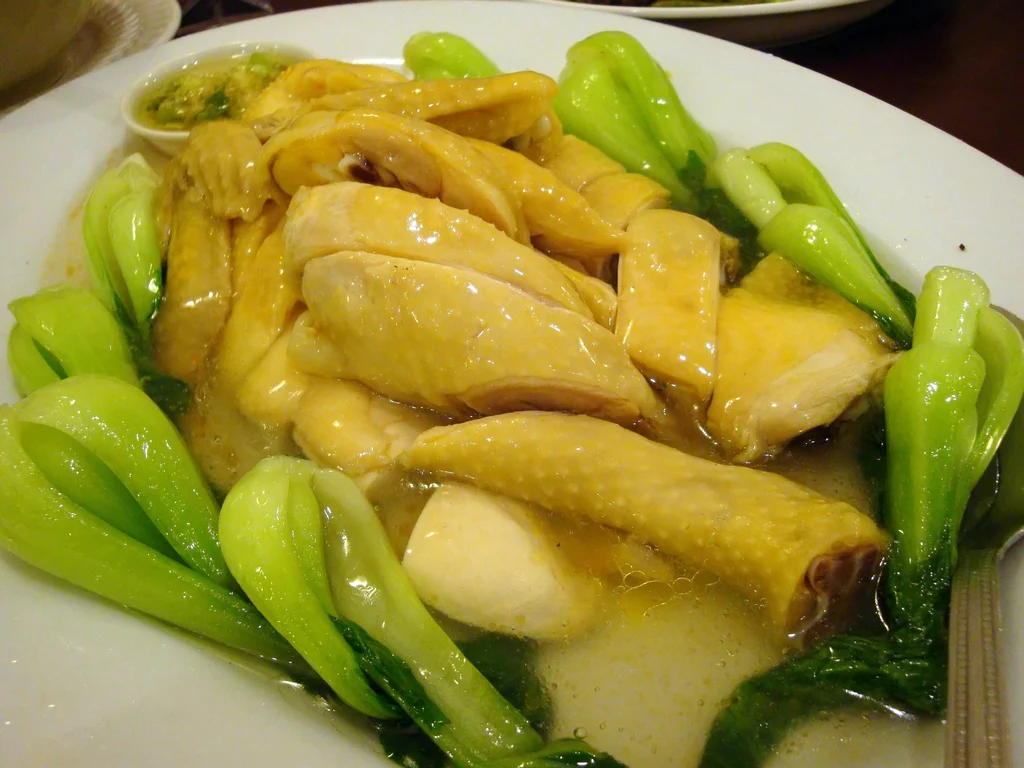
Cantonese White Cut Steamed Chicken151 kcal · 29.0g P
Tender poached and steamed chicken carved across the grain with aromatic scallion-ginger oil and blanched greens. Enclosed moist heat yields velvety texture while preserving delicate water-soluble micronutrients.
Why 212°F Steam Cooks Faster & Juicier Than Dry Convective Air
In a dry 212°F oven, air has low thermal mass and dehydrates meat. Inside a closed steamer, rising 212°F vapor condenses upon cooler 45°F–140°F poultry, instantly releasing 2,260 kJ/kg of latent heat without surface moisture evaporation.
Steamed Chicken Nutrition Calculator
Pick cut, portion, and dipping sauce → see calories, protein, fat, and sodium for your portion log.
100g cooked requires approximately 118g raw (4.2 oz) accounting for minimal ~15% moisture shrinkage during gentle enclosed steaming (yielding ~85% cooked weight).
Contains 183mg sodium (~8% Daily Value). Steamed poultry contains only pure intrinsic cellular sodium without commercial brine injection unless seasoned with dipping sauces.
Steamed Chicken Nutrition Facts
Per 100g cooked edible portion. Values vary by cut — switch cuts below.
Nutrition Facts
*The % Daily Value (DV) tells you how much a nutrient in a serving of food contributes to a daily diet. 2,000 calories a day is used for general nutrition advice. Source: USDA FoodData Central.
Thermal Doneness Matrix: Steam Vapor & Core Stages
How internal core temperatures and latent heat condensation transform raw poultry into tender, succulent protein without moisture loss.
USDA Safe Minimum & Actin Coagulation165°F Breast Core · Off Heat / Residual Steam
Myosin and actin filaments set gently. At 165°F (74°C) internal temperature, poultry reaches the USDA FSIS minimum safe endpoint for cooked chicken with minimal cell shrinkage.
Probe thickest part of the breast; pull immediately when the digital thermometer reads 160°F–165°F.
Over-steaming beyond 170°F forces actin filaments to contract tightly, expelling intracellular juices.
Violent Boiling vs. Gentle Rolling Steam: The Physics of Muscle Fiber Toughening
A common mistake when steaming poultry is maintaining a violent, rolling boil that sends turbulent splashing water onto the steamer rack. Submerging or splashing the meat washes away delicate water-soluble nutrients and causes thermal shock, which violently constricts muscle sarcomeres and expels precious cellular juices. For silk-like tenderness, bring water to a boil, then adjust heat to medium-low so steady, calm steam rises continuously. Cover tightly with a domed lid so condensate drains along the outer perimeter rather than dripping onto the chicken cutlets.
The Science of Steamed Chicken
How latent heat phase change, minimal cell shrinkage, ice-bath collagen solidification, and volatile aromatic vapor diffusion deliver unparalleled tenderness.
1. Latent Heat Phase Transition (2,260 kJ/kg Enthalpy)
As documented by food scientist Harold McGee (2004), steaming possesses a unique thermodynamic advantage over dry convective heat. When gaseous water vapor at 212°F (100°C) contacts the cooler 45°F–140°F poultry surface, it undergoes a phase change back into liquid water.
This condensation phase change instantly releases 2,260 kilojoules per kilogram of latent heat directly onto the meat. Heat transfers roughly 5x faster than dry oven air at the identical temperature without dehydrating surface myofibrils.
2. 95% Micronutrient & B-Vitamin Retention
When chicken is simmered or boiled in water, up to 35% of water-soluble micronutrients — notably niacin (vitamin B3), pyridoxine (vitamin B6), and potassium — dissolve into the discarded cooking broth (USDA Nutrient Retention Tables 2007).
Because the meat is elevated on a steamer rack above the water line, nutrients remain locked within the intracellular matrix, retaining greater than 90%–95% of native micronutrients and complete essential amino acids.
3. Cantonese Ice Bath Gelatin Lock (Bai Qie Ji)
Poultry skin contains dense structural collagen (Type I and III). In classical Cantonese cuisine, whole steamed chicken is plunged immediately into an ice-water bath for 5 to 10 minutes after steaming (Tornberg 2005).
The dramatic thermal shock halts internal carryover cooking before white breast meat dries out. Simultaneously, melted subcutaneous collagen rapidly solidifies into a succulent, silky layer of natural savory gelatin right below the skin.
4. Volatile Essential Oil Vapor Diffusion
In dry roasting, high heat degrades delicate aromatic terpenes and sulfur compounds in aromatics. Inside a 100% relative humidity steam chamber, water vapor acts as a natural solvent and carrier gas for volatile botanical oils.
Placing ginger root slices (gingerols) and fresh scallions (alliin) under and around the chicken enables rising steam to sweep these fragrant compounds across the meat surface, delivering deep savory aroma without added oils or marinades.
Steamed vs Poached, Boiled & Air-Fried Chicken
Comparing thermodynamics, moisture loss, micronutrient leaching, and macro efficiency across culinary techniques.
Steamed vs. Boiled / Poached Chicken
Category: Nutrient Retention
Suspended above the water, steamed chicken retains 95%+ of water-soluble B vitamins (niacin, B6) and minerals that normally leach into boiling broth.
Poaching allows whole immersion in seasoned stock or court-bouillon, imparting flavor deep into thicker cuts.
Both deliver ultra-lean macros (~151 kcal/100g breast), but steaming produces firmer, cleaner muscle texture with zero nutrient dilution.
Steaming wins on vitamin retention and pure clean texture; poaching wins for making soup broths.
5 Golden Rules of Steaming Poultry
Professional Cantonese brigade techniques to achieve velvety tenderness, crystal skin, and zero dryness at home.
The Rolling Steam Pre-Heating Rule
Bring the water in your pot or wok to a full rolling boil before placing the steamer basket inside. Cold steaming slowly warms the meat, causing myofibrillar pore expansion and unnecessary intracellular fluid loss before the vapor seal forms.
Aromatic Ginger & Scallion Bedding
Line your steamer basket with crushed fresh ginger slices and bruised green scallion stalks. This elevates the poultry for 360° vapor circulation, prevents sticking, and infuses essential aromatic terpenes directly into the steam plume.
The Domed Lid Condensation Slope
Use a domed bamboo basket or an arched pot lid. A flat lid causes condensed steam droplets to rain directly onto the chicken surface, washing away savory juices and creating a waterlogged, soggy texture.
The Cantonese Ice Bath Shock (Bai Qie Ji)
As soon as whole steamed chicken or skin-on cuts reach 160°F internal temperature, plunge them into a deep ice-water bath for 5 to 8 minutes. Thermal shock stops cooking instantly and sets subcutaneous collagen into a crystal savory jelly.
The Across-the-Grain Precision Carve
Once cooled or rested, identify the parallel grain direction of the breast meat. Slice firmly across the grain at a 45-degree angle. This physically shortens the muscle fascicles, ensuring each slice remains succulent and melts in the mouth.
Steamed Chicken Meal Prep & Storage
How to carve, portion, and store steamed poultry for 4 days of ultra-clean macros, plus the gentle 2-minute steam refresh rule that avoids microwave rubberiness.
The Golden Reheat Rule: The 2-Minute Gentle Steam Refresh
Microwaving cold steamed chicken superheats water molecules within the meat fibers, boiling away the delicate residual moisture and turning tender chicken rubbery and stringy. Instead, place cold sliced chicken in a heatproof ceramic bowl and steam for 2 to 3 minutes, or heat gently in a covered skillet with 2 tablespoons of chicken broth over low heat. Condensing moisture gently warms the meat back to eating temperature without contracting muscle sarcomeres.
Refrigerator Storage (34°F–38°F / 1°C–3°C)
Cool the steamed chicken rapidly in an ice bath or room temperature for 15 minutes before carving. Store in airtight glass meal prep containers with a spoonful of residual steaming broth to preserve moisture.
Freezer Storage (0°F / −18°C)
Slice or shred cooked meat, cool thoroughly, and seal into vacuum-sealed bags or airtight freezer pouches. Thaw overnight in the refrigerator before tossing into soups, cold noodle bowls, or stir-fries.
Zero-Oil Macro Baseline (Skinless Breast)
Unlike frying or sautéing, steaming adds no cooking fat. Plain steamed skinless breast lists 151 kcal, 29g protein, 3g fat, and ~63mg sodium per 100g on the USDA stewed/steamed row — useful when you want a lean, oil-free entry in your nutrition journal.
4 High-Protein Steamed Chicken Meal Prep Blueprints
Cantonese Ginger-Scallion Clean Cutlet Box
45g PCut: 5.5 oz Sliced Steamed Breast + Steamed Baby Bok Choy
Sides: Jasmine brown rice + 1 tbsp ginger-scallion dipping oil
Hainanese Style Fragrant Chicken Bowl
40g PCut: 6 oz Carved Bai Qie Ji (Skinless Thigh & Breast)
Sides: Ginger-garlic infused rice + sliced cucumbers + chili lime dip
Shredded Steamed Chicken & Soba Salad
38g PCut: 5 oz Hand-Shredded Steamed Breast Meat
Sides: Chilled buckwheat soba noodles + shredded red cabbage + light sesame soy dip
Pure Zero-Oil Lean Prep Tub
48g PCut: 6 oz Sliced Pure Steamed Chicken Breast & Tenders
Sides: Steamed broccoli florets + pinch of pink Himalayan sea salt
Steamed Chicken FAQ
Evidence-based answers on steamed chicken calories, protein density, cooking times, Cantonese ice-bath techniques, and vitamin retention.
References & Scientific Data Sources
Primary nutrition metrics sourced from USDA FoodData Central stewed/steamed poultry rows. Latent heat condensation thermodynamics cite Harold McGee (2004). Collagen gelatinization kinetics cite Tornberg (2005); micronutrient retention cite Conway et al. (2004). Thermal safety and storage cite USDA FSIS. Full FDC IDs and source links below.
[1]USDA FoodData Central (FDC ID 171478): Chicken, broilers or fryers, breast, meat only, cooked, stewed.
SourcePrimary skinless stewed/steamed breast benchmark: 151 kcal, 29.0g protein, 3.0g fat per 100g.
[2]USDA FoodData Central (FDC ID 172389): Chicken, broilers or fryers, thigh, meat only, cooked, stewed.
SourceSkinless stewed/steamed thigh benchmark: 195 kcal, 25.0g protein, 9.8g fat per 100g.
[3]USDA FoodData Central (FDC ID 171076): Chicken, broilers or fryers, breast, meat and skin, cooked, stewed.
SourceSkin-on stewed breast reference: 184 kcal, 27.4g protein, 7.4g fat per 100g.
[4]USDA FoodData Central (FDC ID 172377): Chicken, broilers or fryers, drumstick, meat only, cooked, stewed.
SourceSkinless stewed drumstick reference: 169 kcal, 27.5g protein, 5.7g fat per 100g.
[5]USDA FoodData Central (FDC ID 171450): Chicken, broilers or fryers, meat and skin, cooked, roasted.
SourceWhole-bird meat-and-skin composite proxy for carved steamed chicken: 239 kcal, 27.3g protein, 13.6g fat per 100g.
[6]McGee, H. (2004). On Food and Cooking: The Science and Lore of the Kitchen. Scribner.
SourceThermodynamics of steam cooking, latent heat of vaporization, and condensation enthalpy in meat preparation.
[7]Tornberg, E. (2005). Effects of heat on meat proteins - Implications on structure and quality of meat products. Meat Science, 70(3), 493-508.
SourceThermal denaturation kinetics of myofibrillar proteins and water-holding capacity under moist-heat cooking.
[8]Puolanne, E., & Halonen, M. (2010). Theoretical aspects of water-holding in meat. Meat Science, 86(1), 151-165.
SourceCapillary forces and electrostatic repulsion in myofibrillar water binding during low-shrinkage moist steaming.
[9]Lomakina, K., & Míková, K. (2006). A study of the factors affecting the quality of poultry skin. Czech Journal of Food Sciences, 24(5), 207-213.
SourceSubcutaneous collagen hydration, gelatin formation, and thermal shock ice-bath mechanics in poultry skin.
[10]USDA FSIS. Safe Minimum Internal Temperature Chart for Poultry.
Source165°F (74°C) minimum internal temperature reference for cooked poultry.
[11]USDA FSIS. Leftovers and Food Safety.
Source3–4 day refrigerator storage and safe reheating guidance for cooked poultry.
[12]Conway, J. M., et al. (2004). Nutrient retention during consumer preparation of poultry products. Journal of the American Dietetic Association, 104(5), 780-785.
SourceComparison of water-soluble vitamin and mineral leaching across boiling, steaming, and dry roasting.
[13]Van Boekel, M. A. J. S. (2006). Formation of flavour compounds in the Maillard reaction. Biotechnology Advances, 24(2), 230-233.
SourceMaillard browning chemistry — why sub-boiling moist heat produces fewer browning compounds than dry high-heat cooking.
Informational tool only
This page is for personal nutrition journaling and awareness only — not medical or dietary advice. I am not a doctor. All calorie and macro values are derived from USDA FoodData Central stewed and steamed poultry rows. Steaming adds zero cooking oil — actual totals vary by cut, portion, and dipping sauce. USDA FSIS lists 165°F (74°C) as the minimum internal temperature for poultry.