Wok Stir-Fry Fluid Dynamics & Flash Conduction Mechanics
How extreme carbon-steel thermal conduction, oil droplet aerosolization (Wok Hei), and starch velveting preserve intracellular moisture while creating savory pyrazine crusts.
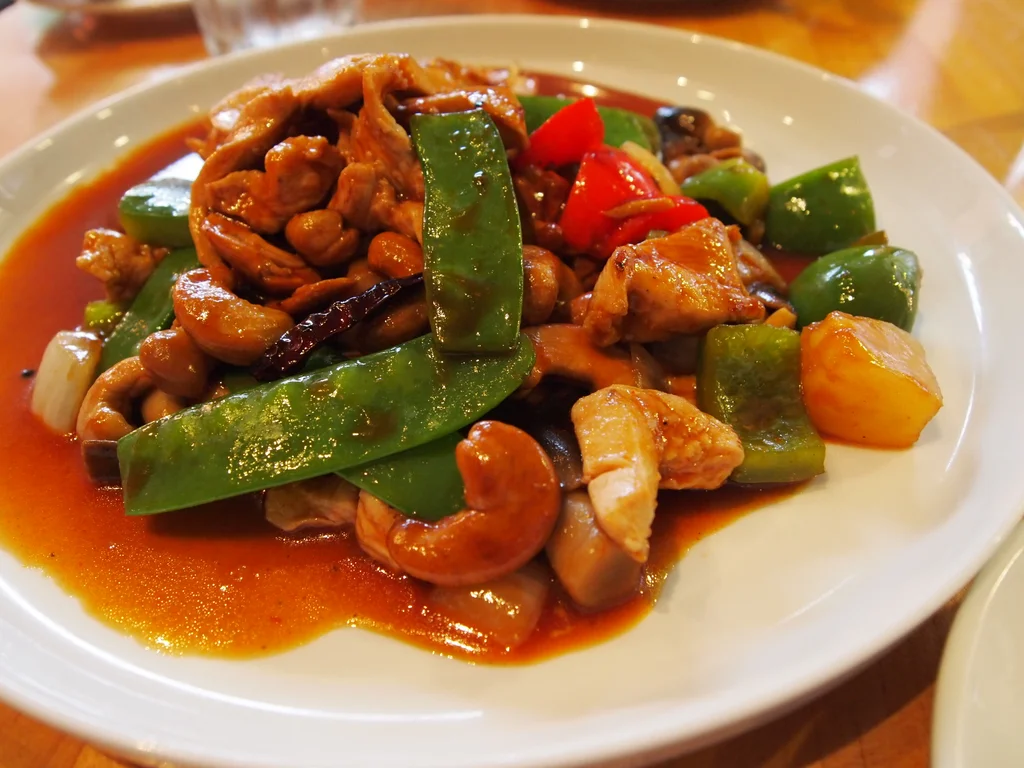
Authentic Chicken Breast Wok Stir-Fry185 kcal · 30.5g P
Thinly sliced chicken breast velveted in egg white and cornstarch, flash-seared in 1 tsp avocado oil with crisp snow peas, bell peppers, cashews, and aromatic ginger-garlic soy reduction.
Why Flash Conduction Prevents Dry, Rubbery Chicken
In a rounded carbon steel wok, heat concentrates at the base (475°F–500°F) while sides radiate moderate heat (350°F). Rapid tossing circulates chicken strips through thermal cycles, evaporating surface humidity without overcooking the core.
Stir-Fried Chicken Nutrition Calculator
Pick your cut, portion weight, and wok sauce to see exact calories, protein, fat, carbs, and micronutrients.
Skinless Chicken Breast Strips (Wok Seared) (Ginger-Garlic Wok)
To yield 100g cooked, weigh out approximately 122g (4.3 oz) raw sliced chicken (~18% moisture loss).
Stir-Fried Chicken Nutrition Facts
Per 100g cooked edible portion. Values vary by cut — use the cut switcher above.
Nutrition Facts
*The % Daily Value (DV) tells you how much a nutrient in a serving of food contributes to a daily diet. 2,000 calories a day is used for general nutrition advice.
Wok Temperature Matrix: 300°F Simmer Trap vs 500°F Flash Sear
How surface contact temperature dictates whether chicken sears into tender golden ribbons or boils into watery rubber.
High-Heat Carbon Steel Wok Sweet Spot450°F–500°F (232°C–260°C)
Vigorous sizzling roar upon contact; wisps of translucent vapor; chicken chars with amber edges in 90 seconds.
Glass-smooth velvety crust with an intensely juicy, succulent interior (core reaches 165°F in 3 minutes).
Contact temperature exceeds the Leidenfrost threshold. Water boils instantly, forming an insulating vapor cushion while oil caramelizes surface sugars and amino acids.
The gold standard. Spread chicken across the hot wok perimeter, let sear untouched for 60 seconds, then toss continuously for 2 minutes.
The Crowded Pan Simmer Trap: Why Stir-Frying Too Much Chicken at Once Ruins Texture
Standard residential kitchen gas burners generate 7,000–12,000 BTUs, while commercial wok jet-burners produce 50,000–100,000 BTUs. When you dump more than 8–10 oz (250g) of cold chicken into a home pan simultaneously, the thermal mass of the meat instantly saps the pan's heat capacity. The temperature plummets below 212°F, causing cell water to pool out into a murky gray broth. Instead of flash-searing in 3 minutes, the meat boils for 8 minutes, turning tough and chalky. Always sear chicken in two smaller batches over high heat, set aside on a plate, and recombine at the very end with your vegetables and sauce.
The Science of Stir-Frying Chicken
How extreme carbon-steel thermal conduction, oil droplet aerosolization, and starch velveting preserve intracellular moisture while creating savory pyrazine crusts.
1. Wok Hei Pyrolysis & Aerosolized Flavor Chemistry
As documented by food scientist Harold McGee (2004), authentic “Wok Hei” (Breath of the Wok) is a complex chemical phenomenon. When a rounded wok is tossed over roaring heat, microscopic oil droplets are aerosolized into the superheated air above the rim (exceeding 600°F / 315°C).
These suspended lipid droplets undergo partial thermal pyrolysis and momentarily ignite, generating volatile carbonyls, furans, and pyrazines that recondense as a micro-thin, savory, smoky patina across the surface of the chicken.
2. Starch Gelatinization & The Velveting Hydrogel
Raw chicken breast begins contracting violently at 140°F (60°C), expelling up to 25% of cell water as myofibrils shrink. The traditional Chinese technique of velveting (Shang Jiang) solves this biochemically.
Cornstarch amylose polymers gelatinize instantaneously upon touching the 475°F oil film, forming a transparent, semi-permeable hydrogel envelope. This barrier holds moisture inside the muscle fibers while allowing heat to penetrate rapidly, resulting in silky tenderness.
3. Vegetables in the Wok
A 50/50 chicken-and-vegetable stir-fry averages 125 kcal, 17.5g protein, and 4.2g fat per 100g — about 60 fewer calories than breast strips alone. Broccoli, bell peppers, and snap peas cook in 180–240 seconds with minimal added water.
Chicken strips (185 kcal/100g) and vegetables (~34 kcal/100g for broccoli) have very different macro profiles. Weighing each component gives a more accurate total than guessing a blended average.
4. Outward Vapor Pressure vs Lipid Penetration
Many assume that cooking in oil inevitably leads to high fat absorption. In stir-frying, intense thermal energy rapidly turns surface moisture into escaping steam. As demonstrated by Moreira et al. (1997), this outward vapor pressure physically blocks cooking oil from penetrating deep into the meat.
The oil functions solely as a high-heat conductive thermal bridge on the exterior. Stir-fried chicken absorbs only 4–5g of fat per 100g, compared to 14g+ in deep-fried breaded chicken.
Stir-Fried vs Deep-Fried, Grilled & Poached
Per 100g nutrition side-by-side: stir-fried vs deep-fried, grilled, and poached chicken — same cuts, different cooking methods.
Stir-Fried vs Deep-Fried Chicken: Wok Sear vs Submerged Fat Bath
Comparing Stir-Fried Chicken Breast (185 kcal / 6.2g F) against Deep-Fried Battered Breast (260 kcal / 13.5g F)
| Metric / Property | Stir-Fried Chicken Breast (185 kcal / 6.2g F) | Deep-Fried Battered Breast (260 kcal / 13.5g F) | Nutritional & Culinary Note |
|---|---|---|---|
| Calories (per 100g) | 185 kcal | 260 kcal | Deep-frying adds ~75 kcal purely from absorbed lipid matrix |
| Total Fat | 6.2g | 13.5g | Wok stir-frying uses minimal oil film vs full submersion |
| Saturated Fat | 1.2g | 3.4g | Deep frying oils often contain higher saturated fats |
| Carbohydrates | 0.4g | 12.0g | Deep-fried chicken relies on thick refined flour breading |
| Cooking Duration | 3 minutes | 7–9 minutes | Wok strips cook in under half the time |
| Vegetable Synergy | High (Broccoli, Peppers) | None (Solo meat) | Stir-frying seamlessly integrates fresh produce |
Deep-frying submerges chicken in a 360-degree bath of hot oil, allowing heavy flour batter to absorb up to 14g of fat per 100g. Stir-frying in a wok requires only 1 teaspoon of high-heat oil (4.5g fat) to conduct heat across the surface, delivering vibrant caramelization with zero heavy grease.
5 Golden Rules of Stir-Frying Chicken
Professional Cantonese and Sichuan culinary techniques to eliminate watery sogginess and guarantee restaurant-quality tenderness in home kitchens.
The Chinese Velveting Law (Shang Jiang)
Toss thinly sliced chicken strips with 1 egg white, 1 teaspoon cornstarch, 1 teaspoon Shaoxing wine, and a pinch of salt. Let stand for 15 minutes. The cornstarch gelatinizes instantaneously upon hitting hot oil, forming a micro-thin hydrogel armor that prevents intracellular water from boiling off.
Bisection Perpendicular to the Grain
Examine the breast muscle fibers: they run longitudinally. Slicing lengthwise leaves long cord-like muscle fibers that chew like rubber. Slicing across the grain severs these filaments into short segments, creating a melt-in-the-mouth texture that cooks through in 180 seconds.
The Smoking Wok Principle (Re Guo Liang You)
Heat your dry carbon-steel or cast-iron wok until wisps of smoke rise from the metal. Only then swirl in high-smoke-point oil (avocado or peanut). Adding cool oil to a screaming hot wok creates an instantaneous non-stick Leidenfrost vapor barrier.
Batch Searing Discipline (Avoid the Simmer Trap)
Home stove burners lack the 50,000 BTU firepower of restaurant woks. Overloading the pan causes pan temperatures to plummet below 212°F, boiling meat in released puddle water. Sear your chicken in two smaller batches, transfer to a clean plate, and recombine at the very end.
Perimeter Sauce Glazing (Wok Wall Reduction)
Never dump liquid sauce directly into the center pool. Pour it along the upper rim of the wok so it sizzles, caramelizes, and reduces instantaneously into a sticky lacquer as it slides down into the tossing chicken and vegetables.
Stir-Fried Chicken Meal Prep & Storage
How to store batch-cooked chicken stir-fries for 4 days of pristine macros, plus the 90-second skillet flash technique that eliminates microwave rubberiness.
The Golden Reheat Rule: The 90-Second Sizzling Skillet Flash
Microwaving cold chicken stir-fry excites water molecules at 2.45 GHz, causing rapid moisture vaporization that turns delicate velveted chicken into tough rubber while making crisp vegetables soggy. Instead, heat a nonstick skillet over high heat with 1 tablespoon of water or broth. Add your chilled stir-fry and toss vigorously for 90 seconds. The water immediately vaporizes into steam, reconstituting the sauce glaze and rehydrating the chicken without cooking the core further.
Refrigerator Storage (34°F–38°F / 1°C–3°C)
Store in airtight glass meal prep containers. Ensure stir-fry cools to room temperature (under 30 minutes) before sealing to prevent condensation from softening crisp vegetable textures.
Freezer Storage (0°F / −18°C)
Freeze meat and sturdy vegetables (peppers, broccoli) in vacuum bags. Avoid freezing watery vegetables like zucchini or bean sprouts. Thaw overnight in the refrigerator before skillet reheating.
4 High-Protein Meal Prep Blueprints
Kung Pao Chicken & Cauliflower Rice Box
48g PCut: 6 oz Seared Breast Strips + Bell Peppers & Peanuts
Sides: Seasoned riced cauliflower + steamed edamame pods + scallion garnish
Ginger Soy Chicken & Snap Pea Sauté
52g PCut: 6 oz Velveted Breast Medallions + Sugar Snap Peas
Sides: Steamed brown jasmine rice + baby bok choy + low-sodium tamari glaze
Thai Basil Minced Chicken Lettuce Wraps (Pad Krapow)
44g PCut: 6 oz Wok-Crumbled Ground Chicken + Garlic & Thai Chilies
Sides: Crisp butter lettuce cups + cucumber ribbons + bird's eye chili lime dressing
High-Fiber Chicken & Broccoli Macro Bowl
54g PCut: 6 oz Seared Chicken Breast Strips + Double Broccoli Florets
Sides: Tri-color quinoa + sliced water chestnuts + sesame ginger drizzle
Stir-Fried Chicken FAQ
Evidence-based answers on stir-fry calories, cornstarch velveting carbs, oil absorption, vegetable nutrient retention, and meal prep storage.
References & Scientific Data Sources
Primary nutrition data sourced from USDA FoodData Central. Wok aerodynamics and Wok Hei pyrolysis cite Harold McGee (2004). Water-holding kinetics cite Puolanne & Halonen (2010); oil uptake mechanics cite Moreira et al. (1997). Thermal safety and storage cite USDA FSIS. Full FDC IDs and DOI links below.
[1]U.S. Department of Agriculture, Agricultural Research Service. (2019). Chicken, broilers or fryers, breast, meat only, cooked, roasted. FoodData Central (FDC ID: 171477).
SourcePrimary skinless cooked breast benchmark: 165 kcal, 31.02g protein, 3.57g fat per 100g. Stir-fry composites add ~1 tsp wok oil on top of this row.
[2]U.S. Department of Agriculture, Agricultural Research Service. (2019). Chicken, broilers or fryers, thigh, meat only, cooked, roasted. FoodData Central (FDC ID: 172388).
SourceSkinless dark meat benchmark: 179 kcal, 24.82g protein, 8.24g fat per 100g.
[3]U.S. Department of Agriculture, Agricultural Research Service. (2019). Chicken, broilers or fryers, thigh, meat and skin, cooked, roasted. FoodData Central (FDC ID: 173625).
SourceBone-in skin-on roasted thigh reference: 232 kcal, 23.3g protein, 14.7g fat per 100g — proxy for wok-rendered skin-on thigh strips.
[4]U.S. Department of Agriculture, Agricultural Research Service. (2019). Chicken, ground, raw. FoodData Central (FDC ID: 171116).
SourceGeneric raw ground chicken anchor: ~143 kcal, 17.4g protein, 8.1g fat per 100g. Cooked 93/7 crumbles use package label estimates (~172 kcal/100g) plus wok oil.
[5]U.S. Department of Agriculture, Agricultural Research Service. (2019). Broccoli, raw. FoodData Central (FDC ID: 170379).
SourceRaw broccoli proxy for 50/50 chicken-and-vegetable wok medley composites: ~34 kcal, 2.8g protein, 2.6g fiber per 100g.
[6]U.S. Department of Agriculture, Agricultural Research Service. (2019). Chicken, broilers or fryers, breast, meat only, cooked, stewed. FoodData Central (FDC ID: 171478).
SourceMoist-heat poached/stewed breast comparison row: 151 kcal, 29.0g protein, 3.0g fat per 100g — zero added wok oil.
[7]McGee, H. (2004). On Food and Cooking: The Science and Lore of the Kitchen. Scribner, New York (Chapter: The Wok and Wok Hei, pp. 780–783).
SourceDocuments high-heat wok aerodynamics, oil droplet aerosolization, and the molecular mechanism of Wok Hei pyrolysis.
[8]Puolanne, E., & Halonen, M. (2010). Theoretical aspects of water-holding in meat. Meat Science, 86(1), 151–165.
SourceDetails myofibrillar water retention kinetics; flash high-heat cooking limits evaporative loss when strips are cut across the grain.
[9]Moreira, R. G., Castell-Perez, M. E., & Barrufet, M. A. (1997). Deep-fat frying: fundamentals and applications. Aspen Publishers.
SourceExplains outward vapor pressure during high-heat frying and searing, limiting deep lipid penetration compared with full submersion deep-frying.
[10]USDA Food Safety and Inspection Service. (2024). Safe Minimum Internal Temperature Chart.
SourceLists 165°F (74°C) as the federal minimum internal temperature reference for poultry. Thin stir-fry strips often reach this in 2.5–3.5 minutes.
[11]USDA Food Safety and Inspection Service. (2024). Leftovers and Food Safety Guidelines.
SourceStandard storage reference: refrigerate cooked poultry within 2 hours; consume refrigerated leftovers within 3–4 days.
Informational tool only
This page is for personal nutrition awareness only — not medical or dietary advice. I am not a doctor. All calorie and macro values are derived from USDA FoodData Central and include typical wok oil (~1 tsp per 100g, adding ~40 kcal and 4.5g fat). Actual totals vary by cut, sauce, and portion weight. Wok stir-frying sears chicken in 2–4 minutes at 450°F–500°F. Starch velveting (Shang Jiang) with 1 tsp cornstarch adds under 1g carbs per serving. USDA FSIS lists 165°F (74°C) as the minimum internal temperature for poultry. Thin 1/4-inch stir-fry strips typically reach this in 2.5–3.5 minutes.