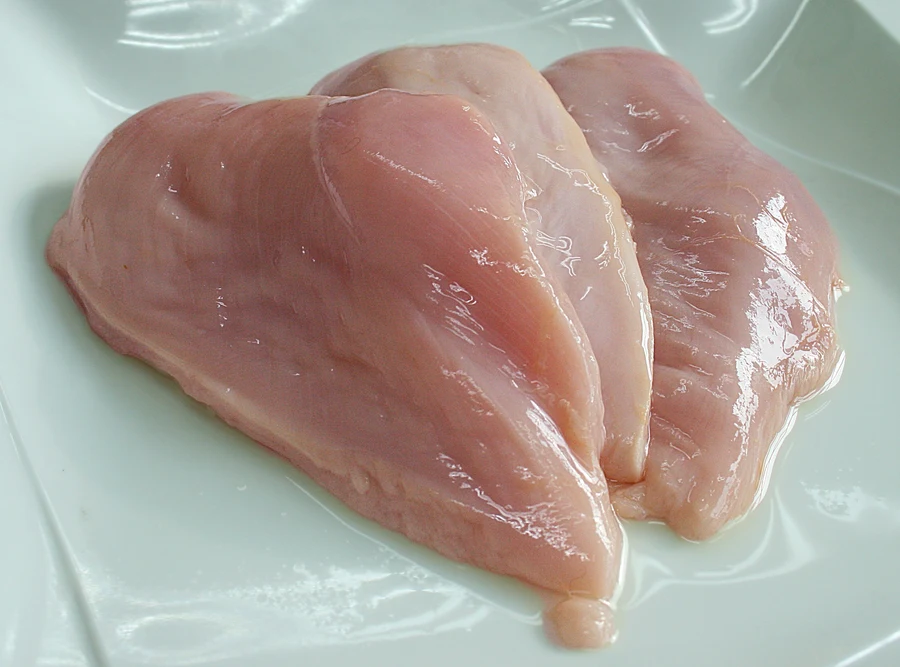
Fabricated from the Chicken Breast Primal
The chicken breast is fabricated from the pectoral girdle of the broiler, sitting directly anterior to the ribs along the large central keel bone (carina of the sternum). A premier poultry subprimal consisting predominantly of the deep, thick Pectoralis major muscle (with the tender Pectoralis minor tenderloin resting along the inner carcass bed), it is composed of fast-twitch Type IIb white muscle fibers. Among common poultry cuts, skinless breast ranks among the leanest by protein-to-calorie ratio (FDC #171477: 165 kcal, 31g protein per 100g cooked) with minimal intramuscular marbling.
Chicken Breast Nutrition & Serving Calculator
Select raw vs cooked weight, cut style, and portion size to calculate precise calories, macros, and leucine.
Official Nutrition Facts Label & Micronutrient Profile
Nutrition Facts
B-Vitamins & Essential Mineral Density per 100g Cooked
Per 100g cooked skinless breast (FDC #171477), listed micronutrients below are shown as % Daily Value for a 2,000 kcal reference diet.
Literature estimates place leucine at roughly 2.6–2.8g per 100g cooked skinless breast (FDC #171477), or about 9% of total protein. A 4 oz (113g) cooked portion supplies approximately 2.9–3.2g leucine. These are food-composition figures for portion awareness — not meal or physiological guidance.
Cooking Temperature Matrix & Pull-Temp Science
Remove from grill/oven at 155°F–160°F. Tent with foil for 5 minutes. Carryover heat rises to 165°F naturally while retaining 15% more juice.
Master Cooking Methods Comparison (Cook Times & Pan Temps)
| Cooking Method | Equipment Temp | Cook Duration | Water Loss | Cooked Density | Chef Execution Rule |
|---|---|---|---|---|---|
| Grilled / Direct BBQ | 400°F–425°F (204°C–218°C) | 10–12 minutes total | ~25% | 31g protein165 kcal / 100g | Sear 5–6 mins per side over medium-high heat (400°F). Pull at 160°F internal and tent with foil for 5 mins. |
| Oven-Baked / Roasted | 425°F (218°C) Preheated Oven | 18–22 minutes | ~24% | 30.8g protein164 kcal / 100g | Bake at 425°F (218°C) hot and fast for 18–20 mins rather than low and slow to lock in cellular moisture. |
| Air-Fried (Convection) | 375°F–380°F (190°C) | 10–12 minutes | ~28% | 31.5g protein168 kcal / 100g | Preheat air fryer to 375°F. Cook 10–12 mins, flipping once at 6 mins. Slightly higher moisture loss concentrates protein. |
| Poached / Simmered in Broth | 170°F–180°F (77°C–82°C) Water | 12–15 minutes | ~22% | 30.5g protein151 kcal / 100g | Bring seasoned broth to a bare simmer (175°F / 80°C). Never boil vigorously; gentle poaching prevents protein toughening. |
| Pan-Seared / Cast Iron Skillet | Medium-High (375°F skillet) | 8–10 minutes total | ~26% | 31g protein165 kcal / 100g | Use a heavy cast iron skillet. Pound breast to uniform 3/4-inch thickness so the center cooks as fast as the edges. |
Raw vs. Cooked Weight Science & USDA Entry Matching
Raw chicken breast is approximately 75% intracellular water and 22.5% protein by mass. When exposed to heat during grilling or baking, muscle fibers contract and squeeze out liquid water as steam.
Portion Matching Rule:
Chicken breast, raw (FDC #171077) at 120 kcal & 22.5g protein per 100g.Chicken breast, cooked, grilled (FDC #171477) at 165 kcal & 31.0g protein per 100g.| Raw Weight | Raw Macros | Cooked Yield | Cooked Macros |
|---|---|---|---|
| 4 oz (113g) | 136 kcal · 25.5g P | 3.0 oz (85g) | 140 kcal · 25.5g P |
| 6 oz (170g) | 204 kcal · 38.3g P | 4.5 oz (128g) | 211 kcal · 38.3g P |
| 8 oz (227g) | 272 kcal · 51g P | 6.0 oz (170g) | 281 kcal · 51g P |
| 12 oz (340g) | 408 kcal · 76.5g P | 9.0 oz (255g) | 421 kcal · 76.5g P |
| 16 oz (1 lb) (454g) | 545 kcal · 102g P | 12.0 oz (340g) | 561 kcal · 102g P |
*Based on standard 25% moisture loss during dry convection roasting or grilling (yield factor 0.75).
Chicken Breast vs. Other Cuts: Protein per Calorie
Among common poultry cuts, skinless breast (FDC #171477) delivers the highest share of calories from protein — 75.2% per 100g cooked — compared to 55.4% for skinless thighs (FDC #172388) and 37.5% for roasted wings (FDC #173630).
Skinless Breast vs. Skinless Thigh
Breast vs. Inner Tenderloins
Skinless Breast vs. Skin-On Breast
Butchery, Texture Troubleshooting & Slicing Protocol
Slice Against the Muscle Grain
Muscle fibers in the breast run diagonally from the shoulder joint toward the keel bone. Always inspect fiber direction and slice perpendicular (across) the grain. This mechanically shortens long muscle fibers, making each bite tender rather than chewy.
The 30-Minute Dry Brine
Sprinkle kosher salt (approx 1/2 tsp per breast) 30 to 45 minutes before cooking. Salt dissolves on the surface, denatures surface myosin protein coils, and allows muscle fibers to reabsorb seasoned moisture, boosting cooked juice retention by ~12%.
Identifying Woody Breast
Woody breast is a growth myopathy causing tough, pale, rigid breast fillets. If a raw breast feels unusually firm and wooden when pressed, slice it thinly into cutlets, marinate with acidic yogurt or lemon, or grind it for meatballs to break up tough connective collagen.
Meal Prep Batch Math, Safe Storage & Reheating
Cold Storage (Refrigerator)
- • Raw Chicken: Cook or freeze within 1 to 2 days at <40°F (4°C).
- • Cooked Breast: Safe for 3 to 4 days in airtight glass containers.
- • Cool cooked chicken to room temperature within 90 minutes before sealing in the fridge.
Freezer Longevity (0°F / -18°C)
- • Raw Breast: Retains peak quality for up to 9 months.
- • Cooked Breast: Best used within 4 months to avoid freezer burn.
- • Vacuum-seal or wrap tightly in plastic and aluminum foil to prevent ice crystal sublimation.
Reheating Without Rubbery Dryness
- • Skillet / Pan: Add 2 tbsp of water or chicken broth, cover with a lid on low heat.
- • Oven: 325°F covered in foil with a splash of broth for 12–15 mins.
- • Microwave: Cover with a damp paper towel and reheat at 60% power to prevent rubbery texture.
Standard 5-Day Meal Prep Batch Math:
Start with 1,000g (1 kg / 2.2 lbs) of raw boneless breast (~1,200 calories, 225g protein). After grilling with ~25% moisture shrinkage, you yield ~750g of cooked chicken. Dividing this evenly across 5 meal prep containers delivers exactly 150g cooked chicken per meal, providing 248 calories and 46.5g of pure protein per container.
Frequently Asked Questions: Chicken Breast Calories & Protein
Answers on chicken breast calories, protein density, raw vs cooked moisture math, skin-on vs skinless differences, and matching weighed portions to USDA FoodData Central entries.
Scientific Sources & USDA FoodData Central Citations
Nutritional values, moisture evaporation percentages, and cooking temperature guidance are referenced from USDA FoodData Central and peer-reviewed poultry science research.
- [1]USDA FoodData Central (Agricultural Research Service) (2021). Chicken, broiler or fryers, breast, meat only, cooked, roasted (FDC ID 171477).. U.S. Department of Agriculture FoodData Central Standard Reference Legacy.View Data
- [2]USDA FoodData Central (Agricultural Research Service) (2021). Chicken, broiler or fryers, breast, meat only, raw (FDC ID 171077).. U.S. Department of Agriculture FoodData Central Standard Reference Legacy.View Data
- [3]Kuttappan, V. A., Hargis, B. M., & Owens, C. M. (2016). White striping and woody breast myopathies in modern broiler chickens: Impact on meat quality and nutritional composition.. Poultry Science, 95(11), 2724-2733.View Data
- [4]Tornberg, E. (2005). Effects of heat on meat proteins — Implications on structure and quality of poultry.. Meat Science.View Data
- [5]USDA Food Safety and Inspection Service (2024). Safe Minimum Internal Temperature Chart. USDA FSIS.View Data
Informational & journaling tool only
This page is a nutrition reference and personal awareness utility — not medical, dietary, or professional advice. Macro values come from USDA FoodData Central (FDC #171077, #171477, #171075, #171079, and related entries). Actual values vary by brand, trim, and cooking method. Match the FDC entry to how the chicken was prepared and weighed. I am not a doctor.