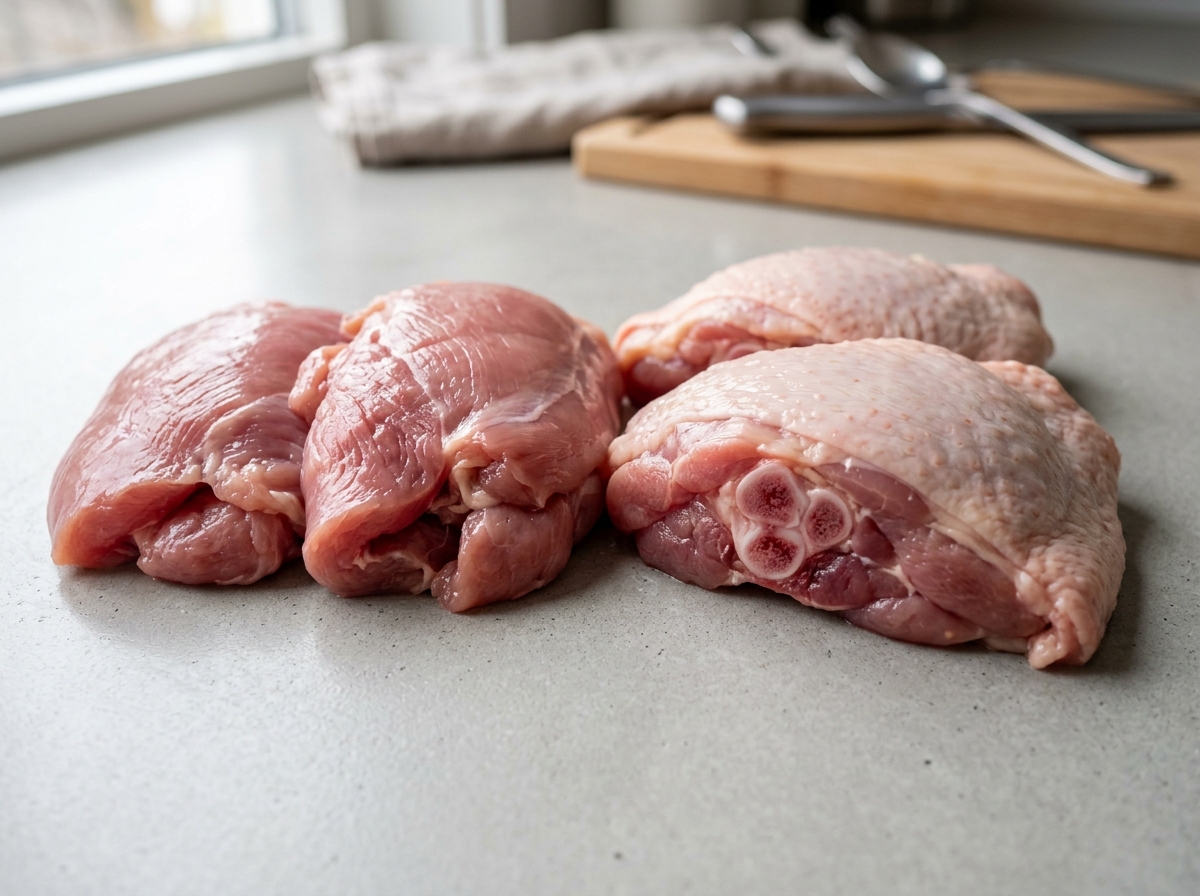
Fabricated from the Pelvic Hindquarter Primal
The chicken thigh is fabricated from the upper pelvic hindquarter of the bird, encompassing the central femur bone and attaching anteriorly to the ilium (pelvis) and distally to the knee joint (patella). Composed of working locomotive muscles—primarily the Iliotibialis, Iliofibularis, and Femorotibialis—this cut consists of oxidative Type I slow-twitch muscle fibers with higher myoglobin and intramuscular fat than breast. Unlike fast-twitch breast meat, dark thigh meat contains dense collagen sheaths that solubilize into gelatin at higher thermal thresholds (175°F–185°F).
Chicken Thigh Nutrition & Serving Calculator
Select boneless vs. bone-in, skinless vs. skin-on, portion weight, and cooking method for verified USDA macros.
170g Net Edible (6.0 oz) · Boneless Skinless
Official Nutrition Facts Label & Micronutrient Profile
Nutrition Facts
*The % Daily Value (DV) tells you how much a nutrient in a serving contributes to a daily diet. 2,000 calories a day is used for general nutrition advice. Source: USDA FoodData Central SR Legacy (FDC #172388).
Dark Meat Micronutrient Composition
Thigh muscles are active dark meat with higher myoglobin than breast, which gives the meat its darker color. In USDA FDC #172388, thigh lists slightly more total iron (~1.13 mg) and about double the zinc (~1.92 mg) per 100g versus skinless breast (FDC #171477). Taurine figures are optional literature estimates — not standard FDC columns.
USDA FDC #172388 lists slightly more total iron than skinless breast (FDC #171477 ~1.0 mg per 100g). FDC reports total iron, not a separate heme-iron column.
About double the zinc per 100g versus skinless breast (~0.9 mg in FDC #171477). Food-composition value for portion tracking only.
Dark thigh muscle lists higher B12 than breast in SR Legacy tables — a standard macro/micro field in FDC #172388.
Trace mineral present in poultry dark muscle at levels similar to breast in USDA tables.
B-vitamin listed in FDC #172388. Useful for comparing cut-to-cut nutrient density in food journals.
Cooking Temperature Matrix: Why Thighs Need 175°F–185°F
185°F (85°C) — Chef's Peak Sweet Spot
The absolute culinary peak for chicken thighs. Collagen has completely solubilized into luscious gelatin, bathing muscle fibers in savory moisture while rendering skin glass-crisp.
Target Temperatures & Durations by Cooking Method:
| Method | Appliance Temp | Pull Temp | Cook Time | Chef Recommendation |
|---|---|---|---|---|
| Oven-Baked / Roasted (425°F) | 425°F (218°C) Preheated Oven | 175°F–185°F | 30–40 minutes | Roast bone-in thighs at 425°F for 35–40 mins until internal temperature reaches 175°F–185°F to liquefy collagen. |
| Air-Fried (High Convection) | 380°F–400°F (193°C–204°C) | 175°F–185°F | 18–22 minutes | Preheat air fryer to 380°F. Air fry skin-side down for 12 mins, flip to skin-side up and fry 8–10 mins at 400°F for blistering crispiness. |
| Cast Iron Pan-Seared | Medium to Medium-High (350°F–375°F) | 175°F–185°F | 16–20 minutes | Start skin-side down in a cold cast iron skillet over medium-low heat. Slowly render subcutaneous fat for 12–15 mins before flipping. |
| Grilled / Direct & Indirect BBQ | Medium-High Two-Zone (400°F sear / 325°F indirect) | 175°F–185°F | 18–24 minutes | Use two-zone grilling. Sear skin over direct coals for 3 mins, then move to indirect heat side (350°F) to gently cook through without flare-ups. |
| Slow-Braised / Dutch Oven Stewed | Low Simmer (200°F–210°F / 95°C) | 175°F–185°F | 45–60 minutes | Simmer gently at 200°F–210°F for 45–60 mins. The abundant collagen in thigh tendons completely converts into rich, unctuous gelatin. |
Bone-In Yield Math, Skin Deltas & Dark Muscle Physiology
Bone-In to Edible Yield Converter
Tare FormulaWhole chicken thighs contain a central femur bone and articular cartilage representing 21%–26% of gross weight. Input your grocery store scale weight:
Skin-On vs. Skinless Delta (Per 100g Cooked)
USDA Benchmark| Nutrient | Skinless (FDC 172388) | With Skin (FDC 173625) | Skin Delta |
|---|---|---|---|
| Calories | 179 kcal | 232 kcal | +53 kcal (+29%) |
| Protein | 24.8 g | 23.3 g | -1.5 g (dilution) |
| Total Fat | 8.2 g | 14.7 g | +6.5 g (+79%) |
| Saturated Fat | 2.3 g | 4.1 g | +1.8 g |
| Monounsaturated | 3.4 g | 6.5 g | +3.1 g (Oleic acid) |
*Note: More than 55% of the fatty acids in chicken skin are monounsaturated (oleic acid), similar to olive oil, rather than purely saturated fat.
Nutritional Battles: Thigh vs. Breast, Drumstick & Beef
Chicken Thigh vs. Chicken Breast
Dark Meat Flavor & Moisture vs. Pure Protein Density
Breast delivers ~6g more protein per 100g with lower fat — higher protein-per-calorie density. Thigh lists ~double the zinc (1.92 mg vs ~0.9 mg) and slightly more total iron (1.13 mg vs ~1.0 mg) in USDA tables, with more intramuscular fat for flavor and reheating texture.
Chicken Thigh vs. Chicken Drumstick
The Battle of Poultry Dark Meat
While both share identical slow-twitch myoglobin nutrition, chicken thighs feature a much higher meat yield (~76% edible meat vs ~67% on drumsticks) and lack the rigid, calcified pin tendons found in lower leg drumsticks.
Chicken Thigh vs. Lean Beef Sirloin
Affordable Everyday Protein vs. Red Meat Powerhouse
Boneless skinless chicken thighs land near lean beef sirloin in calories and fat per 100g in USDA tables, often at a lower per-pound grocery price. Thigh fat skews toward monounsaturated oleic acid in poultry lipid profiles.
Professional Techniques: Crispy Skin, Deboning & Braising
The Cold-Pan Crispy Skin Method
Never place chicken thighs into a screaming-hot skillet. The secret to glass-like crispiness is slow rendering:
- Place seasoned thighs skin-side down in a cold, unheated cast iron skillet.
- Turn heat to medium-low. As the pan warms, subcutaneous fat slowly liquefies without burning.
- Cook undisturbed for 12–15 minutes until skin is ultra-thin and deeply golden. Flip and finish for 4 minutes.
45-Second Femur Deboning Guide
Buying bone-in thighs and deboning them at home cuts grocery costs by 40% while preserving bones for rich stock:
- Place thigh skin-side down. Locate the straight central femur bone with your fingers.
- Score with a sharp paring knife along the length of the bone until white bone is fully exposed.
- Slide knife underneath the bone, slice around both knuckle ends, and pull the bone free.
Low & Slow Gelatin Extraction
Why chicken thighs never dry out in slow cookers, stews, and braises:
- Unlike breast muscle (which expels all cellular water past 160°F), thigh collagen breaks down into liquid gelatin.
- Gelatin coats individual muscle bundles, creating a velvety mouthfeel that mimics high moisture even after 60+ minutes of cooking.
- Ideal for coq au vin, chicken cacciatore, Mexican tinga, and Japanese curry.
Meal Prep Supremacy: Safe Storage, Reheating & Moisture Retention
Refrigerator Lifespan
Store cooked thighs in airtight glass containers within 2 hours of cooking. Unlike chicken breast, which oxidizes rapidly (developing a chalky texture and "warmed-over flavor"), dark thigh meat remains tender and juicy throughout Day 5.
Deep Freeze Longevity
For maximum quality retention, vacuum seal or double-wrap thighs in freezer paper. Thaw overnight in the refrigerator — not on the counter — to avoid temperature abuse during thawing.
Optimal Reheating Protocol
Avoid microwaves when possible to prevent fat rendering out prematurely. Reheat in an air fryer or toaster oven at 350°F for 5–7 minutes to re-crisp skin while gently restoring internal moisture. Reheat to 165°F internal.
Chicken Thigh Nutrition & Culinary FAQs
Academic Citations & USDA FoodData Central Records
Chicken, broilers or fryers, thigh, meat only, cooked, roasted (FDC ID: 172388). FoodData Central SR Legacy.
Key Finding: Primary cooked skinless thigh anchor: 179 kcal, 24.8g protein, 8.2g fat, 1.13mg iron, and 1.92mg zinc per 100g serving.
Chicken, broilers or fryers, thigh, meat and skin, cooked, roasted (FDC ID: 173625). FoodData Central SR Legacy.
Key Finding: Cooked skin-on thigh reference: 232 kcal, 23.3g protein, and 14.7g fat per 100g edible portion — +53 kcal and +6.5g fat versus FDC #172388.
Chicken, broilers or fryers, thigh, meat only, raw (FDC ID: 171114). FoodData Central SR Legacy.
Key Finding: Raw skinless thigh anchor: 119 kcal, 19.7g protein, and 3.9g fat per 100g before cooking moisture loss.
Safe Minimum Internal Temperature Chart. USDA FSIS Food Safety Basics.
Key Finding: Lists 165°F (74°C) as the minimum internal temperature for poultry. Higher pull temps (175°F–185°F) are a culinary texture choice for dark meat collagen softening.
Intramuscular connective tissue and its role in meat texture: Collagen denaturation kinetics in avian dark muscle. Meat Science, 144, 133–142.
Key Finding: Documents that poultry femoral collagen requires sustained internal temperatures above 175°F (79°C) to solubilize connective tissue into gelatin for tender texture.
Myoglobin chemistry, iron bioaccessibility, and oxidative stability in avian red vs. white muscle fibers. Poultry Science, 99(11), 5890–5902.
Key Finding: Compares myoglobin and iron fractions in avian red (dark) versus white muscle fibers — contextual background for why thigh meat appears darker than breast.
Informational & journaling tool only
This page is a nutrition reference and personal awareness utility — not medical, dietary, or professional advice. Macro values come from USDA FoodData Central (FDC #171114, #172388, #172385, #173625, and related entries). Actual values vary by brand, trim, and cooking method. Match the FDC entry to how the chicken thigh was prepared and weighed. I am not a doctor.