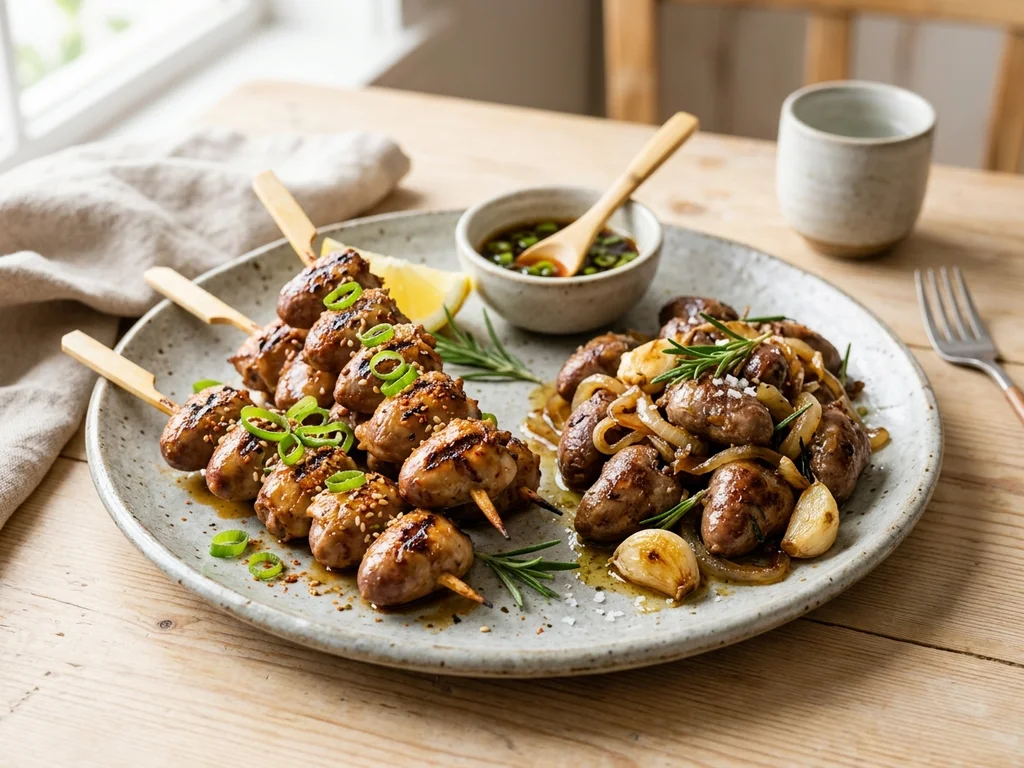
Anatomical Origin: Thoracic Cavity Organ & Butcher Harvest Point
On a whole bird, the chicken heart sits in the thoracic cavity — the chest space behind the breast keel and above the abdominal organs. At evisceration, butchers remove it with the giblet pack (heart, liver, gizzard, neck). Unlike glandular liver tissue, the heart is pure striated cardiac muscle (myocardium) with no silverskin gristle. A natural ring of coronary fat at the base melts during high-heat grilling, helping the lean ventricles stay juicy. USDA tables list this cut under organ meat (FDC #171064 raw / #171485 cooked).
Chicken Heart Nutrition, CoQ10 & Taurine Calculator
Your 100g serving equals approx. 13 whole cooked hearts. This portion logs 11.2mg CoQ10 and 175mg taurine (literature estimates) alongside 9mg iron and 10.8mcg vitamin B12 from USDA tables.
Official USDA Nutrition Facts Label (Per 100g)
Nutrition Facts
Micronutrient Density (Per 100g)
Avian cardiac muscle is dense with mitochondria, giving it high iron, B12, and zinc values in USDA tables. CoQ10 and taurine come from peer-reviewed food assays — not standard FDC nutrient columns.
Striated Muscle vs. Hepatic Storage: Vitamin A Comparison
Chicken liver (FDC #171061) lists ~4,200 mcg RAE preformed vitamin A per 100g — many food journals log 75–100g portions 1–2× weekly against the IOM 3,000 mcg RAE/day upper reference. Chicken heart lists only ~11 mcg RAE (<2% DV), making it easier to log more frequently in a food diary.
Chicken Heart Cooking Temperature & Doneness Guide
Avian cardiac muscle consists of dense, striated myofibrils with hollow ventricular chambers. Undercooking leaves the core below the USDA FSIS 165°F (74°C) poultry minimum, while cooking past 175°F (79°C) wrings out intracellular moisture and turns hearts rubbery. Pulling at 160°F with a 3-minute carryover rest reliably reaches the safe 165°F floor with a tender, juicy spring.
160°F (71°C) — Chef's Pull Point (Juicy Spring)
The sweet spot for grilled skewers. Pulling at 160°F allows a 3-minute tented carryover rest to hit 165°F without tightening cardiac muscle fibers into rubber.
Whole unbroken chicken hearts contain hollow internal chambers (left and right ventricles). If not butterflied or thoroughly rinsed, small blood clots trapped inside take longer to heat than surface flesh. Always ensure the thermal core hits 165°F (74°C) — the USDA FSIS minimum for all poultry, including organ meats — throughout the entire heart wall.
When grilling Yakitori Hatsu or Brazilian Churrasco skewers over 450°F coals, the coronary fat cap sizzles and chars quickly. Insert a needle-thin instant-read probe sideways into the thickest heart. Pull the skewer at 160°F (71°C), tent loosely with aluminum foil, and rest 3 minutes. Carryover heat will safely push the core to 165°F while locking in steak-like juiciness.
CoQ10, Taurine & USDA Micronutrient Profile
A broiler chicken's heart beats hundreds of times per minute, so cardiac tissue is dense with mitochondria. Standard USDA FoodData Central entries for chicken heart (FDC #171064 / #171485) list protein, iron, B12, zinc, and cholesterol — but not CoQ10 or taurine. The values below come from peer-reviewed food-composition assays cited in our references section and are useful for personal food-log comparisons only.
Kamei et al. (1986) measured ubiquinone (CoQ10) in foods and found avian cardiac muscle among the richest whole-food sources at roughly 10–13mg per 100g — about 7× higher than chicken breast (~1.4mg) in the same study. This compound is not listed in USDA FDC nutrient columns.
Spitze et al. (2003) reported high free taurine in poultry dark and cardiac muscles (150–200mg/100g). Cooking method affects retention — grilling and pan-searing generally preserve more taurine than prolonged boiling. Again, taurine is not a standard FDC column for chicken heart.
FDC #171485 lists 9.03mg iron (50% DV) and 10.8mcg vitamin B12 (450% DV) per 100g cooked. These are official USDA food-composition values for journaling and label-style reference — not personalized intake recommendations.
Preformed vitamin A (retinol) is fat-soluble. The IOM tolerable upper intake level is 3,000 mcg RAE/day. Chicken liver (FDC #171061) lists ~4,200 mcg RAE per 100g cooked — many food journals log 75–100g portions 1–2× weekly. Chicken heart lists only ~11 mcg RAE per 100g (FDC #171485), making it easier to log more frequently without approaching that reference ceiling.
FDC #171485 lists 242mg dietary cholesterol per 100g cooked chicken heart. This is a food-composition figure for nutrition logging — the 2020–2025 USDA Dietary Guidelines removed the prior 300mg/day cholesterol limit, noting that dietary cholesterol intake is not a nutrient of concern for overconsumption in general populations.
When comparing cuts in a food journal, heart ranks higher in cholesterol than breast (~85mg) but lower than some shellfish and egg yolks. Log the value that matches your portion size and cooking method.
Chicken Heart vs. Gizzard, Liver & Chicken Breast
Chicken Heart vs. Chicken Gizzard
Involuntary Cardiac Muscle vs. Muscular Grinding Stomach (100g Cooked)Both are muscular organs free from the metallic taste of liver. However, chicken heart is naturally tender when grilled quickly due to its coronary fat buffer and delivers 5× more CoQ10. Chicken gizzard is virtually pure collagen and protein (only 2.7g fat) but requires 1.5–2 hours of slow simmering to become tender.
Chef's Playbook: Trimming, Yakitori Hatsu & Churrasco
Essential 3-minute prep for tender texture and clean, sweet flavor.
- Aortic Cap Slice: Trim off the top 2mm containing the white arterial vessels and tough connective cap. Retain the yellow coronary fat ring for basting.
- Butterfly Slit: Make a clean lengthwise incision down the center of the ventricular wall, opening the heart flat like a book.
- Cold Water Rinse: Rinse under cold running water to flush any dark coagulated blood droplets, then press bone-dry with paper towels.
The classic izakaya skewer grilled over screaming-hot binchotan charcoal.
- Skewering: Thread 4 to 5 butterflied hearts flat onto pre-soaked bamboo skewers through the thick muscular lobes.
- High Direct Heat: Grill over high heat (425–450°F) for 90 to 120 seconds per side until edges develop a crisp, smoky char.
- Tare Glaze & Rest: Brush generously with tare (soy, mirin, sake reduction) during the last 30 seconds. Pull at 160°F; dust with sansho pepper.
Steakhouse rodizio staple roasted on rotisserie swords over wood embers.
- Wine & Herb Marinade: Marinate whole trimmed hearts in dry white wine, crushed garlic cloves, oregano, bay leaf, and coarse salt for 4–8 hours.
- Sword Skewering: Pack whole hearts tightly onto long flat metal skewers, alternating orientations to maintain a compact, juicy cylinder.
- Open Flame Roasting: Roast 10–12 minutes over medium-high embers, turning frequently until coronary fat bubbles and chars. Pull at 165°F.
Weekly Meal-Prep Logistics, Skewer Assembly & Freezing
Three High-Performance Meal-Prep Strategies
Trim, butterfly, and skewer 12 to 16 hearts on Sunday. Stack them separated by parchment paper in an airtight glass container. Cooks on high cast iron in just 4 minutes on busy weeknights!
Quickly sear 1 lb of hearts with olive oil, crushed garlic, and rosemary. Portion into 100g containers alongside rice or sweet potatoes for high-protein meal-prep lunches.
Poach hearts in unseasoned water, dice, and freeze in silicone ice trays. Thaw 1–2 cubes as a whole-food topper — a natural source of taurine (~175mg/100g in literature assays). Consult a veterinarian before adding new foods to a pet's diet.
Fresh poultry organs are highly perishable. Store on the coldest bottom shelf at ≤40°F in original sealed pack or glass container. Cook or freeze within 48 hours.
When marinating in wine (Churrasco style) or soy-mirin (Yakitori style), keep chilled. Do not exceed 36 hours or acidic wine can denature muscle fibers into a mushy texture.
Seal in glass meal prep containers. To reheat without rubberiness, warm briefly in a hot skillet with a teaspoon of butter or broth for 90 seconds instead of high microwave radiation.
Cardiac muscle fibers freeze exceptionally well due to lower moisture content than skeletal cutlets. Vacuum-sealing prevents surface lipid oxidation and freezer burn.
Lay assembled raw skewers on a parchment-lined sheet pan and freeze until solid (2 hours). Transfer into vacuum pouches or freezer bags. Grill directly over medium coals.
Allow 8 to 12 hours in the refrigerator for gentle thawing. Avoid warm water thawing, which keeps outer layers in the unsafe temperature zone per USDA FSIS guidance.
Frequently Asked Questions: Chicken Heart Nutrition & Cooking
Academic Citations & USDA FoodData Central References
U.S. Department of Agriculture, Agricultural Research Service. (2019). Chicken, heart, all classes, raw. FoodData Central (FDC ID: 171064).
View SourceOfficial raw baseline: 153 kcal, 15.6g protein, 9.33g fat, 5.96mg iron, 7.29mcg B12 per 100g.
U.S. Department of Agriculture, Agricultural Research Service. (2019). Chicken, heart, all classes, cooked, simmered. FoodData Central (FDC ID: 171485).
View SourceOfficial cooked anchor: 185 kcal, 26.4g protein, 7.9g fat, 9.03mg iron, 10.8mcg B12 per 100g.
Kamei, M., Fujita, T., Kanbe, T., et al. (1986). The distribution and content of ubiquinone in foods. International Journal for Vitamin and Nutrition Research, 56(1), 57–63.
View SourceSeminal quantitative study establishing avian and mammalian cardiac tissue as primary dietary sources of CoQ10 (10–13mg/100g).
Spitze, A. R., Wong, D. L., Rogers, Q. R., & Fascetti, A. J. (2003). Taurine concentrations in animal feed ingredients; cooking influences taurine content. Journal of Animal Physiology and Animal Nutrition, 87(7‐8), 251–262.
View SourceValidates high free taurine concentrations in poultry dark and cardiac muscles (150–200mg/100g).
USDA Food Safety and Inspection Service. (2024). Safe Minimum Internal Temperature Chart for Poultry and Organ Meats.
View SourceKitchen reference: 165°F (74°C) minimum internal temperature for all poultry, including organ meats.
USDA Food Safety and Inspection Service. (2024). Leftovers and Food Safety.
View SourceKitchen reference: refrigerate cooked poultry within 2 hours and use leftovers within 3–4 days.
Informational & journaling tool only
This page is a nutrition reference and personal awareness utility — not medical or dietary advice. Macro and micronutrient values are derived from USDA FoodData Central (FDC #171064 raw, FDC #171485 cooked) and peer-reviewed food-composition assays for CoQ10 and taurine (not standard FDC columns). Chicken heart lists minimal vitamin A (~11 mcg RAE per 100g) compared to liver (~4,200 mcg RAE) — useful for portion logging only. Always ensure internal core temperature reaches 165°F (74°C) with a calibrated digital thermometer per USDA FSIS guidance. I am not a doctor.