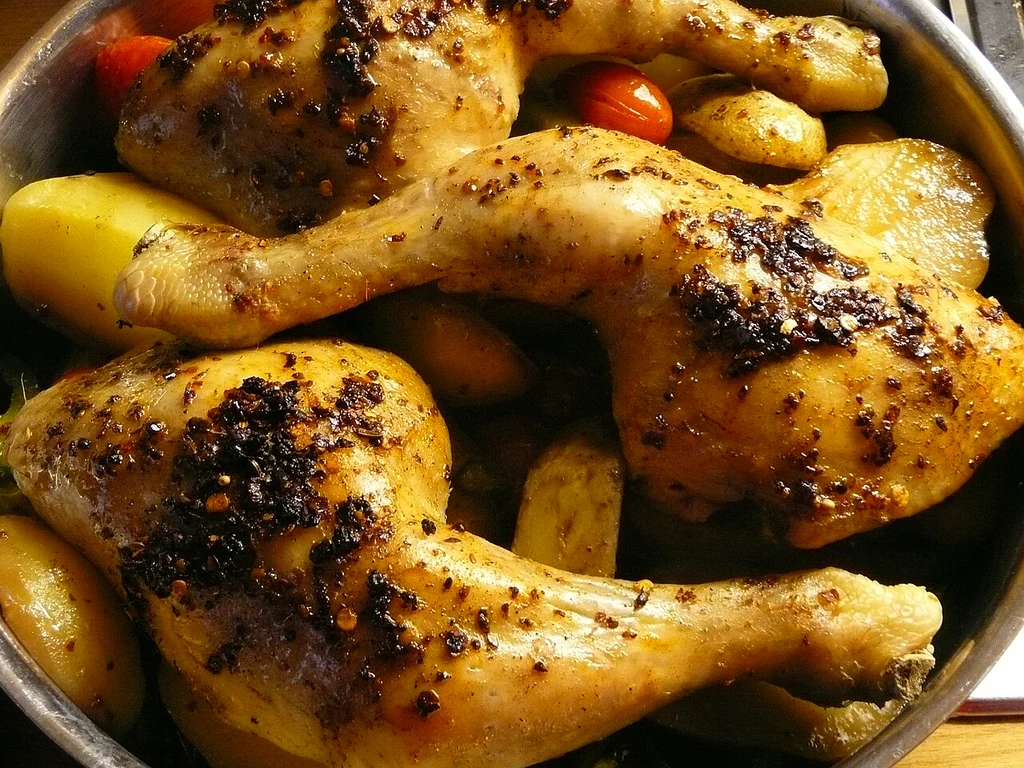
Thigh, Drumstick & Knee Joint: Anatomy of a Whole Leg Piece
In poultry butchery, a Whole Chicken Leg Piece (USDA IMPS 1101) represents the complete avian hindquarter, comprising the upper thigh (femur) and the lower drumstick (tibia and fibula) fused at the hinge-like patellar knee joint. Because chickens spend their lives walking and scratching, these muscles are dense with oxidative slow-twitch fibers that store abundant myoglobin, vascular blood supply, and natural joint collagen. The non-edible skeletal bones account for exactly ~30% of total cooked weight.
Patellar Knee Joint & Collagen Gelatinization
The pivot point connecting thigh and drumstick. Packed with type-I collagen, synovial fluid, and cartilage. When cooked to 175°F–185°F, this tough collagen completely hydrolyzes into melting gelatin, enriching surrounding meat with succulent juiciness.
Chicken Leg Piece Macro, Bone Tare & Skin Calculator
Log 125g net meat (~0.9 whole leg pieces) for a 30g protein journal entry.
Log 166g net meat (~1.1 whole leg pieces) for a 40g protein journal entry.
Log 208g net meat (~1.4 whole leg pieces) for a 50g protein journal entry.
Full Micronutrient Breakdown (145g Net Edible Dark Meat)
Official USDA Nutrition Facts Label (Per 100g Edible Meat)
Nutrition Facts
Serving size: 100g (3.53 oz)
Approx. 0.7 cooked leg piece
* The % Daily Value (DV) tells you how much a nutrient in a serving of food contributes to a daily diet of 2,000 calories.
Zinc, Iron & B-Vitamins in Dark Meat
Per USDA FDC #172380, 100g skinless roasted leg lists 2.11mg zinc, 1.08mg iron, and 0.39µg vitamin B12 — higher zinc than skinless breast (FDC #171477). Values below are for food-composition logging only.
Chicken Leg Piece Cooking Temperature Matrix: The 175°F–185°F Gelatinization Law
USDA FSIS requires poultry to reach 165°F (74°C) at the thickest point. Leg pieces also contain dense type-I collagen around the femur, tibia, and knee joint. At the FSIS minimum, meat is fully cooked but connective tissue may still feel firm. Many cooks pull leg pieces at 175°F–185°F (79°C–85°C) so collagen softens into gelatin for tender, pull-from-bone texture — kitchen guidance only, not personalized advice.
Common kitchen target for chicken leg pieces. Between 175°F and 185°F, type-I collagen around the knee and drumstick hydrolyzes into gelatin, and meat pulls cleanly from bone with more juiciness than at 165°F alone.
Soft gelatinous texture, bone pulls out clean, rich pan juices.
Place seasoned leg pieces skin-side up on a wire rack inside a roasting pan. Blast at 425°F to liquefy subcutaneous fat reservoirs and kickstart Maillard browning.
Heat penetrates dense muscle surrounding the femur and tibia. Insoluble collagen triple-helix structures begin unwinding and hydrating into tender, silky gelatin.
Insert a fast-read digital probe into the deep meat between the thigh and knee joint without touching bone. Pull the pan when the internal reading hits 180°F (82°C).
Rest on a warm board for 5 minutes. The liquefied gelatin thickens slightly into an unctuous glaze, coating every dark muscle strand before the first slice.
Dark Meat Biology: Myoglobin, Collagen & Mineral Profile
Why is leg meat darker and more forgiving in the kitchen than breast? Below is a food-science breakdown of muscle fiber types, collagen behavior around the knee joint, and USDA mineral data — for personal awareness and accurate food journaling only, not personalized nutrition advice.
1. Slow-Twitch Fibers & Myoglobin
Chickens walk and stand throughout their lives. Hindquarter muscles — iliotibialis, femorotibialis, and gastrocnemius — contain more slow-twitch oxidative fibers than breast, with higher myoglobin content that produces the characteristic ruby-brown color.
2. Knee Joint Collagen & Gelatin
The stifle (knee) joint and anchoring tendons contain dense type-I collagen that requires higher temperatures to soften than breast myofibrils alone. Smith & Fletcher (1992) documented slower collagen solubilization in thigh muscle compared to breast.
Gelatinized collagen traps moisture between muscle bundles, which is why leg pieces stay juicy during longer cooks.
3. Zinc & Iron in USDA Tables
Skinless roasted leg (FDC #172380) lists higher zinc than skinless breast (FDC #171477) in USDA FoodData Central. Use these values when comparing mineral columns in a food journal — not as intake recommendations.
Iron and zinc are listed in USDA composition tables for logging purposes. Heme iron in poultry is a food-chemistry category, not a clinical recommendation.
Chicken Leg Piece vs. Breast, Skin-On vs. Skinless & Pork Chop
Food-logging comparison: whole chicken leg piece vs. skinless breast, skin-on vs. skinless leg, and center-cut pork chop. Compare macro columns, zinc/iron values from USDA tables, cooking texture, and typical retail cost — not a ranking of which cut to eat.
Chicken Leg Piece vs. Skinless Chicken Breast
Dark meat vs. white meat (100g cooked, FDC #172380 vs #171477)
Skinless breast (FDC #171477) delivers ~18.8g protein per 100 kcal versus ~13.9g for skinless leg (FDC #172380). Leg meat lists roughly twice the zinc (2.11mg vs 1.0mg per 100g) and similar iron. Leg pieces tolerate longer cooking without drying out, thanks to intramuscular fat and collagen — a texture trade-off, not a ranking of which cut to eat.
Culinary Masterclass: Skin Scoring, Knee Joint Bisection & Braising
The whole chicken leg piece is the most versatile cut in classical butchery. Master the cross-hatch scoring technique for shatteringly crisp skin, learn the effortless joint bisection method, and leverage natural bone collagen in slow-simmered sauces.
Cross-Hatch Skin Scoring & Fat Rendering
Chicken leg pieces hold substantial subcutaneous fat under the skin, especially across the thigh curvature.
- Thoroughly pat the skin completely dry with paper towels.
- Using the razor-sharp tip of a paring knife, slice 3 shallow diagonal slits across the thigh and 2 across the drumstick.
- Cut through the skin and yellow fat layer only—never score deeply into the red muscle.
- Rub with kosher salt. In the oven or pan, heat melts the fat through the slits, basting the meat while turning the skin wafer-thin and crisp.
The Effortless Knee Joint Separation
Separate a whole leg piece into an isolated thigh and drumstick in under 5 seconds with zero bone shards.
- Lay the leg piece skin-side down on your cutting board.
- Locate the thin white fat line running diagonally across the knee joint.
- Hold the drumstick in one hand and the thigh in the other; bend backward until the knee joint pops audibly out of its socket.
- Slide a sharp chef’s knife directly through the open cartilage gap. The blade glides like butter with zero resistance!
Collagen-Enriched Braises & Curries
Why restaurants favor bone-in chicken leg pieces for stews, curries, and French Coq au Vin.
- Hard-sear the seasoned whole legs in a Dutch oven until deeply caramelized; remove to a plate.
- Sauté onions, garlic, ginger, and spices in the rendered chicken fat, deglazing the browned fond with wine or broth.
- Return legs to the pot, submerge halfway, cover tightly, and simmer on low (180°F–190°F) for 45–55 minutes.
- Collagen and marrow leach directly into the braising liquid, thickening the sauce naturally into a glossy, gelatin-rich glaze.
Chicken Leg Piece Meal Prep: Cold-Chain Storage & Bone Broth Engine
Dark leg meat retains moisture well during refrigeration and reheating thanks to intramuscular fat and collagen. Follow USDA FSIS storage timelines below. Leftover leg bones can be simmered into stock — a common zero-waste kitchen practice.
Roast 6 whole leg pieces at 425°F on Sunday. While still warm, peel away skin and pull dark meat clean off femur and tibia bones with two forks. Weigh 120g skinless shredded portions (~209 kcal, ~29g protein per FDC #172380) into airtight containers. Refrigerate up to 3–4 days per FSIS guidance.
Store stripped femurs, tibias, and knee cartilage joints in a freezer bag. When you have 6–8 bones, simmer in water with 1 tbsp apple cider vinegar, mirepoix, and peppercorns for 8–10 hours. The long simmer extracts gelatin from connective tissue into a rich stock — log any added salt or fat separately in your food journal.
Place 4 skinless whole leg pieces into a slow cooker with crushed tomatoes, garlic, ginger, and garam masala. Cook on low for 6 hours until meat pulls easily from the bone. Portion into airtight containers (~125g skinless meat per leg ≈ ~218 kcal, ~30g protein per FDC #172380). Refrigerate 3–4 days or freeze 3–4 months.
Never blast refrigerated chicken legs on high microwave wattage—it boils off internal moisture and turns the meat tough. Instead, place whole legs or shredded meat in a skillet with 2 tablespoons of chicken broth or water. Cover tightly and steam over medium-low heat for 3 minutes to melt chilled gelatin back to luscious juiciness.
Chicken Leg Piece Nutrition & Culinary FAQs
Frequently asked questions regarding whole chicken leg piece calories, bone tare deduction math, skin removal fat savings, purple bone marrow safety, and safe cooking temperatures.
References & Scientific Data Sources
Macronutrient and micronutrient values anchor to USDA FoodData Central FDC #173617 (cooked with skin), FDC #172380 (cooked skinless), and FDC #172378 (raw with skin). Collagen kinetics cite Smith & Fletcher (1992). Food safety and storage timelines cite USDA FSIS.
[1]U.S. Department of Agriculture, Agricultural Research Service. (2019). Chicken, broilers or fryers, leg, meat and skin, cooked, roasted. FoodData Central (FDC ID: 173617).
SourceOfficial skin-on cooked leg reference: 184 kcal, 24.03g protein, 8.99g fat, 98mg sodium, 127mg cholesterol per 100g.
[2]U.S. Department of Agriculture, Agricultural Research Service. (2019). Chicken, broilers or fryers, leg, meat only, cooked, roasted. FoodData Central (FDC ID: 172380).
SourceOfficial skinless cooked leg reference: 174 kcal, 24.22g protein, 7.8g fat, 99mg sodium, 128mg cholesterol per 100g.
[3]U.S. Department of Agriculture, Agricultural Research Service. (2019). Chicken, broilers or fryers, leg, meat and skin, raw. FoodData Central (FDC ID: 172378).
SourceOfficial raw leg reference: 214 kcal, 16.37g protein, 15.95g fat, 84mg sodium, 93mg cholesterol per 100g.
[4]Smith, D. P., & Fletcher, D. L. (1992). Chicken breast and thigh muscle collagen and gelatinization kinetics during thermal processing. Poultry Science, 71(12), 2094–2101.
SourceDocuments higher collagen in hindquarter muscles and slower heat solubilization, supporting 175°F–185°F pull targets for leg dark meat.
[5]USDA Food Safety and Inspection Service. (2024). Safe Minimum Internal Temperature Chart.
SourceKitchen reference: 165°F (74°C) minimum internal temperature for all poultry, including leg pieces.
[6]USDA Food Safety and Inspection Service. (2024). Leftovers and Food Safety.
SourceKitchen reference: refrigerate cooked poultry within 2 hours; use refrigerated leftovers within 3–4 days.
Informational & journaling tool only
This page is a nutrition logging and personal awareness tool only — not medical or dietary advice. I am not a doctor. Whole chicken leg pieces contain non-edible bone (femur, tibia, fibula, patella) that constitutes approximately 30% of total cooked weight. Weigh cooked bone scraps after eating or subtract ~30% from gross scale weight to estimate net edible dark meat. USDA FSIS minimum internal temperature for poultry is 165°F (74°C); many cooks pull leg pieces at 175°F–185°F (79°C–85°C) for tender texture. Always verify values against your package label when available. Marinades, breading, and gravies add sodium, carbs, and fats beyond these USDA baseline entries.