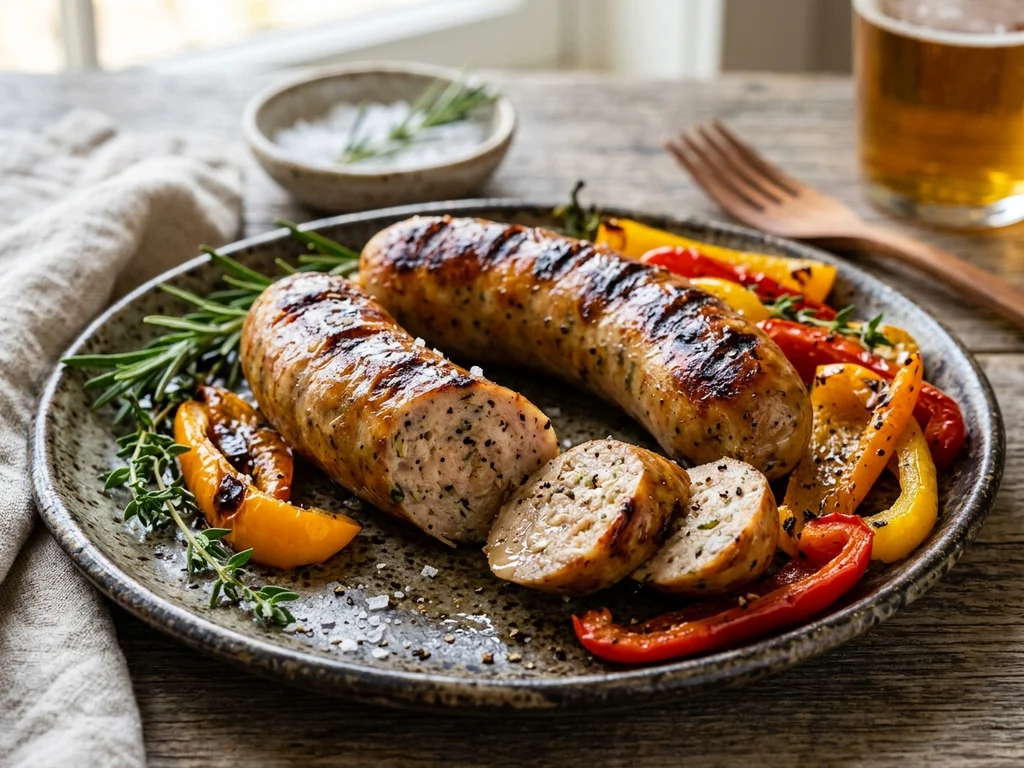
Emulsion Physics: Salt-Soluble Myosin & Collagen Casing Snap
Unlike whole skeletal cuts, chicken sausage is a carefully engineered myofibrillar protein gel emulsion. High-quality links combine dark thigh meat (which contributes rich myoglobin, succulence, and moisture) with lean breast trimmings (which supply high concentrations of salt-soluble myosin). When ground with precise salt levels (1.5%–2.0%), myosin fibrils unravel and form a microscopic matrix that permanently traps water and rendered lipid droplets. Encased in edible bovine collagen or natural sheep casings, this emulsion yields a crisp, tactile snap upon biting without dumping grease.
Salt dissolves actomyosin fibers from poultry muscle into a thick sticky paste that solidifies irreversibly above 145°F, locking in juiciness without crumbling.
Chicken Sausage Calories, Protein & Sodium Calculator
Selected: Sweet Italian Chicken Sausage — Coarse ground chicken thigh and breast seasoned with whole toasted fennel seed, sweet basil, cracked black pepper, and garlic in a natural collagen casing.
Moderate sodium content: standard for cured/seasoned sausages. Typical for one meal entry in a daily sodium journal.
Official USDA Nutrition Facts Label (Per 100g)
Nutrition Facts
Nutrient Profile in Ground Poultry Links (Per 100g)
Chicken sausage delivers high complete protein with only ~3g saturated fat per 100g. However, because salt is functionally necessary for myosin protein binding, sodium levels range from 520mg to 740mg per serving.
The "Uncured" Label Myth & Celery Juice Powder Chemistry
Many artisanal chicken sausages bear the claim "Uncured — No Nitrates or Nitrites Added Except Those Naturally Occurring in Cultured Celery Juice Powder." Under USDA regulations, this distinction is semantic. Cultured celery extract contains natural nitrates that starter cultures reduce to active nitrites. Functionally and biochemically, celery-cured chicken sausages produce the same cured color and nitrosylmyoglobin complexes as conventional synthetic curing agents (Sindelar et al., 2007).
Chicken Sausage Cooking Temperature & Doneness Guide
Cooking chicken sausage requires understanding whether your links are fully pre-cooked or raw fresh. Pre-cooked links only need gentle reheating to 140°F (60°C). Fresh raw links must reach the USDA FSIS 165°F poultry threshold, but pulling at 160°F with a 3-minute carryover rest prevents the high internal steam pressure that causes casings to split and dump savory juices.
160°F (71°C) — Raw Link Chef's Pull Point
For raw fresh chicken sausage, pull from direct skillet heat at 160°F. A 3-minute resting period allows carryover thermal momentum to hit 165°F while locking in maximum intracellular juices.
Examine packaging carefully. Most supermarket specialty brands (Aidells, Bilinski’s, Trader Joe’s) are fully cooked at the plant; they merely require warming to 140°F (60°C). Fresh raw chicken sausages from butcher trays contain raw ground poultry and must reach 165°F (74°C) — the USDA FSIS minimum for all ground poultry.
Tossing cold raw links directly into a dry, screaming-hot skillet scorches the casing before the thick core cooks, causing trapped steam to burst the links open. Instead, add 2–3 tablespoons of water to the skillet and cover with a lid over medium heat for 4 minutes. Once the water evaporates, drizzle a teaspoon of olive oil to sear the exterior to a crisp golden snap!
Myosin Gel Chemistry, Fat Reduction & Sodium Dynamics
Creating a juicy, tender sausage from lean poultry requires precise food biochemistry. Because poultry muscle has significantly less natural saturated fat than pork belly, processors utilize salt-soluble protein extraction, targeted spice inclusions, and curing chemistry to build a tender emulsion with a leaner macro profile per USDA tables.
Traditional pork sausage contains 25–30g total fat and 8–10g saturated fat per 100g. Chicken sausage replaces dense swine lard with poultry thigh lipids (rich in monounsaturated oleic acid), cutting saturated fat to just 2.5–3.0g per 100g while melting smoothly at mouth temperature.
Sodium is not just a seasoning; it is a structural reagent. At 1.5%–2.0% concentrations, ionic sodium dissolves the cellular sheath of muscle fibers, allowing filamentous myosin to extract into an adhesive paste that traps moisture and prevents dry crumbling upon cooking.
"Uncured" chicken sausages use cultured celery powder containing concentrated natural nitrates. Starter cultures reduce these to active nitrites, binding to myoglobin to slow lipid oxidation, extend shelf stability, and yield the signature pink cured hue per USDA labeling rules.
With 520mg to 740mg of sodium per link, eating two chicken sausages logs ~1,200mg sodium (~52% of the FDA 2,300mg Daily Value reference). Track this in your food journal when planning daily sodium totals.
- Pair with potassium-rich roasted sweet potatoes or spinach to balance the K:Na ratio in your log.
- Avoid adding tabletop salt to your cooking pan; the link seasoning bastes everything.
- Slice into grain bowls with unsalted quinoa and steamed broccoli to spread the savory flavor.
The external casing dictates the sensory experience of every bite:
Chicken Sausage vs. Pork Sausage, Ground Chicken & Turkey Bacon
Chicken Sausage vs. Traditional Pork Sausage
Lean Poultry Emulsion vs. Fatty Swine Trimmings (100g Cooked)Per USDA tables, chicken Italian sausage lists ~40% fewer calories and ~70% less saturated fat (2.8g vs 8.8g) than pork Italian sausage per 100g, while delivering ~17% more protein. Same fennel, garlic, and herb profile with less total fat for food-log comparisons.
Chef's Playbook: Steam-and-Sear, Sheet-Pan & Coin Caramelization
Guarantees a juicy core and a crisp casing snap with zero bursting.
- Water Bed: Place whole links in a cold skillet. Add 2 to 3 tbsp of water and turn heat to medium.
- Cover & Steam: Cover tightly with a lid for 3 to 4 minutes. The gentle steam cooks the center through without scorching.
- Uncover & Crisp: Remove lid, let water evaporate completely, add 1 tsp olive oil or butter, and roll links for 2 to 3 minutes until blistered and golden.
High-yield 25-minute weeknight meal with sweet caramelized vegetables.
- Vegetable Bed: Slice bell peppers, red onions, and zucchini into 1-inch ribbons. Toss with 1 tbsp olive oil, oregano, and black pepper (no added salt).
- Nestle Links: Arrange chicken sausage links evenly among vegetables on a parchment-lined baking sheet.
- 400°F Roast: Roast at 400°F (204°C) for 20 to 25 minutes, turning links once halfway through until edges are deeply caramelized and juices run clear.
Maximizes crispy Maillard surface area for grain bowls, pastas, and eggs.
- Bias Slice: Cut fully cooked chicken sausages diagonally into 1/2-inch thick coins to maximize surface contact area.
- Hot Dry Sear: Place coins flat in a dry nonstick or cast-iron skillet over medium-high heat (their internal fat is sufficient).
- Maillard Crust: Sear undisturbed for 90 seconds per side until a deep reddish-golden crust forms. Toss into marinara pasta or rice bowls.
Weekly Meal-Prep Blueprint, Storage & Freezing Kinetics
Three High-Yield Meal-Prep Strategies
Sear 4 sliced dinner links on Sunday. Divide into 4 glass meal prep containers with brown rice, steamed broccoli, and roasted sweet potatoes. Heats in 90 seconds all week!
Dice 2 Italian or Apple Sage links and fold into 8 whisked eggs with spinach and feta in a baking dish. Bake at 375°F for 22 minutes for 4 ready-to-grab 25g protein breakfasts.
Pre-slice raw sausages, bell peppers, and red onions into a gallon freezer bag with olive oil and Italian seasoning. Dump onto a hot sheet pan directly from frozen for a rapid dinner.
Commercial pre-cooked vacuum-sealed packages are pasteurized and flushed with inert gas; they stay fresh until the manufacturer's printed use-by date.
Once unsealed, oxygen exposure accelerates spoilage. Seal leftovers in airtight glass containers or ziplocks and consume within 3–4 days per USDA FSIS leftovers guidance.
Raw fresh ground poultry sausages from the butcher counter are highly perishable. Cook immediately within 48 hours or freeze.
Because sausage emulsions have bound water networks, they freeze with minimal ice crystallization damage. Vacuum sealing prevents surface lipid oxidation.
Freeze seared coins flat on a sheet pan for 1 hour, then transfer into a freezer bag. Grab a handful directly into hot soups, pastas, or morning egg scrambles!
Thaw in the refrigerator for 8–12 hours. Pre-cooked links can also be dropped directly into simmering pasta sauce or skillet water baths from frozen!
Frequently Asked Questions: Chicken Sausage Nutrition & Cooking
Academic Citations & USDA FoodData Central References
U.S. Department of Agriculture, Agricultural Research Service. (2019). Sausage, chicken, pre-cooked. FoodData Central (FDC ID: 171116).
View SourceOfficial cooked baseline: 183 kcal, 15.7g protein, 12.2g fat, 543mg sodium, 1.1mg iron per 100g.
U.S. Department of Agriculture, Agricultural Research Service. (2019). Sausage, Italian, chicken, link. FoodData Central (FDC ID: 173426).
View SourceOfficial Italian style anchor: 175 kcal, 17.0g protein, 9.8g fat, 620mg sodium, 240mg potassium per 100g.
Sun, X. D., & Holley, R. A. (2011). Factors influencing gel formation by myofibrillar proteins in muscle foods. Comprehensive Reviews in Food Science and Food Safety, 10(1), 33–51.
View SourceSeminal food chemistry paper explaining how salt extraction of myosin enables stable moisture and lipid retention in poultry emulsion sausages.
Sindelar, J. J., Cordray, J. C., Sebranek, J. G., et al. (2007). Investigating quality attributes and consumer acceptance of uncured, no-nitrate/nitrite-added commercial cooked sausages. Journal of Food Science, 72(8), S551–S558.
View SourceAnalyzes natural nitrate conversion in celery powder versus synthetic sodium nitrite in commercial poultry sausages.
USDA Food Safety and Inspection Service. (2024). Safe Minimum Internal Temperature Chart for Ground Poultry and Sausages.
View SourceKitchen reference: 165°F (74°C) minimum for raw ground poultry sausage; 140°F (60°C) reheat target for fully cooked links.
USDA Food Safety and Inspection Service. (2024). Leftovers and Food Safety.
View SourceKitchen reference: refrigerate cooked poultry within 2 hours and use leftovers within 3–4 days.
Informational & journaling tool only
This page is a nutrition reference and personal awareness utility — not medical or dietary advice. Macro and micronutrient values are derived from USDA FoodData Central (FDC #171116 pre-cooked, FDC #173426 Italian link) and verified commercial composites. Chicken sausage contains functional sodium (520–740mg per link) necessary for myofibrillar protein binding — track this in your daily food log. Raw chicken sausage links must reach 165°F (74°C) internal temperature per USDA FSIS guidance; pre-cooked links need only 140°F (60°C) reheat. I am not a doctor.