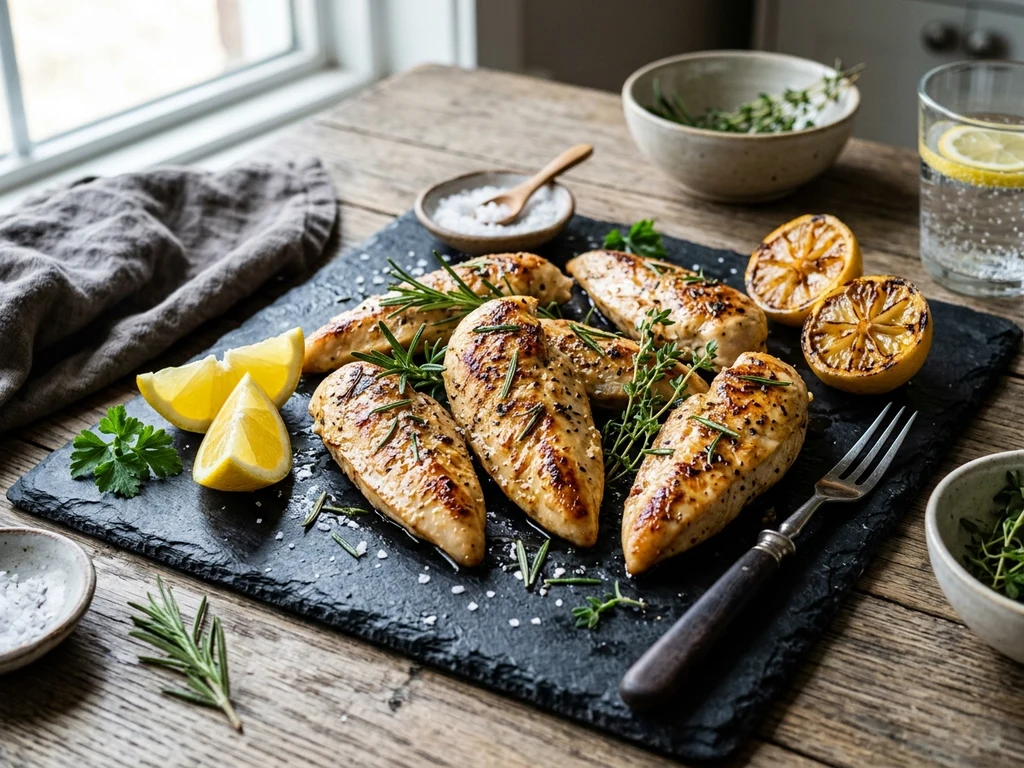
Pectoralis Minor: The Protected Keel Muscle of Pure Tenderness
In avian anatomy, the Pectoralis minor (culinarily known as the chicken tenderloin or inner fillet) lies deep beneath the large outer Pectoralis major, flanking both sides of the prominent central keel bone (sternum carina). While the outer breast powers the downward wing stroke, the tenderloin acts via a pulley-like triosseal canal to raise the wing. In domestic broilers that rarely fly, the tenderloin experiences virtually zero mechanical strain. Consequently, its muscle fiber bundles have smaller diameters and significantly less heat-resistant cross-linked collagen than whole breasts.
Pectoralis Minor (Tenderloin Muscle Belly)
Weighs ~40–45g raw per strip (~33g cooked). Tucked between the sternum and outer breast, this muscle is protected from mechanical wear. Logs with FDC #171477 (~31g protein, ~3.6g fat per 100g cooked) for plain preparations.
Chicken Tenderloin Macro, Leucine & Piece Count Calculator
Plain cooked values anchor to FDC #171477 (USDA proxy for skinless tenderloin). Breading and sauces require a different log entry.
Log 97g cooked (~2.9 strips) for a 30g protein journal entry.
Log 129g cooked (~3.9 strips) for a 40g protein journal entry.
Log 161g cooked (~4.9 strips) — 75% of calories from protein.
Full Micronutrient Profile for Current Weight (100 g / 3 pcs)
Official USDA Nutrition Facts Label (Per 100g Benchmark)
Nutrition Facts
Serving size: 100g (3.53 oz)
Approx. 3 cooked tenderloins
* The % Daily Value (DV) tells you how much a nutrient in a serving of food contributes to a daily diet of 2,000 calories.
B-Vitamins, Selenium & Mineral Content
Per USDA FDC #171477, 100g cooked plain tenderloin lists meaningful amounts of niacin (Vitamin B3), Vitamin B6, selenium, phosphorus, and zinc. Values below are for food-composition logging — not intake recommendations.
Chicken Tenderloin Temperature Matrix & The 4-Minute Flash-Sear Law
Because chicken tenderloins are slender (~0.5 inches thick) with virtually no insulating fat, thermal penetration occurs 3x faster than in whole breasts. Overcooking past 170°F violently collapses myofibrillar proteins, squeezing out up to 35% of cellular fluid. Learn why pulling at 160°F (71°C) with a mandatory 2-minute rest yields the safest, juiciest results.
Common kitchen pull point for thin poultry strips. Removing from heat at 160°F (71°C) allows carryover conduction to reach 165°F (74°C) within about 2 minutes of resting, while limiting moisture loss in the slender cut.
Tender white fibers, clear juices, soft but fully set protein.
Preheat cast iron skillet to medium-high. Lay dried tenderloins down without touching. Sizzle undisturbed for 2 minutes to build golden Maillard crust.
Flip once. Add 1 tsp butter, crushed garlic clove, and fresh rosemary sprig. Spoon foaming butter over fillets for 90 seconds.
Insert digital probe horizontally into the thickest center. As soon as it reads 160°F (71°C), pull the tenderloins from the pan immediately.
Rest 2 minutes on a warm plate. Internal temperature glides up to a safe 165°F (74°C) without losing a single drop of succulent intracellular juice.
Tenderness, Thermal Kinetics & Amino Acid Profile
Why does chicken tenderloin feel softer under the knife than a thick whole breast? Below is a food-science breakdown of muscle fiber structure, heat transfer in thin cuts, and USDA amino acid data — for personal awareness and accurate food journaling only, not personalized nutrition advice.
1. Fiber Diameter & Muscle Anatomy
In domestic broilers, the Pectoralis minor (tenderloin) raises the wing via the triosseal canal. Because broilers rarely fly, this muscle carries less mechanical load than the outer breast, producing narrower myofibrillar bundles and lower razor-shear values in peer-reviewed poultry studies.
Source: Cavitt et al. (2004), Poultry Science — razor shear prediction in poultry white meat.
2. Thermal Diffusion & Moisture Loss
Heat penetration time scales with thickness. A slender ~12–15 mm (0.5 in) tenderloin conducts heat to its core much faster than a 30 mm whole breast cutlet, which is why the cook window is measured in minutes, not quarters of an hour.
Overcooking past ~170°F (77°C) shrinks myofibrils and drives out moisture faster in thin lean cuts than in thicker portions.
3. Leucine Amino Acid Content
USDA amino acid data for cooked white meat (FDC #171477) lists ~2.62g leucine per 100g. Three cooked strips (~100g) deliver that full profile. Leucine is one of nine essential amino acids in USDA tables — log these values when comparing protein sources in a food journal.
Sports nutrition literature often cites ~2.5–3.0g leucine as a reference portion size for amino-acid comparison — this is not personalized intake guidance.
Chicken Tenderloin vs. Breast, Thigh & Flank Steak
How does the tenderloin stack up against whole chicken breasts, juicy dark meat chicken thighs, and premium lean flank steak? Compare protein-per-calorie ratios, tenderness, cooking times, and economic efficiency below.
Chicken Tenderloin vs. Whole Chicken Breast (Pectoralis Major)
Inner strip vs. outer breast muscle (100g cooked, FDC #171477 proxy)
USDA SR Legacy assigns the same nutrient row (FDC #171477) to plain cooked skinless breast and true tenderloin. Anatomically, tenderloin (Pectoralis minor) has narrower muscle fibers and lower shear resistance (Cavitt et al., 2004), cooks in minutes because of its ~0.5-inch thickness, but often costs more per pound at retail.
Culinary Mastery: The 3-Second Tendon Hack, Flash-Sear & Velveting
Tenderloin is the quickest-cooking cut in your kitchen repertoire. Master the viral paper-towel-and-fork tendon stripping technique, lock in juices with a 4-minute skillet sear, and use Chinese velveting for ultra-silky stir-fries.
The Fork & Paper Towel Tendon Stripping Hack
Never carve the white tendon out with a knife—you end up cutting away precious high-protein meat.
- Lay tenderloin flat with the white tendon tip sticking out.
- Grip the slippery tendon tip firmly with a dry sheet of paper towel.
- Position the center tines of a table fork over the tendon right against your paper towel grip.
- Press the fork downward along the meat while pulling the tendon upward. It slides out in one smooth motion!
The 4-Minute Herb-Basted Flash-Sear
Cook hot and fast to create golden Maillard browning without drying out the slender interior.
- Thoroughly pat stripped tenderloins dry with paper towels.
- Preheat a heavy cast-iron skillet over medium-high until lightly smoking.
- Sear undisturbed for 2 minutes on side A until deep golden brown.
- Flip, add 1 tsp butter, fresh thyme, and crushed garlic. Baste for 90 seconds, then pull at 160°F.
Chinese Velveting for Silky Stir-Fries
The secret behind Chinese restaurant chicken that stays slippery, silky-soft, and juicy at scorching wok temperatures.
- Slice tenderloins across the grain into bite-sized medallions.
- Toss with 1 egg white, 1 tbsp cornstarch, 1 tsp Shaoxing wine, and 1/4 tsp baking soda.
- Refrigerate 20 minutes to allow alkaline starch hydration.
- Blanch in 275°F oil or simmering water for 60 seconds, then toss into hot wok stir-fry.
Chicken Tenderloin Meal Prep: Storage Timelines & Batch Cooking
Tenderloins stack neatly in meal-prep containers, cool quickly because of their thin profile, and reheat well with a broth-steam method. Follow USDA FSIS cold-chain guidance below for safe storage when batch cooking.
Grill or sear 12 tenderloins on Sunday. Cool completely, slice into diagonal medallions, and portion 3 strips (~100g) per container with mustard and pickles. Each 100g portion logs ~165 kcal and ~31g protein (FDC #171477 basis).
Toss warm seared tenderloins in hot sauce and a small amount of butter. Serve over romaine, celery, and cucumber with yogurt-based dressing. Log sauce and dressing separately — they add sodium and fat beyond the plain FDC #171477 baseline.
Thread raw tenderloins onto bamboo skewers, brush with chimichurri or teriyaki marinade, and freeze flat on a parchment-lined baking sheet. Once frozen, store in gallon freezer bags. Because each skewer is thin, they thaw in cold water in under 15 minutes!
Never microwave cold tenderloins on high power—it vaporizes remaining water, leaving dry rubber strips. Instead, place tenderloins in a skillet with 2 tablespoons of chicken bone broth, cover with a tight lid, and steam gently over medium heat for 2 minutes. The meat rehydrates to juicy perfection.
Chicken Tenderloin Nutrition & Culinary FAQs
Common culinary, nutritional, and butchery questions regarding chicken tenderloins (*Pectoralis minor*), the white tendon removal technique, protein targeting, and food safety standards.
References & Scientific Data Sources
Macronutrient values anchor to USDA FoodData Central FDC #171077 (raw) and #171477 (cooked) — the official SR Legacy proxy for plain skinless tenderloin. Tenderness data cites Cavitt et al. (2004). Kitchen safety cites USDA FSIS temperature and leftovers guidance.
[1]U.S. Department of Agriculture, Agricultural Research Service. (2019). Chicken, broilers or fryers, breast, skinless, boneless, meat only, raw. FoodData Central (FDC ID: 171077).
SourceUSDA proxy for raw tenderloin logging: 120 kcal, 22.5g protein, 2.62g fat, 77mg sodium, 73mg cholesterol per 100g.
[2]U.S. Department of Agriculture, Agricultural Research Service. (2019). Chicken, broilers or fryers, breast, meat only, cooked, roasted. FoodData Central (FDC ID: 171477).
SourceUSDA proxy for plain cooked tenderloin logging: 165 kcal, 31.02g protein, 3.57g fat, 74mg sodium, 85mg cholesterol per 100g.
[3]U.S. Department of Agriculture, Agricultural Research Service. (2019). Amino acid profile — Chicken, breast, meat only, cooked, roasted. FoodData Central (FDC ID: 171477).
SourceOfficial amino acid anchor: ~2.62g leucine, ~31.02g protein, complete essential amino acid profile per 100g cooked white meat.
[4]Cavitt, L. C., Youm, G. W., Meullenet, J. F., Owens, C. M., & Xiong, R. (2004). Prediction of poultry meat tenderness using Meullenet-Owens razor shear method. Poultry Science, 83(10), 1726–1734.
SourceDocuments lower razor shear resistance and smaller myofibrillar bundle diameters in Pectoralis minor compared to Pectoralis major.
[5]USDA Food Safety and Inspection Service. (2024). Safe Minimum Internal Temperature Chart.
SourceKitchen reference: 165°F (74°C) minimum internal temperature for all poultry, including tenderloin strips.
[6]USDA Food Safety and Inspection Service. (2024). Leftovers and Food Safety.
SourceKitchen reference: refrigerate cooked poultry within 2 hours; use refrigerated leftovers within 3–4 days.
Informational & journaling tool only
This page is a nutrition logging and personal awareness tool only — not medical or dietary advice. I am not a doctor. USDA SR Legacy has no separate cooked tenderloin row; plain skinless strips log with FDC #171077 (raw) and FDC #171477 (cooked), the same entries used for skinless breast. Tenderloins cook quickly because of their thin profile; pull at 160°F (71°C) and rest 2 minutes so carryover heat reaches the USDA FSIS minimum of 165°F (74°C). Always verify values against your package label when available. Breading, frying, and sauces require different log entries.