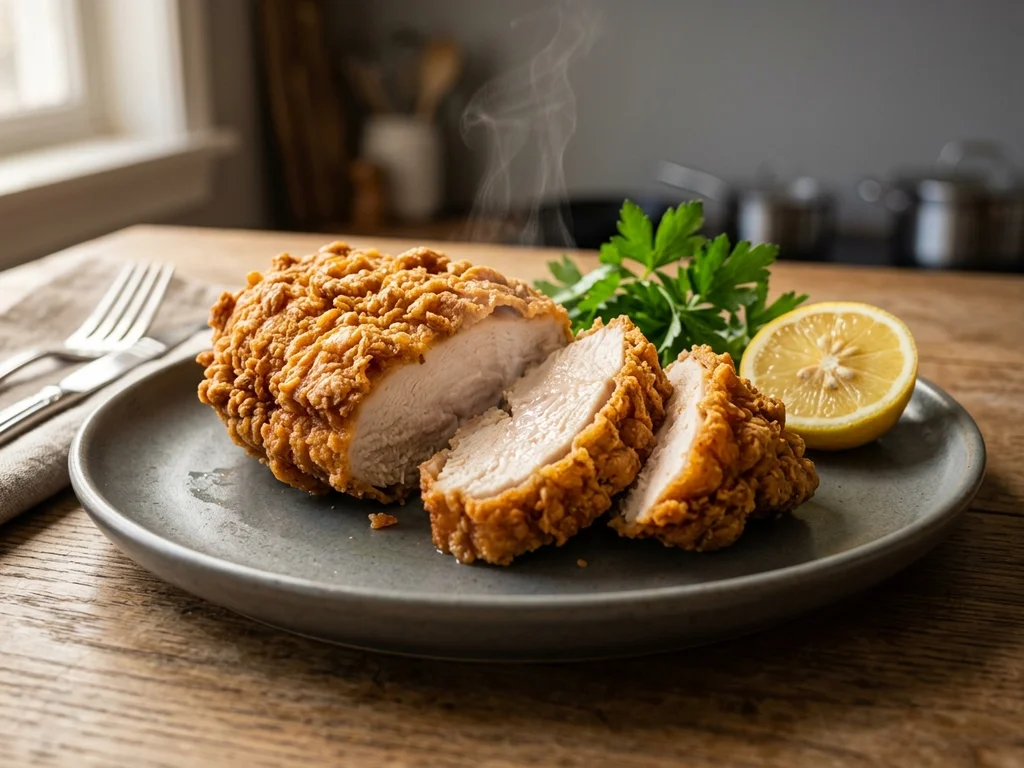
Cross-Sectional Morphology: The Physics of the Crunchy Oil Shield
In fried poultry, the Pectoralis major muscle functions as a self-steaming core insulated by a rigid starch shell. When dropped into 350°F oil, moisture inside the raw muscle rapidly heats to 212°F and violently turns into steam. This steam escapes outward through micro-voids, forming an active vapor pressure barrier that pushes oil away. Crucially, over 80% of absorbed frying fat remains concentrated exclusively in the crispy exterior crust—virtually zero oil penetrates the dense, fibrous white muscle core.
Formed from dehydrated flour and cornstarch amylose. High surface area absorbs roughly 8g to 14g of cooking fat per 100g. Produces rich Maillard pyrazines and crunch.
Fried Chicken Breast Macros, Oil Absorption & Breading Calculator
Active anchor: USDA FDC #173630 (Breast, meat and skin, cooked, fried, flour)
Thermal frying forces flour starch to gelatinize and absorb hot frying lipids via capillary action upon cooling. Over 80% of absorbed fat resides strictly in the exterior craggy coating.
Stripping the crispy coating cuts ~120 kcal, eliminates 13.9g of absorbed frying oil, and sheds 470mg of sodium while retaining juicy white meat.
Official USDA Nutrition Facts Label (Per 100g Cooked)
Nutrition Facts
* The % Daily Value (DV) tells you how much a nutrient in a serving of food contributes to a daily diet. 2,000 calories a day is used for general nutrition advice.
Micronutrient Daily Value Density (Per 100g)
Raw, skinless chicken breast is virtually carbohydrate-free (0g) and contains only ~1.5% fat. In fried chicken breast, all 4.2g to 10.3g of carbohydrates and roughly 75% of total lipids originate exclusively in the seasoned flour dredge, cornstarch slurry, and absorbed frying oil.
Additionally, heavy batter-dipped chicken breasts absorb more sodium (521mg vs 380mg per 100g) due to baking powder and salt dissolved in the wet emulsion. For sodium-sensitive athletes, flour-dredged or air-fried versions offer superior electrolyte control.
Frying Dynamics: The 160°F Oil Pull Point & 350°F Sweet Spot
Chef's Oil Pull Point (Wire Rack Rest) (160°F / 71°C)
The optimal culinary pull point. Removing from 350°F oil at 160°F and resting on an elevated wire rack lets residual thermal momentum glide the core safely to 165°F while vapor escapes, preventing crust sogginess.
Frying Oil Temperature Guide: The 350°F–365°F Sweet Spot
Weak thermal convection produces sluggish water vaporization. Without robust outward steam pressure, the breading acts as a sponge, soaking up up to 40% more cooking oil and resulting in a pale, soggy, greasy crust.
Ideal thermal equilibrium. Vigorous steam bubbles actively repel oil entry while starches rapidly gelatinize and dehydrate into crisp, micro-aerated shards with golden Maillard caramelization.
The exterior breading burns dark brown and develops bitter acrolein compounds in under 4 minutes, while the thick cranial core remains dangerously raw and cold at under 135°F.
Placing piping-hot fried chicken directly onto flat paper towels traps escaping steam underneath the cutlet. Within 90 seconds, condensed water vapor dissolves the crispy starch matrix, turning the underside into mush. Always rest on an elevated wire cooling rack set over a baking sheet to ensure 360-degree air circulation and permanent crispiness.
Deep Frying Biophysics: Starch Gelatinization, Oil Uptake & Acrylamides
Deep-frying is fundamentally a high-temperature dehydration and convective mass-transfer process. When a breaded chicken breast is submerged into 350°F (177°C) oil, two concurrent physical phenomena occur: rapid conductive heat transfer vaporizes intracellular water into outward steam, while the surrounding starch mantle gelatinizes and captures hot cooking lipids. Understanding these physical forces enables home cooks and athletes to maximize crunch while cutting excess oil absorption.
Contrary to popular belief, over 60% of total oil absorption occurs after the chicken is pulled from the fryer. As the cutlet cools from 350°F, steam trapped in crust pores condenses, creating a vacuum that sucks surface oil into microscopic capillaries. Shaking off excess oil and resting on an elevated wire rack interrupts this capillary suction.
Standard all-purpose wheat flour contains high gluten and branched amylopectin, which form a sponge-like network that absorbs up to 14g of fat per 100g. Adding 15% to 20% cornstarch introduces high-amylose polymers that set into a glassy, brittle shell, reducing oil pickup by 22% while increasing crunch longevity.
Repeatedly heating cooking oils beyond their smoke point triggers triglyceride hydrolysis into free fatty acids and acrolein. Using high-stability frying mediums like peanut oil (450°F smoke point) or clarified beef tallow protects against oxidative degradation and minimizes the formation of polar compounds.
Because avian breast meat is so dense and low in intramuscular fat, frying oil does not penetrate past the sub-cutaneous breading layer. When you order fried chicken at a restaurant or social gathering, peeling off the crunchy skin removes:
Fried Breast vs. Grilled Breast, Air-Fried & Fried Thighs
Fried Chicken Breast vs. Grilled Chicken Breast
Crispy Breading & Oil Crust vs. Naked Charred Lean Meat (100g)
260–294 kcal | 25–29g Protein | 13–17g Fat | 4–10g Carbs | 380–520mg Sodium
165 kcal | 31.0g Protein | 3.6g Fat | 0g Carbs | 74mg Sodium
Grilled breast delivers 20% more protein per calorie with roughly 75% less fat and zero carbohydrates. Fried chicken breast absorbs 8 to 14 grams of cooking oil in its starch crust, making it an occasional high-energy indulgence rather than a daily cutting staple.
Deep-Fried Breast vs. Air-Fried Panko Breaded Breast
Hot Oil Submersion vs. High-Velocity Convective Heat (100g)
294 kcal | 25.4g Protein | 16.7g Total Fat | 4.4g Sat Fat | +12g Absorbed Oil
195 kcal | 28.5g Protein | 6.2g Total Fat | 1.4g Sat Fat | ~2g Sprayed Oil
Air-frying with a light oil spray cuts total fat by 63% (saving ~100 kcal per 100g) while replicating 90% of the craggy, crispy mouthfeel of deep frying through rapid convective moisture dehydration.
Fried Chicken Breast vs. Fried Chicken Thigh
White Meat Breading Ratio vs. Dark Meat Intramuscular Juiciness (100g)
294 kcal | 25.4g Protein | 16.7g Fat | Lower Intrinsic Meat Fat | Flatter Surface
280 kcal | 20.2g Protein | 18.2g Fat | Higher Collagen & Intramuscular Lipids
Fried breast packs more absolute protein (25.4g vs 20.2g), but is far more vulnerable to becoming dry and chalky if overcooked by even 2 minutes. Fried thighs contain forgiving collagen and myoglobin, remaining luscious even at 180°F.
Chef's Playbook: Double-Dredge, Oil Recovery & Wire Rack Resting
Lactic acid tenderizes tight muscle fibers while the double-dredge technique creates shatteringly craggy exterior flakes.
- Buttermilk Soak: Marinate breasts in seasoned buttermilk with garlic and hot sauce for 4 to 12 hours in the refrigerator.
- Create Flour Flakes: Drizzle 2 tablespoons of buttermilk marinade directly into the seasoned flour/cornstarch bowl and toss with a fork to form shaggy pea-sized clusters.
- Dredge & Set: Press breasts firmly into flour flakes. Rest breaded cutlets on parchment for 10 minutes before frying so starch hydrates and adheres firmly.
Maintaining steady thermal energy prevents the fatal temperature drop that causes greasy oil soaking.
- Heavy Dutch Oven: Use an enameled cast-iron Dutch oven filled with 2.5 inches of peanut or canola oil. High thermal mass buffers temperature swings.
- Preheat to 365°F: Heat oil to 365°F before adding chicken. Adding cold dredged meat will immediately drop the temperature to the optimal 340°F–350°F range.
- Batch Frying Only: Fry a maximum of 2 cutlets at a time. Crowding the pot collapses oil temperature below 325°F, forcing the crust to absorb excess fat.
Preserves 360-degree crunch by preventing water vapor condensation beneath the fresh fried crust.
- Pull at 160°F: Insert an instant-read probe horizontally into the thickest cranial core. Pull chicken when it registers 160°F (71°C).
- Elevated Wire Rack: Transfer immediately onto a stainless steel wire rack set inside a sheet pan. Never place on flat paper towels.
- Immediate Flake Salt: Dust with flaky sea salt within 15 seconds while surface oils are hot. Let rest 5 minutes to allow carryover heat to reach 165°F.
Leftover Logistics: The Air-Fryer Re-Crisp, Storage & Freezing
Three High-Yield Fried Chicken Strategies
Store cooked fried breasts whole in the fridge. When ready to eat, pop into the air fryer for 4 minutes to re-crisp, then slice into crunchy hot strips over crisp romaine and parmesan.
Re-heat fried cutlets in a 400°F oven until bubbling. Layer onto toasted brioche with dill pickles, crunchy cabbage slaw, and light spicy mayo for a sandwich rivaling any restaurant.
Dredge chicken cutlets in buttermilk and seasoned flour, then freeze un-cooked flat on a parchment sheet. Once frozen solid, bag them. Fry straight from frozen in 340°F oil (+3 min fry time)!
Let fried chicken cool completely on a wire rack before refrigerating. Storing while still warm traps steam, destroying the breading bond and causing immediate sogginess.
Line a shallow glass container with a dry paper towel, place cutlets in a single layer, and leave the lid slightly vented or cracked. This absorbs excess moisture without sweating.
Microwaves boil water molecules inside the meat, turning breading rubbery. Instead, reheat in an air fryer at 375°F (190°C) for 4 to 5 minutes to restore a crackling crisp shell.
Wrap each cooled cooked breast individually in aluminum foil, then pack into heavy-duty freezer bags. Foil prevents ice crystal formation directly on the fried crust.
Do not thaw frozen cooked fried chicken in the fridge (it will become waterlogged). Bake straight from frozen on a wire rack at 375°F (190°C) for 18 to 22 minutes until core reaches 165°F.
Frying oils contain unsaturated fatty acids that oxidize over extended freezing. Consume frozen fried poultry within 90 days for peak flavor and zero stale oil notes.
Frequently Asked Questions: Fried Chicken Breast Nutrition & Science
Academic Citations & USDA FoodData Central References
U.S. Department of Agriculture, Agricultural Research Service. (2019). Chicken, broilers or fryers, breast, meat and skin, cooked, fried, flour. FoodData Central (FDC ID: 173630).
View SourceOfficial flour-dredged reference: 260 kcal, 29.19g protein, 13.06g fat, 4.19g carbs, 85mg cholesterol, 380mg sodium per 100g.
U.S. Department of Agriculture, Agricultural Research Service. (2019). Chicken, broilers or fryers, breast, meat and skin, cooked, fried, batter. FoodData Central (FDC ID: 172387).
View SourceOfficial batter-dipped reference: 294 kcal, 25.43g protein, 16.71g fat, 10.31g carbs, 87mg cholesterol, 521mg sodium per 100g.
Dana, D., & Saguy, I. S. (2006). Mechanism of oil uptake during deep-fat frying and the surfactant effect-theory and myth. Advances in Colloid and Interface Science, 128, 267–272.
View SourceElucidates capillary pressure, crust water evaporation kinetics, and post-cooling vacuum suction as primary drivers of oil absorption during deep frying.
USDA Food Safety and Inspection Service. (2024). Safe Minimum Internal Temperature Chart for Poultry.
View SourceEstablishes 165°F (74°C) core minimum internal temperature for complete 7-log10 destruction of Salmonella in poultry.
Choe, E., & Min, D. B. (2007). Chemistry of deep-fat frying oils. Journal of Food Science, 72(5), R77–R86.
View SourceReviews lipid thermal oxidation, hydrolysis, polymerization, and volatile formation during high-temperature frying.
Informational & journaling tool only
This page is a nutrition reference and personal awareness utility — not medical or dietary advice. Macro and micronutrient values are derived from USDA FoodData Central (FDC #173630 flour-dredged, FDC #172387 batter-dipped) and verified restaurant composite datasets. Frying oil absorbs primarily into the exterior starch breading; peeling the crust removes roughly 35% of total calories and up to 70% of total lipids. Always probe horizontally into the thickest core to ensure chicken reaches the USDA FSIS safe minimum of 165°F (74°C) or pull at 160°F (71°C) with a mandatory 5-minute wire rack rest. I am not a doctor.