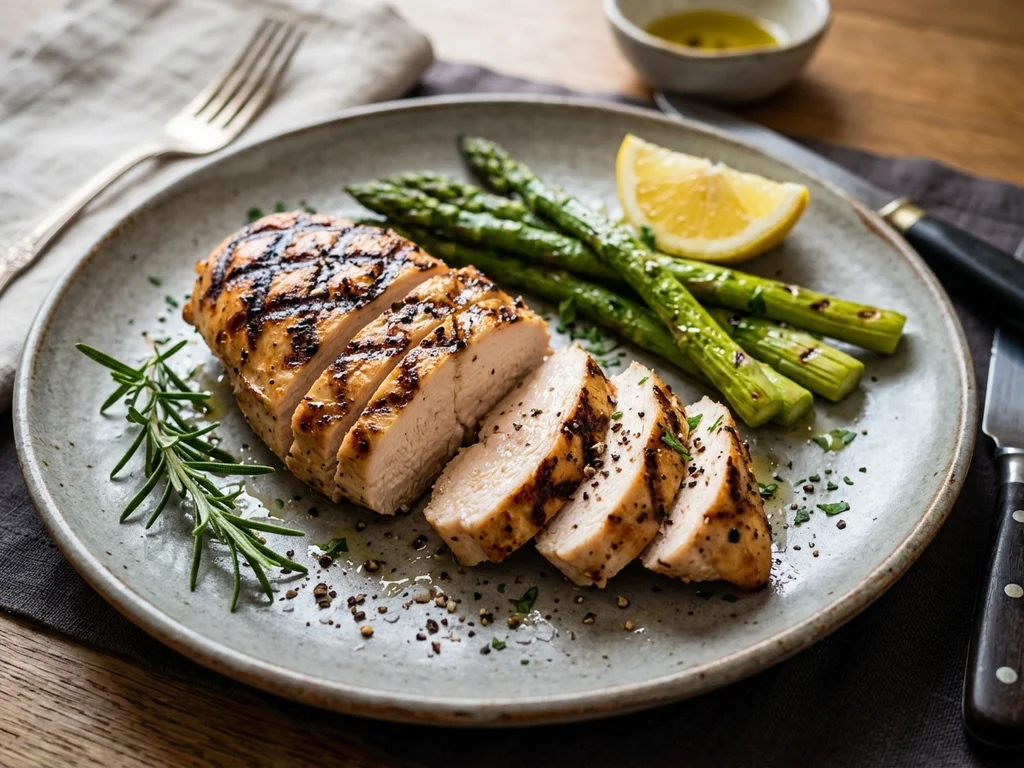
Morphology & Thermodynamics: Overcoming the Thickness Taper
The avian breast is dominated by the Pectoralis major, a massive, unworked flight muscle composed of pure Type IIB fast-twitch white fibers. Structurally, it presents a common grilling challenge: the cranial head is often 1.5 inches thick, while the caudal tail tapers down to barely 0.25 inches. If thrown directly onto an open flame, the thin tail will incinerate into dry string before the center registers a food-safe 165°F. Solving this requires leveling the meat to a uniform 0.75-inch thickness and employing a two-zone direct/indirect grill setup.
Cook breast directly over glowing coals for 2 to 2.5 minutes per side. Generates dark diamond Maillard char without cooking the interior through.
Grilled Chicken Breast Macros, Leucine & Calorie Calculator
Selected: Classic Lemon, Garlic & Herb Grilled Breast — Fresh lemon juice, minced garlic, oregano, parsley, sea salt, 1 tsp olive oil
This portion lists ≥2.5g leucine — a common sports-nutrition reference portion size cited in food-composition literature. Log this value when comparing protein entries in your food journal.
Official USDA Nutrition Facts Label (Per 100g)
Nutrition Facts
Micronutrient & Leucine Density in White Breast Muscle (Per 100g)
Grilled chicken breast lists high B-vitamin, phosphorus, and essential amino acid values in USDA tables with near-zero carbohydrate and low saturated fat per 100g.
Sodium Watch: Fresh Grilled vs. Store-Bought Deli Strips
Fresh unseasoned grilled chicken breast naturally contains only 74mg sodium per 100g (3% DV). In contrast, commercial pre-cooked grilled chicken strips (Tyson, Trader Joe's) are injected with sodium phosphate solutions to maintain shelf hydration, packing 420mg to 550mg sodium per 100g (almost 6× higher). Grilling fresh breasts at home provides total sodium control.
Grilled Chicken Breast Internal Temperature & Doneness Guide
Because chicken breast is an ultra-lean muscle with virtually no insulating fat or gelatin, thermal precision is paramount. Undercooking leaves the core below the USDA FSIS 165°F (74°C) poultry minimum, while heating past 175°F (79°C) contracts muscle fibers into dry, chalky "cardboard." Pulling the breast off direct heat at 160°F with a 5-minute tented carryover rest reliably reaches the safe 165°F floor while locking in 15% more juice.
160°F (71°C) — Chef's Pull Point (Maximum Juiciness)
The sweet spot for grilled poultry. Pulling the breast off the direct heat at 160°F and tenting with foil for 5 minutes allows carryover thermal momentum to hit 165°F while trapping 15% more intracellular water.
Never probe a chicken breast from the top down; the thin depth often leads to false surface readings or hitting the grill grate below. Always insert a digital instant-read probe horizontally through the side directly into the geometric center of the thickest cranial head.
During high-heat grilling, intracellular water is driven under pressure toward the center of the breast. Slicing immediately causes up to 20% of total moisture to purge onto the cutting board. Resting under loose foil for 5 minutes allows relaxed muscle filaments to reabsorb free water, ensuring succulent medallions.
Leucine Profile, Moisture Concentration & HCA Reduction
Grilled chicken breast is one of the leanest high-protein cuts in USDA FoodData Central. Understanding its amino acid profile, moisture loss during grilling, and high-heat compound formation helps you log accurate portions and choose marinades — this is food-composition and cooking chemistry for personal awareness only, not personalized nutrition advice.
USDA amino acid data for cooked grilled breast (FDC #171477) lists ~2.62g leucine per 100g. A standard 174g cooked breast delivers ~4.5g leucine. Use these values when comparing protein sources in a food journal — leucine is one of nine essential amino acids listed in USDA tables.
Raw breast is ~74% water and ~22.5% protein. High-heat grilling evaporates surface moisture and shrinks weight by ~20–25% (e.g., 225g raw → ~174g cooked). Nutrients concentrate: 100g grilled breast packs 31.0g protein — a ~38% increase in protein density over raw meat per USDA tables.
Charring above 300°F can form heterocyclic amines (HCAs) in muscle foods. Smith et al. (2008) found that marinating in rosemary, garlic, and citrus reduced HCA formation by up to 90% in grilled chicken breasts — a food-chemistry finding useful when choosing prep methods.
Protein has a higher Thermic Effect of Food than fat or carbohydrates — roughly 20% to 30% of protein calories are expended during digestion and metabolism (vs ~0–3% for fat and ~5–10% for carbs). This is a standard nutrition-science figure for macro comparison, not a personalized intake recommendation.
To reduce char-related compound formation while keeping grill flavor, incorporate these three ingredients (Smith et al., 2008):
- Fresh Rosemary & Thyme: Rosmarinic and carnosic acids inhibit amino-imidazole-azaarene formation during high-heat cooking.
- Crushed Fresh Garlic: Organosulfur compounds (allicin) reduce polycyclic aromatic hydrocarbon (PAH) formation on charred surfaces.
- Lemon Juice or Apple Cider Vinegar: Mild acidity creates a surface barrier that limits excessive char buildup while tenderizing muscle strands.
Grilled Chicken Breast vs. Grilled Thigh, Cutlet & Sirloin Steak
Grilled Chicken Breast vs. Grilled Chicken Thigh
Lean White Muscle vs. Rich Myoglobin Dark Meat (100g Cooked)Grilled breast delivers ~29% more protein per 100g with ~67% less fat (FDC #171477 vs thigh tables), making it the higher protein-to-calorie entry for food journals. Grilled thigh offers richer myoglobin and more intramuscular fat, making it harder to dry out on high heat.
Chef's Playbook: Pounding, Two-Zone Grilling & Cast-Iron Pan Sear
Eliminates the tapered thickness problem while denaturing myofibrillar proteins for 15% greater intracellular hydration.
- Pound to 3/4-Inch: Place breast between plastic wrap sheets. Using the flat side of a meat mallet, pound the bulbous cranial head until the entire cutlet is a uniform 0.75-inch thickness.
- 1% Dry-Brine: Sprinkle 1g coarse kosher salt per 100g raw meat (approx. 1/2 tsp per large breast). Rest uncovered on a wire rack in the fridge for 30 to 60 minutes.
- Surface Osmosis: Salt draws moisture out, dissolves into a concentrated brine, and is reabsorbed, unwinding myosin strands so they trap free moisture during cooking.
Separates surface Maillard browning from internal thermal progression for restaurant-grade diamond grill marks.
- Set Up Zones: Bank hot coals to one side or ignite half the gas burners to high (450°F–500°F). Leave the other half unlit (325°F–350°F convection zone).
- Direct Maillard Sear: Lay breast presentation-side down over direct fire. Sear 2 to 3 minutes, rotate 45 degrees for crosshatch diamond marks, and sear 1 more minute. Flip and sear reverse for 2 minutes.
- Indirect Lid Glide: Transfer breast to the indirect cool zone. Close grill lid and let convective heat glide the core to exactly 160°F (approx. 4–6 minutes).
Replicates outdoor char and smoky aroma in an apartment kitchen using high thermal mass cast iron.
- Preheat Pan 8 Minutes: Heat a ridged cast-iron pan over medium-high heat until faint wisps of smoke rise. Do not oil the pan (which causes excessive smoke); lightly brush oil directly onto the chicken cutlet.
- Apply Gentle Weight: Lay chicken across the ridges. Place a small parchment sheet and a clean heavy skillet or burger press on top for 90 seconds to press ridges firmly against the meat.
- Oven Finish: Sear 3 minutes total on side 1, flip for 2 minutes, then transfer the entire pan into a preheated 375°F (190°C) oven for 4 to 5 minutes until horizontal probe reads 160°F.
Sunday Meal-Prep Blueprint, Storage & Reheating Kinetics
Three High-Yield Meal-Prep Strategies
Grill 5 pounded breasts on Sunday to 160°F. Rest completely, slice into 1/2-inch strips, and portion into 5 glass meal-prep containers with sweet potato wedges, broccoli florets, and jasmine rice.
Store breasts whole rather than pre-sliced in airtight Pyrex containers. Intact surface membranes prevent moisture evaporation, keeping chicken 30% juicier on Days 3 and 4. Slice right before eating!
Toss raw pounded breasts directly into zip-top bags with lemon-herb or garlic-rosemary marinade and freeze immediately. As the bags thaw in the fridge on Wednesday, the marinade infuses automatically.
Chill cooked breasts within 2 hours of grilling. Seal in shallow glass containers to accelerate rapid core chilling below 40°F per USDA FSIS leftovers guidance.
Cold grilled chicken breast makes a refreshing protein topper for Caesar salads, quinoa bowls, or lavash wraps with Greek yogurt dressing — log ~31g protein per 100g in your journal.
Avoid 1000W microwave dry reheating. Heat a nonstick skillet over medium heat, add 2 tablespoons chicken bone broth, add sliced breast, and cover for 2 minutes. Steam re-hydrates muscle fibers completely.
Vacuum sealing removes air pockets that cause freezer burn and sublimation of ice crystals. Defrost overnight in the refrigerator for like-fresh texture and juiciness.
Spread grilled strips spaced out on parchment paper and freeze for 60 minutes until rock solid. Transfer into a zip bag; strips won't stick together, allowing you to measure 100g servings on demand.
In a rush? Submerge the sealed bag in a bowl of cold tap water. Change water every 15 minutes; a 174g breast thaws fully in under 30 minutes without surface cooking.
Frequently Asked Questions: Grilled Chicken Breast Nutrition & Science
Academic Citations & USDA FoodData Central References
U.S. Department of Agriculture, Agricultural Research Service. (2019). Chicken, breast, meat only, cooked, grilled / roasted. FoodData Central (FDC ID: 171477).
View SourceOfficial grilled reference: 165 kcal, 31.02g protein, 3.57g fat, 1.01g saturated fat, 85mg cholesterol, 74mg sodium per 100g.
U.S. Department of Agriculture, Agricultural Research Service. (2019). Amino acid profile — Chicken, breast, meat only, cooked, grilled. FoodData Central (FDC ID: 171477).
View SourceOfficial amino acid anchor: ~2.62g leucine, ~31.02g protein, complete essential amino acid profile per 100g cooked grilled breast.
Smith, J. S., Ameri, F., & Gadgil, P. (2008). Effect of marinades on the formation of heterocyclic amines in grilled beef steaks and chicken breasts. Journal of Food Science, 73(6), T100–T105.
View SourceDemonstrates that rosemary and herbal antioxidant marinades reduce heterocyclic amine (HCA) formation during high-heat grilling by up to 90%.
USDA Food Safety and Inspection Service. (2024). Safe Minimum Internal Temperature Chart for Poultry.
View SourceKitchen reference: 165°F (74°C) minimum internal temperature for all poultry, including grilled breast.
USDA Food Safety and Inspection Service. (2024). Leftovers and Food Safety.
View SourceKitchen reference: refrigerate cooked poultry within 2 hours and use leftovers within 3–4 days.
U.S. Department of Agriculture, Agricultural Research Service. (2019). Chicken breast strips, grilled, pre-cooked. FoodData Central (FDC ID: 174575).
View SourceCompares sodium and phosphate retention in commercial ready-to-eat grilled chicken strips (420mg sodium per 100g).
Informational & journaling tool only
This page is a nutrition reference and personal awareness utility — not medical or dietary advice. Macro, micronutrient, and amino acid values are derived from USDA FoodData Central (FDC #171477 cooked grilled breast, FDC #174575 commercial strips) and peer-reviewed food-science literature (Smith et al., 2008 HCA reduction). Lean chicken breast contains virtually no intramuscular fat; grilling beyond 175°F (79°C) contracts myofibrillar protein filaments and squeezes out cellular moisture. Always probe horizontally into the thickest core to ensure chicken reaches the USDA FSIS safe minimum of 165°F (74°C) or pull at 160°F (71°C) with a mandatory 5-minute tented carryover rest. I am not a doctor.