Grilled vs. Fried Chicken Nutrient Matrix
Compare USDA SR Legacy entries for roasted/grilled vs battered fried chicken by cut, portion size, and comparison focus.
USDA values are identical across focus modes — labels help you interpret the table.
Roasted/Grilled Skinless Breast vs. Fried Battered Breast
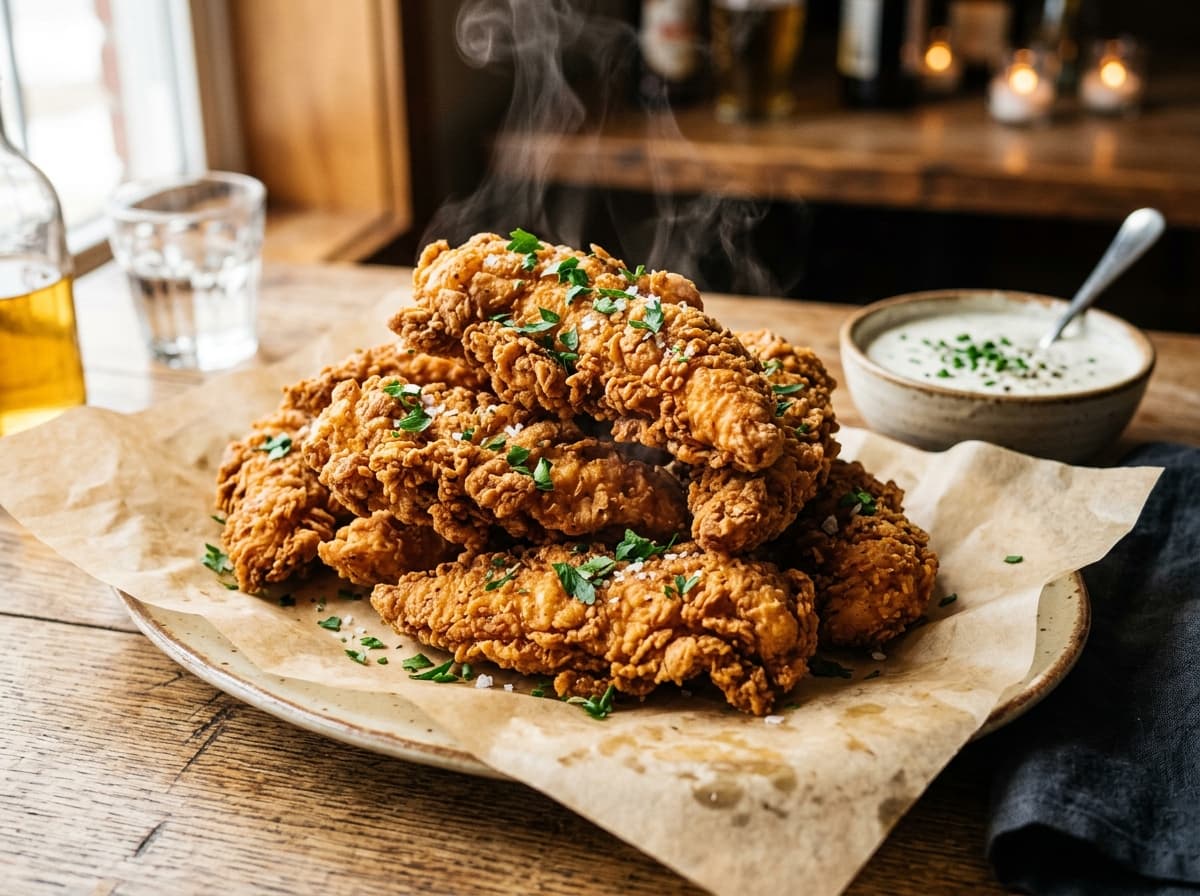
100 g · FDC 171477 vs 171475Grilled or roasted skinless breast lists ~165 kcal and ~31 g protein per 100 g. Fried breast with batter and skin (FDC 171475) lists ~260 kcal, ~25 g protein, ~13 g fat, and ~9 g carbohydrate from flour coating — a common USDA pairing when comparing dry-heat vs deep-fried breast.
95 kcal difference at this portion
Breading and oil dilute protein per calorie
Oil uptake in battered preparations
Flour coating adds starch to fried rows
Nutrient table (100 g portion)
FDC 171477 (grilled/roasted) · FDC 171475 (fried)| Nutrient | Unit | Grilled / roasted | Fried / battered | Difference |
|---|---|---|---|---|
| Energy | kcal | 165 | 260 | +58% fried |
| Protein | g | 31 | 24.8 | +6.2 g grilled |
| Protein per 100 kcal | g / 100 kcal | 18.8 | 9.5 | Grilled higher |
| Total fat | g | 3.6 | 13.2 | +9.6 g fried |
| Saturated fat | g | 1 | 3.5 | +2.5 g fried |
| Monounsaturated fat | g | 1.2 | 5.5 | Higher in fried |
| Polyunsaturated fat | g | 0.8 | 3.1 | Higher in fried |
| Carbohydrate | g | 0 | 9 | Batter starch |
| Sodium | mg | 74 | 275 | +201 mg fried |
| Potassium | mg | 334 | 201 | Higher in grilled |
| Cholesterol | mg | 85 | 85 | Similar in FDC |
| Est. cost per 30 g protein | $ USD | 0.95 | 1.55 | Grilled lower |
How Frying Adds Calories
Oil uptake and flour coating shift energy density
- Breast example: Roasted skinless breast (FDC 171477) lists ~165 kcal per 100 g. Fried battered breast with skin (FDC 171475) lists ~260 kcal — about 58% more energy, mostly from absorbed fryer oil and wheat batter.
- Thigh example: Roasted skinless thigh (FDC 172388) ~179 kcal vs fried battered thigh (FDC 172386) ~277 kcal per 100 g.
- Wing example: Roasted wings with skin (FDC 173630) ~254 kcal vs flour-fried wings (FDC 173629) ~321 kcal per 100 g.
- Restaurant portions often exceed SR Legacy lab values because breading is thicker, oil is reused, and extra salt or sauce is added after cooking — weigh your portion when exact numbers matter.
Why Fried Chicken Lists More Calories and Fat in USDA Tables
Grilling or roasting lets surface fat render away on skinless cuts. Deep frying adds oil and starch to the finished weight — the numbers below use the standard SR Legacy breast pair (FDC 171477 vs 171475).
Frying adds ~95 kcal per 100 g in the SR Legacy breast pair — mostly from absorbed oil and flour batter.
Capillary oil uptake into the starch crust is the main reason fried FDC rows list several times more fat than skinless roasted breast.
Flour dredge adds digestible carbohydrate that plain grilled breast lacks in USDA tables.
Same muscle protein — but batter and oil increase calories faster than protein grams, lowering protein density per calorie.
Fat rendering on the grill
Direct heat liquefies subcutaneous fat on skin-on pieces; some drips through the grates. Skinless roasted entries (FDC 171477, 172388) already reflect trimmed, cooked muscle without batter.
Oil uptake in the fryer
Steam leaving the batter creates voids; cooling pulls surface oil inward (Mellema, 2003). Maintaining oil near 350–365 °F (175–185 °C) is a common kitchen target to balance crust set vs excess absorption.
Starch from breading
Wheat or cornstarch dredge gelatinizes then dehydrates into a crisp shell. FDC battered rows list 2–9 g carbohydrate per 100 g depending on cut — wings carry less batter mass than breast tenders in lab preparations.
Grilled vs. Fried at a Glance
Eight parameters across breast, thigh, and wing FDC pairings — plus a practical kitchen note on storage texture.
| Parameter | Grilled / roasted | Fried / battered |
|---|---|---|
| Calories — breast (FDC 171477 vs 171475) | 165 kcal / 100 g | 260 kcal / 100 g (+58%) |
| Most extra energy comes from fryer oil and flour batter in the SR Legacy fried row. | ||
| Protein per 100 kcal — breast | 18.8 g / 100 kcal | 9.5 g / 100 kcal |
| Breading and oil add calories without proportional protein — useful when comparing portion efficiency. | ||
| Total fat — breast | 3.6 g (skinless roasted) | 13.2 g (battered, meat + skin) |
| Fried SR Legacy breast lists roughly 3.7× the fat of skinless roasted breast per 100 g. | ||
| Carbohydrate — breast | 0 g | 9.0 g (batter starch) |
| Only the fried battered row carries meaningful carbohydrate in this pairing. | ||
| Sodium — breast (SR Legacy) | 74 mg | 275 mg |
| FDC fried row includes batter salt. Restaurant recipes with brine and seasoned dredge often list higher sodium on menu panels. | ||
| Calories — thigh (FDC 172388 vs 172386) | 179 kcal / 100 g | 277 kcal / 100 g |
| Dark meat fried with batter and skin adds ~98 kcal per 100 g vs roasted skinless thigh. | ||
| Calories — wings (FDC 173630 vs 173629) | 254 kcal / 100 g (roasted + skin) | 321 kcal / 100 g (flour fried) |
| Roasted wings already carry skin fat; frying adds coating oil on top of that baseline. | ||
| Meal prep texture (kitchen note) | Reheats cleanly 3–5 days | Crust softens within ~24 h refrigerated |
| Practical storage observation — not a nutrient change unless you re-weigh after cooking. | ||
Grilled rows lead on density
Skinless roasted breast delivers ~18.8 g protein per 100 kcal vs ~9.5 g in fried battered breast (FDC 171477 vs 171475) — helpful when you want more protein grams for fewer calories.
Frying adds crisp batter
Dehydrated starch crust and steam-trapped interior moisture explain why fried chicken is often described as juicier and crunchier — a sensory difference, not a separate USDA protein type.
Match preparation to database
Use skinless roasted for plain grilled breast (171477), battered fried for tenders (171475), flour-fried wings (173629), and roasted wings with skin (173630) — mixing rows misstates fat and carbs.
Food-Chemistry Compounds: Grilling vs. Frying
Both methods use high temperatures. Published food-science literature describes distinct surface compounds — summarized here for informational context only, not as personal guidance.
Grilling & open flame
Heterocyclic amines (HCAs): Form when amino acids and creatine in meat react at high surface temperatures during dry-heat cooking. Knize & Felton (2005) reviewed formation pathways in cooked muscle foods.
Polycyclic aromatic hydrocarbons (PAHs): Can deposit on food when fat drips onto hot coals or burners and smoke rises back onto the surface — noted in grilling chemistry literature alongside HCAs.
Common kitchen techniques (literature context)
- Marinating in acidic liquids with herbs before grilling — cited in food-science reviews as reducing surface browning intensity.
- Using indirect heat after a brief sear to finish cooking without prolonged flame contact.
- Turning pieces frequently so no single surface stays at peak grate temperature for long periods.
Deep frying & battered crust
Acrylamide: Mottram et al. (2002) showed acrylamide can form when free asparagine reacts with reducing sugars during high-heat Maillard browning — relevant to starchy batters and coatings, not plain uncoated muscle.
Used frying oil: Repeatedly heated commercial fryer oil undergoes lipid oxidation and polymerization over time — a food-quality and chemistry topic in oils research, separate from the fresh SR Legacy FDC nutrient rows on this page.
Common kitchen techniques (literature context)
- Using fresh oil with a smoke point suited to ~350–365 °F (175–185 °C) frying temperatures.
- Monitoring oil temperature so batter sets quickly without sitting in cool oil that absorbs more fat.
- Draining on a wire rack after frying so surface oil does not pool on the crust.
Cooking Techniques: Grill, Fryer & Air Fryer
Practical kitchen notes for even cooking and texture. USDA safe minimum for poultry is 165 °F (74 °C) internal temperature in the thickest part, verified with a food thermometer.
Two-zone grilling
Bank coals or burners on one side for direct heat (~450 °F / 230 °C) and leave the other side off for indirect finishing (~300 °F / 150 °C). Sear 1–2 minutes per side, then move to the cool zone until the thickest part reaches 165 °F (74 °C).
Frying oil temperature
Keep oil between 350–365 °F (175–185 °C). Oil that drops below ~325 °F when cold chicken enters the pot tends to absorb more fat before the crust sets. Use a probe thermometer clipped to the pot rim.
Air-fryer middle ground
Convection at ~400 °F (200 °C) with a light oil spray on panko or flour coating approximates deep-fry crunch with fewer added fat grams. For USDA comparison, roasted skinless breast (FDC 171477, ~165 kcal) is the nearest SR Legacy proxy — community air-fry estimates often land near ~168 kcal per 100 g.
See our air-fried vs deep-fried comparison for method-specific numbers.
Choosing Grilled vs. Fried Chicken
Pick the cooking method and matching USDA FDC row based on your portion goals — not as a ranking of “good” or “bad” foods.
Grilled or roasted works well when…
- You want maximum protein grams per calorie — skinless roasted breast lists ~18.8 g protein per 100 kcal (FDC 171477).
- You are tracking zero-carbohydrate entries — plain grilled breast lists 0 g carbohydrate in USDA tables.
- You are meal prepping for several days — grilled pieces reheat without a soggy coating.
- You prefer lower sodium SR Legacy values — unseasoned roasted breast lists ~74 mg sodium per 100 g.
Fried battered chicken fits when…
- You ate restaurant-style tenders or battered pieces — use FDC 171475 (breast), 172386 (thigh), or 173629 (wings).
- You need a higher-calorie portion in fewer bites — fried breast lists ~260 kcal vs ~165 kcal grilled per 100 g.
- You are eating it fresh — the crisp crust is best within minutes of leaving the fryer.
- You want crunch with less oil than deep frying — air-fried breast is often close to roasted values (~168 vs ~165 kcal).
Frequently Asked Questions: Grilled vs. Fried Chicken
Common questions about calories, FDC entries, oil uptake, and cooking-method differences — answered with USDA tables and food-science sources.
USDA Records & Food-Science Citations
Nutrient values and cooking-chemistry notes are anchored to the verified records below. Informational only — not medical advice.
Chicken, broilers or fryers, breast, meat only, cooked, roasted
U.S. Department of Agriculture, ARS
FDC 171477
Key finding: Roasted skinless breast proxy for grilled breast: ~165 kcal, 31 g protein, 3.6 g fat, 74 mg sodium per 100 g.
Chicken, broilers or fryers, breast, meat and skin, cooked, fried, batter
U.S. Department of Agriculture, ARS
FDC 171475
Key finding: Fried battered breast with skin: ~260 kcal, 24.8 g protein, 13.2 g fat, 9 g carbohydrate, 275 mg sodium per 100 g.
Chicken, broilers or fryers, thigh, meat only, cooked, roasted
U.S. Department of Agriculture, ARS
FDC 172388
Key finding: Roasted skinless thigh: ~179 kcal, 24.8 g protein, 8.2 g fat per 100 g.
Chicken, broilers or fryers, thigh, meat and skin, cooked, fried, batter
U.S. Department of Agriculture, ARS
FDC 172386
Key finding: Fried battered thigh with skin: ~277 kcal, 21.6 g protein, 16.5 g fat, 9.1 g carbohydrate per 100 g.
Chicken, broilers or fryers, wing, meat and skin, cooked, roasted
U.S. Department of Agriculture, ARS
FDC 173630
Key finding: Roasted wings with skin: ~254 kcal, 23.8 g protein, 16.9 g fat per 100 g.
Chicken, broilers or fryers, wing, meat and skin, cooked, fried, flour
U.S. Department of Agriculture, ARS
FDC 173629
Key finding: Flour-fried wings with skin: ~321 kcal, 26.1 g protein, 22.2 g fat, 2.4 g carbohydrate per 100 g.
Mechanism and reduction of fat uptake in deep-fat fried foods
Mellema, M.
10.1016/S0924-2244(03)00050-5
Key finding: Reviews capillary suction and steam condensation as primary drivers of oil absorption into fried food surfaces — food-engineering context for why fried FDC rows list higher fat.
Formation and human risk of carcinogenic heterocyclic amines formed from natural precursors in meat
Knize, M. G., & Felton, J. S.
10.1111/j.1753-4887.2005.tb00133.x · PMID 15971410
Key finding: Documents HCA formation pathways during high-temperature meat cooking — cited here for food-chemistry context on grilled/broiled poultry surfaces, not as personal guidance.
Acrylamide is formed in the Maillard reaction
Mottram, D. S., Wedzicha, B. L., & Dodson, A. T.
10.1038/419448a · PMID 12368844
Key finding: Identified acrylamide formation from asparagine and reducing sugars in heated starchy foods — relevant to battered fried crust chemistry.
Related comparisons
Other cooking-method and cut breakdowns
Related Tools
Explore more nutrition tools to help you reach your goals
Informational only — not medical advice
Nutrient figures come from USDA FoodData Central SR Legacy: FDC 171477 / 171475 (breast), 172388 / 172386 (thigh), 173630 / 173629 (wings), plus peer-reviewed food-science sources cited below. Actual values vary with breading thickness, oil type, seasoning, and portion weight. Match the FDC entry to how the chicken was prepared.