Chicken Breast vs. Chicken Tender Nutrient Matrix
Compare plain breast (FDC 171477) against tenderloin portions and breaded styles. Informational only — not medical advice.
Plain Roasted Breast vs. Plain Roasted Tenderloin
Portion: 100g (3.5 oz)Whole breast (pectoralis major) and tenderloin (pectoralis minor) are separate muscles, but USDA SR Legacy lists one cooked skinless breast entry (FDC 171477: ~165 kcal, 31 g protein, 3.6 g fat per 100 g). For raw logging, use FDC 171077 (~120 kcal, 22.5 g protein, 2.6 g fat). Differences on this page are anatomical and culinary — size, tendon, cook time — not separate USDA macro rows.
Delta: 0 kcal per 100g portion
Plain cooked rows use the same FDC 171477 baseline unless breading is selected
Breading absorbs significant frying oil on tenders
Uniform 0.5" tender strips cook without uneven drying
Nutrient table (100g portion)
Plain meat: FDC 171477 · Raw proxy: FDC 171077 · Fried breaded proxy: FDC 171475| Nutrient Parameter | Unit | Whole Chicken Breast | Chicken Tender | Comparative Delta | Logging edge |
|---|---|---|---|---|---|
| Energy / Calories | kcal | 165 | 165 | Same FDC row | Neutral |
| Protein | g | 31 | 31 | Same FDC row | Neutral |
| Protein Density per 100 kcal | g / 100 kcal | 18.8 | 18.8 | 18.8g vs 18.8g | Breast Leads |
| Total fat | g | 3.6 | 3.6 | +0.0g Tender | Breast Leads |
| Saturated Fatty Acids | g | 1 | 1 | +0.0g Tender | Breast Leads |
| Monounsaturated Fat (Oleic) | g | 1.2 | 1.2 | 0.0g Delta | Neutral |
| Polyunsaturated Fat (Omega 6/3) | g | 0.8 | 0.8 | 0.0g Delta | Neutral |
| Carbohydrates (incl. breading) | g | 0 | 0 | 0.0g (Both Zero Carb) | Breast Leads |
| Dietary Sodium | mg | 74 | 74 | Comparable (~70mg) | Breast Leads |
| Zinc | mg | 1 | 1 | Comparable (~1.0mg) | Neutral |
| Iron | mg | 1 | 1 | Comparable (~1.0mg) | Neutral |
| Cost per 30g Pure Protein | $ USD | 0.95 | 1.25 | Breast $0.95 vs $1.25 | Breast Leads |
Pectoralis major (breast) vs. pectoralis minor (tenderloin)
A whole breast fillet is mostly pectoralis major. The tenderloin is the smaller pectoralis minor strip tucked along the keel bone. Many products labeled "tenders" are breast meat cut into fingers — check the package. For USDA logging, plain cooked breast and true tenderloin both map to FDC 171477 unless your label lists different values.
Breast vs. Tenderloin: Muscle, Tendon & Cook Time
Supermarket "tenders" are not always true tenderloins — check the label. Plain cooked macros use the same FDC breast row unless breading is added.
Two separate muscles — the large breast fillet vs the smaller tenderloin tucked underneath.
Tenderloin strips are thinner and often feel softer — a texture difference, not a separate USDA macro row for plain meat.
Strip the tendon before cooking to avoid chewy bites and curling during heat.
Even thickness lets tenderloins finish quickly — verify 165°F (74°C) with a food thermometer.
Breast vs. Tenderloin at a Glance
Side-by-side notes for food logging and kitchen planning. Primary plain-meat numbers from FDC 171477 unless noted.
| Parameter | Chicken breast | Chicken tenderloin | Logging note |
|---|---|---|---|
| Muscle & cut | Pectoralis major (whole fillet) | Pectoralis minor (tenderloin strip) | Separate muscles — breast is larger (~150–250 g); tenderloin is smaller (~35–50 g per piece). |
| Plain cooked macros (USDA) | 165 kcal / 31 g protein / 3.6 g fat | Same FDC 171477 row when plain | SR Legacy has no separate tenderloin cooked entry — log plain grilled/roasted meat with FDC 171477 unless your label differs. |
| Breaded & fried macros | Rarely sold breaded whole | ~260 kcal / 24.8 g protein / 13.2 g fat (FDC 171475 proxy) | Small strips pick up batter and oil — use FDC 171475 or brand labels for restaurant tenders. |
| Protein per 100 kcal | 18.8 g (plain) | 18.8 g plain · ~9.5 g if fried breaded | Breading and oil dilute protein density per calorie in fried rows. |
| Central tendon | None on fillet | White tendon on one edge | Remove before cooking to avoid chewy bites and curling — a prep step, not a nutrient change. |
| Typical cook time | 12–15 min (tapered shape) | 3–5 min (uniform thickness) | Thin tenderloins reach doneness faster; use a thermometer for poultry (165°F / 74°C). |
| Surface area | Lower crust-to-mass ratio | Higher when cut into strips | More edge area means marinades and breading coat a larger share of total weight on strips. |
| Retail cost | Lower $/lb (bulk fillets) | Higher $/lb (two strips per bird) | Breast wins cost per 30 g protein; tenderloins win prep speed for small portions. |
Whole breast for volume logging
Large fillets hold shape in containers and cost less per pound — best when you need many identical protein portions from one pack.
Tenderloins for fast cooking
Uniform strips sear in minutes without butterflying a thick fillet — useful when you want small portions ready fast.
Log breading separately
Restaurant-style tenders add carbs, fat, and sodium from batter and fryer oil — switch the matrix to the fried profile or use FDC 171475.
Tendon Removal & Quick-Cook Methods
Prep and cooking tips for plain tenderloins. Cook all poultry to 165°F (74°C) measured at the thickest part.
Fork-and-towel tendon pull
Hook the white tendon tip in a fork tine, grip the end with a paper towel, and push the fork down the strip so the tendon slides out before cooking.
Skillet flash sear
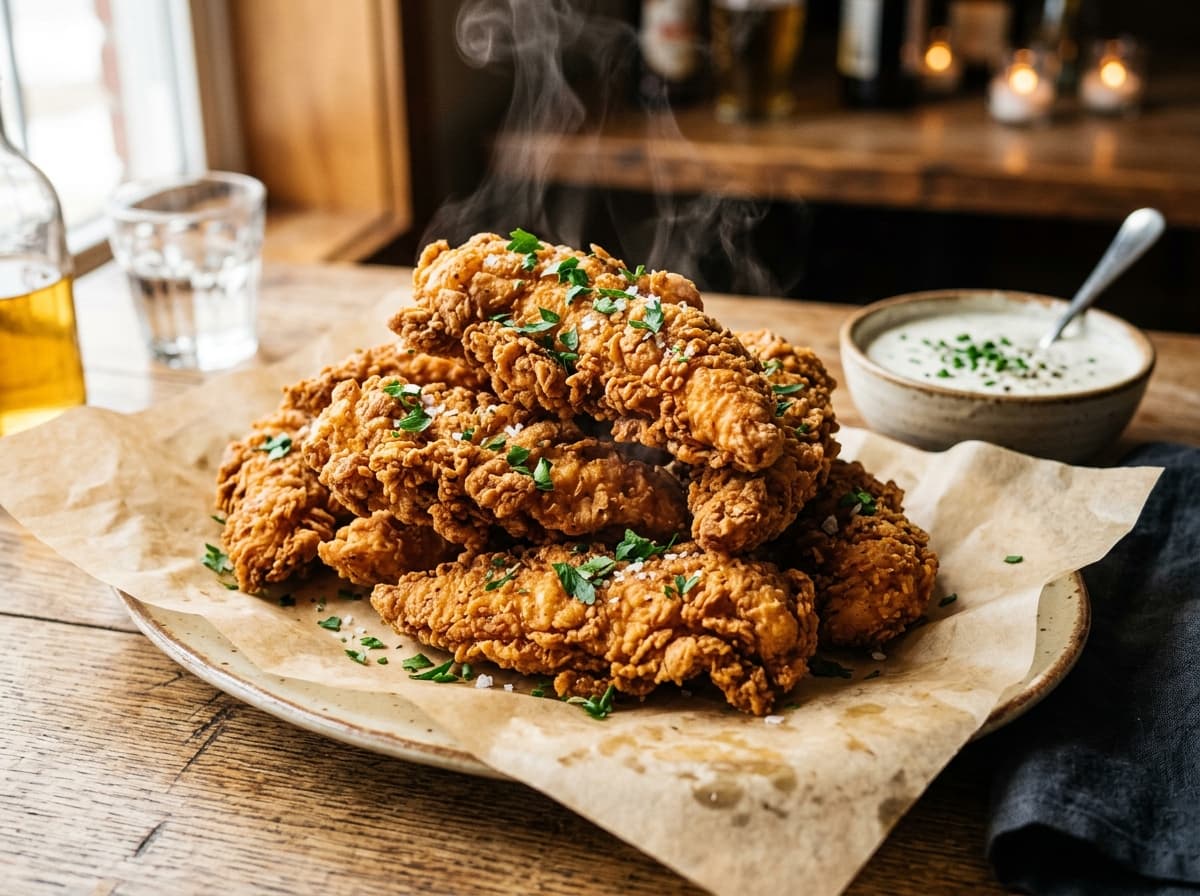
Sear plain strips ~2 min per side in a hot skillet. Pull at 165°F — thin strips overcook quickly if left on high heat too long.
Air-fryer panko strips
Coat stripped tenderloins in egg white and seasoned panko, spray lightly with oil, and air-fry at ~400°F (204°C) for 8–10 minutes, flipping once. Log as the air-fried estimate row in the matrix (~200 kcal per 100 g).
Sauce Cups Often Add More Calories Than the Chicken
Breaded tenders have high surface area, so each dip picks up sauce quickly. Log sauce as its own row — values below are typical ~1.5 oz cup estimates from published brand nutrition panels.
Raising Cane's-style sauce
Per ~1.5 oz dipping cupChick-fil-A sauce
Per ~1.5 oz dipping cupRanch dressing
Per ~1.5 oz dipping cupHot / buffalo sauce
Per ~1.5 oz dipping cupExample combo math
Four fried tenders (~380 kcal) plus two signature sauce cups (~380 kcal) can reach ~760 kcal before fries or drinks. For lower-calorie journals, hot sauce, mustard, or lemon juice add minimal energy compared to cream-based dips.
When to Choose Chicken Breast vs. Chicken Tender
Pick the column that matches how you shop and cook — batch prep cost vs quick single portions vs breaded restaurant-style rows.
Choose Whole Chicken Breast When…
- Batch weekly meal prepping: Large 200–250g fillets hold up exceptionally well to baking, grilling, and shredding for multi-day meal containers.
- Tight grocery budgets: Boneless skinless breast ($2.99–$3.99/lb) costs 25–40% less per pound than premium trimmed tenderloins ($4.49–$5.99/lb).
- Whole carving roasts & stuffings: Thick breast meat can be butterflied, stuffed with spinach and feta, or rolled into a roulade.
- Zero tendon prep time: No central connective tissue to strip out before seasoning and cooking.
Choose Chicken Tenders When…
- Small single portions: One strip (~35 g) logs ~11 g protein — handy when you want a quick protein row without slicing a whole fillet.
- Fast weeknight cooking: Uniform strips sear in about 3–5 minutes without butterflying a thick breast.
- Softer bite when plain: The pectoralis minor strip is thinner and often feels softer — a texture difference, not a separate USDA macro row.
- Air-fryer or breaded strips: Elongated shape coats easily — switch to the air-fried or FDC 171475 fried profile when logging breading and oil.
Frequently Asked Questions: Chicken Breast vs. Chicken Tenders
Common food-logging and kitchen questions about whole chicken breast and tenderloin strips.
USDA Records & Food-Science Citations
Nutrient values and texture notes are anchored to the verified records below. Informational only — not medical advice.
Chicken, broilers or fryers, breast, meat only, cooked, roasted
U.S. Department of Agriculture, ARS
FDC 171477
Key finding: Plain roasted skinless breast/tenderloin proxy: ~165 kcal, 31 g protein, 3.6 g fat, 74 mg sodium per 100 g — use for naked grilled or roasted logging.
Chicken, broiler or fryers, breast, skinless, boneless, meat only, raw
U.S. Department of Agriculture, ARS
FDC 171077
Key finding: Raw skinless breast/tenderloin proxy: ~120 kcal, 22.5 g protein, 2.6 g fat per 100 g — weigh before cooking when your journal uses raw entries.
Chicken, broilers or fryers, breast, meat and skin, cooked, fried, batter
U.S. Department of Agriculture, ARS
FDC 171475
Key finding: Fried battered breast proxy for breaded tender strips: ~260 kcal, 24.8 g protein, 13.2 g fat, 9 g carbohydrate, 275 mg sodium per 100 g.
Chicken breast muscle fiber type and diameter as influenced by age and intramuscular location
Smith, D. P., & Fletcher, D. L.
10.3382/ps.0670908 · PMID 3413015
Key finding: Compared pectoralis major and minor fiber types in broilers — p. minor had more intermediate fibers; useful background for why the two muscles feel different when cooked, not a separate USDA macro row.
Mechanism and reduction of fat uptake in deep-fat fried foods
Mellema, M.
10.1016/S0924-2244(03)00050-5
Key finding: Reviews capillary oil uptake in fried foods — food-engineering context for why small breaded strips log more fat per 100 g than plain whole muscle.
Prediction of poultry meat tenderness using razor blade shear, Allo-Kramer shear, and sarcomere length
Cavitt, L. C., Youm, G. W., Meullenet, J. F., Owens, C. M., & Xiong, R.
10.1111/j.1365-2621.2004.tb17879.x
Key finding: Instrumental shear methods on broiler breast fillets — cited for texture-science context on poultry tenderness measurement, not as a tenderloin-vs-breast nutrition comparison.
Related comparisons
Other cut and cooking-method comparisons
Related Tools
Explore more nutrition tools to help you reach your goals
Informational only — not medical advice
Nutrient figures come from USDA FoodData Central SR Legacy: FDC 171477 (plain cooked breast/tenderloin proxy), FDC 171077 (raw proxy), and FDC 171475 (fried battered breast proxy for breaded strips), plus peer-reviewed food-science sources cited below. Actual values vary with trimming, breading thickness, fryer oil, and sauce volume. Match the FDC entry to how the chicken was prepared.